Why cricket overs are written in base six, and the maths it breaks
34.3 overs is not 34.3. It is 34.5. Every hand-calculated bowling figure and run rate in the world is slightly wrong because of this one notation.
Cricket writes overs as a whole number, a dot, and a ball count. It looks like a decimal and it is not, and the gap between those two things quietly corrupts almost every statistic calculated by hand.
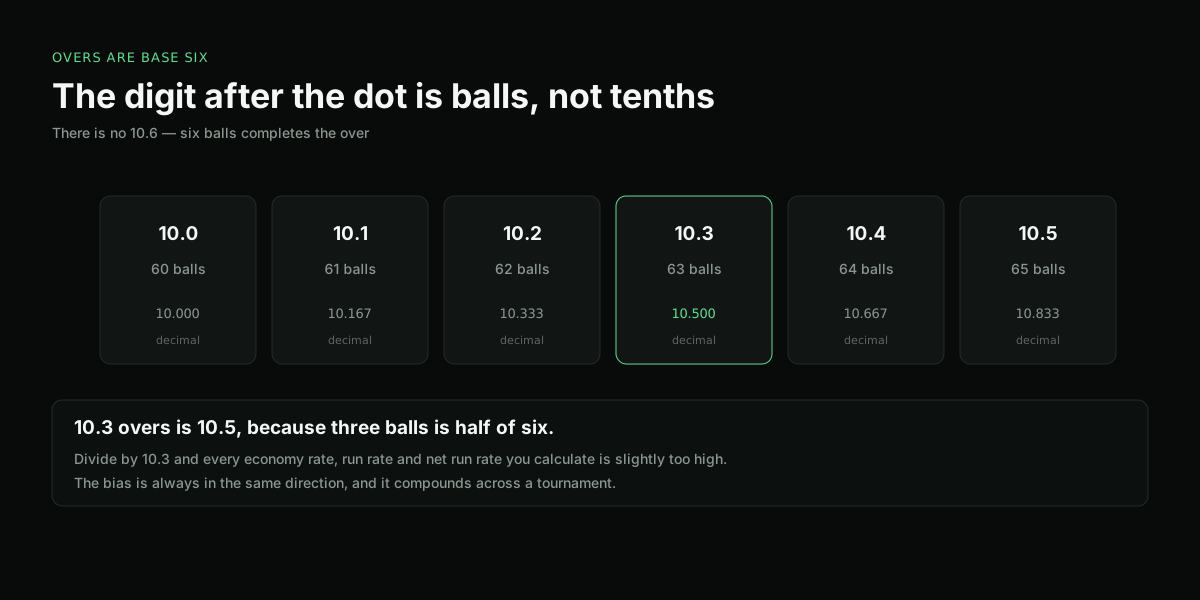
- The digit after the dot is balls out of six, not tenths
- 34.3 overs is 34.5 in decimal, because three balls is half an over
- Every run rate, economy rate and net run rate divides by the decimal, not the notation
- The digit after the dot can never be higher than 5
The conversion
decimal overs = whole overs + (balls ÷ 6)
| Written | Balls | Decimal |
|---|---|---|
| 10.0 | 60 | 10.000 |
| 10.1 | 61 | 10.167 |
| 10.2 | 62 | 10.333 |
| 10.3 | 63 | 10.500 |
| 10.4 | 64 | 10.667 |
| 10.5 | 65 | 10.833 |
| 11.0 | 66 | 11.000 |
There is no 10.6. Six balls completes the over and it becomes 11.0. If you ever see a figure with a 6, 7, 8 or 9 after the dot, somebody has typed a decimal into a field expecting cricket notation.
A bowler has figures of 9.3 overs. How many balls has he bowled?
Nine complete overs is 54 balls, plus three more, so 57. In decimal that is 9.5 overs, which is what you divide by.
What it breaks
Economy rate. 42 runs from 9.3 overs is 42 ÷ 9.5 = 4.42, not 42 ÷ 9.3 = 4.52. A tenth of a run per over, every time, in the same direction.
Run rate and required run rate. Same error, applied to a team.
Net run rate. Which is a run rate difference across a whole tournament, so the error accumulates twice.
The bias is always the same way: dividing by the written figure understates the denominator, so it overstates the rate. Every hand-calculated economy rate in the world is slightly too high.
The eight-ball over
Australia bowled eight-ball overs in domestic and Test cricket at various points until 1979. New Zealand and England both experimented with them too.
While that was true, 10.6 was a legal figure and 10.3 meant three-eighths of an over rather than half. Any historical figure from those periods needs to know which base it was written in before it can be converted, which is one reason bowling averages across eras are harder to compare than batting ones.
Where it bites hardest
Net run rate, because the error compounds. A tournament figure divides total runs by total overs across an entire group stage, and if every over figure has been entered as a decimal rather than converted, the denominator is understated for every match at once.
Sides have been placed wrongly in published tables over exactly this, usually by newspapers rather than officials, and it is why the qualification arithmetic doing the rounds on the last day of a group stage is so often not the same as the official one.
The mistake in the wild
The base-six trap does not stay theoretical. It appears in three places every season.
Net run rate tables. Divide 287 by 49.3 as a decimal and you get 5.82. Divide it by 49.5, which is what 49 overs and 3 balls actually is, and you get 5.80. Two hundredths does not sound like much until a group stage comes down to a third decimal place, and it has.
Required run rates on a broadcast graphic. The number on screen is computed correctly by the scoring software, but the version people work out in their heads at home is not, and the two disagree by a quarter of a run an over in the middle of a chase.
Bowling economy in a spreadsheet. A bowler who has bowled 7.2 overs for 41 has an economy of 5.59, not 5.62. The error is small on one spell and compounds across a tournament, and it always flatters the bowler in the same direction.
The fix is one line: convert to balls first, do the arithmetic there, and convert back only at the end.
| Notation | Balls | Decimal overs |
|---|---|---|
| 9.1 | 55 | 9.167 |
| 9.2 | 56 | 9.333 |
| 9.3 | 57 | 9.500 |
| 9.4 | 58 | 9.667 |
| 9.5 | 59 | 9.833 |
The formats that changed the denominator
Six has not always been the answer, and in one respect it still is not.
England used four-ball overs until 1889 and five-ball overs until 1900. Australia used eight-ball overs on and off until 1979, and New Zealand and South Africa both tried them. During those periods the notation still counted balls after the dot, so 12.7 was a legal score to see on an Australian scoreboard and would be nonsense on an English one.
That is the real argument for the notation. A decimal figure means nothing without knowing how many balls are in an over; a ball count means exactly what it says regardless. A scoreboard reading 12.7 tells you unambiguously that seven balls have been bowled in the current over, in a competition where that is legal, and no conversion table is required to understand it.
What the ball count is actually for
Once you stop reading it as a number and start reading it as a position, the notation becomes useful rather than annoying.
48.3 in a T20 chase does not exist — the innings is twenty overs — but 18.3 does, and it tells you the bowler is halfway through the penultimate over with the field spread. The number after the dot is how far into the over you are, which is the single most important piece of context in a tight finish: three balls left with nine needed is a different game from five balls left with nine needed, and the total on its own cannot tell you which.
It is also why scoreboards show it at all. Nobody needs 18.5 to be a precise quantity of overs. They need to know that one ball remains before the field changes, the bowler changes, and the batters cross.
Why it survives
Because it is genuinely more useful at the ground. A scorer needs to know how many balls are left in the over, and 9.3 answers that immediately: three bowled, three to go. 9.5 overs does not.
The notation optimises for the person keeping score in real time, and it costs the person doing arithmetic afterwards. Given that scoring happens every ball and the arithmetic happens once, that is the right trade.
- Telling a scorer how many balls remain
- Being written quickly on a card
- Matching how an over is actually bowled
- Every division anyone does by hand
- Looking exactly like a decimal
- Producing a consistent upward bias in rates
The one place it does not apply
Balls faced by a batter are counted as a plain number, not in overs. A batter who faced 57 deliveries faced 57, and their strike rate divides by that with no conversion.
So a scorecard contains two different counting systems side by side: bowlers in base six, batters in base ten. Nobody finds this confusing at the ground and everybody gets it wrong on a spreadsheet.
- The digit after the dot is balls, not tenths, and can never exceed 5
- Convert before dividing, or every rate you calculate is slightly too high
- Australia's eight-ball overs mean historical figures need their base checked
- Batting balls faced use ordinary numbers, on the same card
Our economy rate and net run rate calculators convert automatically. For what those numbers then mean, see economy rate explained.