Bowling economy rate explained, and why part overs mislead
Runs per over sounds like the simplest statistic in cricket. The arithmetic trips people up, and the number means three different things in three formats.
Economy rate is runs conceded divided by overs bowled. It is the first number anyone learns and the one most often calculated wrongly, because cricket writes overs in a notation that looks like decimals and is not.
- Runs conceded divided by overs bowled, not by balls
- 9.3 overs is 9.5 in decimal, not 9.3
- Wides and no-balls add runs but not balls, so they hurt twice
- A good economy rate in a Test is a terrible one in a T20
The arithmetic, and the trap
economy rate = runs conceded ÷ overs bowled
A bowler who concedes 42 from 9.3 overs has not gone at 4.52. Nine point three overs is nine overs and three balls, which is 9.5 overs, so the economy rate is 4.42.
The gap looks trivial on one spell. Across a career it moves the figure by a tenth of a run, which is the difference between a very good ODI bowler and an ordinary one.
| Written | Balls | Decimal |
|---|---|---|
| 9.0 | 54 | 9.000 |
| 9.1 | 55 | 9.167 |
| 9.3 | 57 | 9.500 |
| 9.5 | 59 | 9.833 |
Our economy rate calculator converts before it divides. So does net run rate, which is the same trap at team level.
Why extras hurt twice
A wide or a no-ball adds a run to the numerator and nothing to the denominator, because it does not count as a legal delivery.
So an over containing three wides that otherwise goes for four runs is a seven-run over off six legal balls, and the bowler has bowled nine deliveries to get there. The economy rate records the seven and forgets the effort.
This is why a bowler who is expensive and wayward looks far worse than one who is merely expensive, and why coaches treat wides as a discipline problem rather than a run problem.
A bowler concedes 42 runs from 9.3 overs. What is the economy rate?
9.3 overs is nine overs and three balls, which is 9.5 in decimal. 42 divided by 9.5 is 4.42. Dividing by 9.3 gives 4.52 and is wrong.
What counts as good depends entirely on the format
| Economy rate | Test | ODI | T20 |
|---|---|---|---|
| under 2.5 | outstanding | almost never happens | impossible |
| 3.0 | very good | excellent | impossible |
| 4.5 | expensive | very good | outstanding |
| 6.0 | being hit | par | excellent |
| 8.0 | disaster | expensive | good |
| 10.0+ | disaster | disaster | expensive |
Quoting an economy rate without its format is like quoting a strike rate without one: the number is real and the comparison is meaningless.
What it hides
Economy rate has no idea when the runs went.
Four overs for 24 in the first powerplay, when the field is up and the ball is new, is a good spell. Four overs for 24 at the death, when the field is out and the batter is set, is an outstanding one. The number is identical.
It also cannot see wickets. A bowler who goes for 40 in four overs and takes three is usually more valuable than one who goes for 28 and takes none, because the wickets changed what the other batters could do.
This is why franchise analysts talk about phase economy — powerplay, middle, death — rather than a single career figure. The single figure averages three different jobs into one number and loses all of them.
- Runs conceded
- Legal deliveries bowled
- The total across a spell
- Every over weighted the same
- When they were conceded
- Wickets taken
- Whether the field was up or out
- Whether the batter was set
The identity that links all three
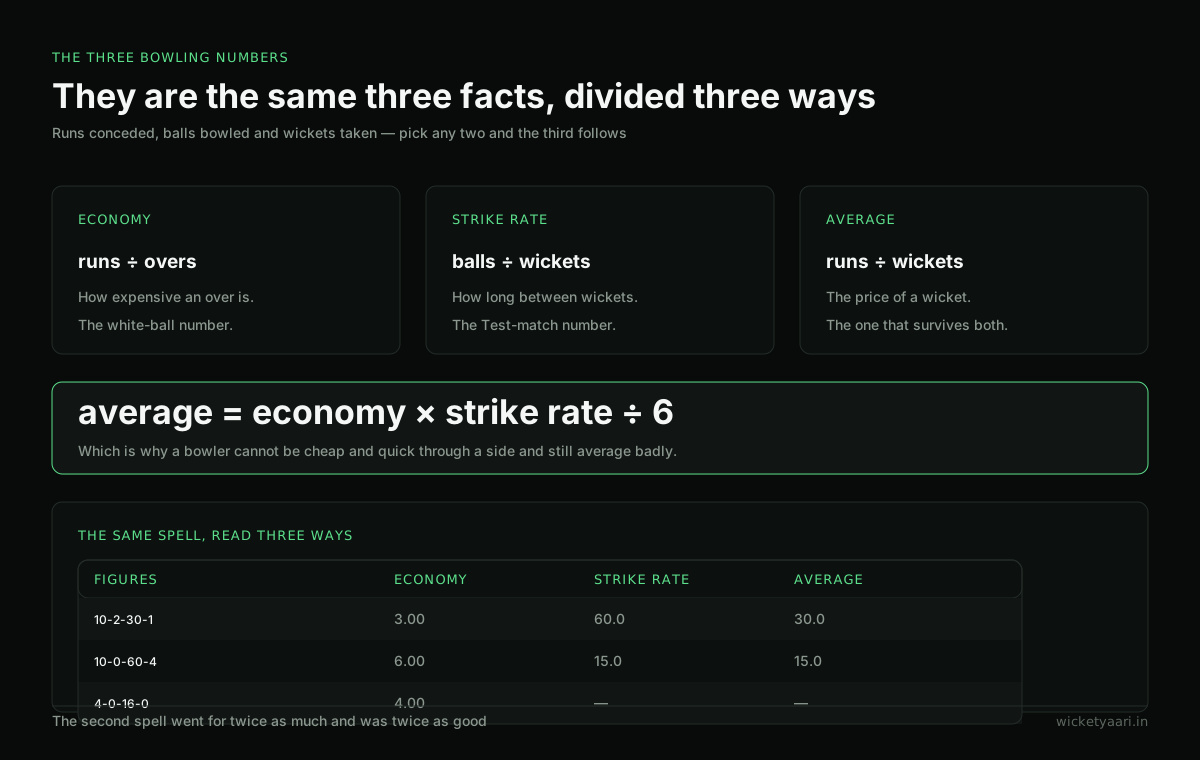
Economy, strike rate and average are not three independent measurements. They are the same three quantities — runs, balls, wickets — divided three ways, and any two of them fix the third.
average = economy x strike rate / 6
Six because a strike rate is counted in balls and an economy in overs. Put a bowler's numbers in and it holds every time, which is a useful check when somebody quotes a set of figures at you that cannot all be true at once.
It also explains a thing that confuses people about T20 bowling. A bowler with an economy of 6.5 and a strike rate of 15 averages 16.25 — excellent. A bowler with an economy of 8.5 and a strike rate of 12 averages 17 — very nearly identical, by a completely different method. The first is drying the game up. The second is buying wickets. The average cannot tell them apart, which is exactly why the format cares about economy and not average.
The overs that are not equal
Economy treats every over as one over, and the game does not.
An over in the T20 powerplay, with two fielders out, is worth roughly a run and a half more than an over in the middle with five out. A death over is worth three or four more. So a bowler with an economy of 8.2 who bowls the nineteenth over every week is outperforming a bowler with an economy of 7.4 who bowls the eighth, and the table will tell you the opposite.
| Phase | Typical economy | What 8.00 means there |
|---|---|---|
| Overs 1-6 | 7.5 to 8.5 | ordinary |
| Overs 7-15 | 7.0 to 7.8 | expensive |
| Overs 16-20 | 9.5 to 11.0 | outstanding |
This is why coaches talk about "economy against expectation" and why the selection arguments that use a raw economy column are usually arguments between people looking at two different jobs.
Extras, and the two ways they are counted
A wide or a no-ball is charged to the bowler and does not count as a delivery, which is a double penalty: the run goes on the card and the over gets longer.
Byes and leg byes are the opposite. They are runs the batting side scores off the bowler's delivery, and they are not charged to the bowler at all. A bowler can concede fourteen off an over in the scorebook and have an economy that says six, because eight of them went through the keeper.
That asymmetry is defensible — a bye is a keeper's error, a wide is the bowler's — but it means a bowler's economy is not the same as the runs their overs cost the fielding side, and in a tight chase it is the second number that decides it.
The Test cricket exception
In Tests, a very low economy rate is sometimes a warning rather than a compliment. A bowler going at 2.1 an over with no wickets has been contained, not containing: the batters have decided he is not a threat and are simply not taking risks against him.
The bowlers who win Tests are usually somewhere around 2.8 to 3.2, because attacking lengths concede more. Shaun Pollock's four hundred Test wickets at under 2.4 is remarkable precisely because it is the combination nobody else managed.
- Convert overs out of cricket notation before dividing, always
- Extras add runs without adding balls, so they punish twice
- The same figure is excellent, average or disastrous depending on format
- In Tests a very low rate with no wickets means contained, not containing
For the team-level version of this number, see net run rate. For what the batter's side of the same trade-off looks like, see strike rate.