Net run rate, and the two rules almost everyone gets wrong
Net run rate decides more qualifications than any other number in cricket, and most explanations of it skip the two rules that actually change the answer.
Every few months a World Cup group or an IPL league table comes down to a number with three decimal places, half the internet works it out on the back of an envelope, and half of those envelopes are wrong. Net run rate is not complicated. It is just that the two rules that matter are the two rules nobody mentions.
The formula, which is the easy part
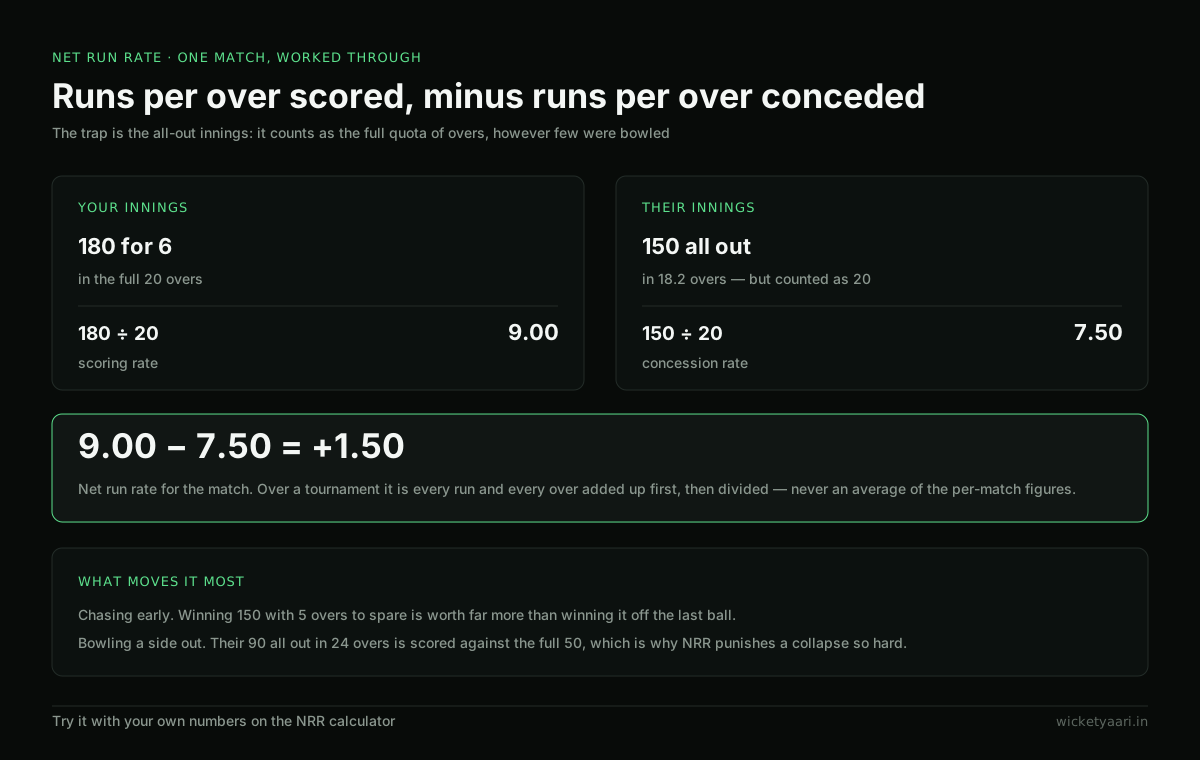
Net run rate is the average runs a team scores per over across a tournament, minus the average it concedes per over.
NRR = (total runs scored / total overs faced)
    - (total runs conceded / total overs bowled)
Note the word total. It is not the average of each match's net run rate. You add up every run scored across the whole group stage, divide by every over faced across the whole group stage, and do the same for the bowling side of it. Averaging per-match figures gives a different and wrong answer, and it is the single most common mistake in a pub argument.
Our net run rate calculator does the arithmetic and shows its working, but the working is not where people go wrong.
A side is bowled out for 180 in 34 overs of a 50-over match. What is its run rate for net run rate purposes?
Being bowled out charges the full quota. 180 divided by 50 is 3.60, not 180 divided by 34. This one rule decides more qualifications than any other.
Rule one: a team bowled out is charged the full quota
This is the one that decides tournaments.
If a side is dismissed for 180 in 34 overs of a 50-over match, its run rate for that innings is not 180 divided by 34. It is 180 divided by 50. The full allocation is charged, because the side used up its entire innings — it simply used it in the form of wickets rather than overs.
The difference is not small. 180 off 34 overs looks like 5.29 an over. Charged at 50, it is 3.60. Across a group stage that gap is the difference between qualifying and going home.
The logic is fair once you see it. Overs and wickets are the two resources a batting side has. Spending all ten wickets early is not thrift, it is a collapse, and net run rate refuses to reward it.
Rule two: a chase that finishes early counts only the overs used
Now the other direction. A side chasing 180 that gets there in 34 overs does get 180 divided by 34. It kept wickets in hand and finished early, so only the overs it actually used are counted.
Put the two rules side by side and the asymmetry looks odd, but it is consistent: the batting side is charged for the resources it consumed. Being bowled out consumes everything. Winning early consumes only what it took.
This is why chasing teams move their net run rate so much faster than defending ones. A side defending a total can only improve its figure by bowling the opposition out cheaply. A side chasing can improve it by finishing eight overs early, which is far easier to arrange.
What a rain-shortened match does to it
Reduced-overs matches are where hand calculations quietly fall apart, because the figures that go into net run rate are not always the figures on the scoreboard.
If the match is shortened before a ball is bowled, nothing unusual happens: both sides get the new quota and the arithmetic is normal. If it is interrupted mid-innings and a revised target is set, the side batting second is measured against the revised target, not the original score, and against the revised number of overs. A side chasing a Duckworth-Lewis target of 212 in 30 overs and getting there in 27 has its run rate computed from 212 and 30, not from the 280 the first innings actually produced.
Abandoned matches with no result contribute nothing at all. Neither side's runs or overs enter the totals, which is why a washout can be worse for a team than a narrow defeat: a defeat at least gives it the chance to lose by a small enough margin to protect the decimal.
A Super Over does not count either. It is a tiebreaker sitting outside the match, and its runs and its single over are invisible to the table.
Moving it on purpose
Captains do arithmetic in the middle, and the arithmetic is simpler than it looks. To lift a net run rate by a given amount, you need either runs or overs, and overs are cheaper.
Chasing 180 in a 50-over match, every over you save is worth roughly 0.07 to your tournament figure across a seven-match group. Winning in 40 overs rather than 45 is worth about a third of a run per over on that match alone. That is why you see a side four wickets down and 20 runs from a win still swinging: the result is already safe and the only thing left to play for is the decimal.
Defending is harder. The only lever is bowling the other side out cheaply, because their all-out innings is recharged at the full quota. A side dismissed for 110 in 28 overs of a 50-over match hands you a concession rate of 2.20 rather than 3.93, and one of those innings can carry a group stage.
| Situation | The lever | Roughly worth |
|---|---|---|
| Chasing, result already safe | Finish earlier | 0.05 to 0.10 per over saved |
| Batting first | Score more, but the denominator is fixed | small, and slow |
| Bowling, side collapsing | Take the last wicket rather than contain | large, immediately |
| Bowling, side batting out the overs | Almost nothing | negligible |
What the number cannot tell you
Net run rate has no memory of context. A ninety-run win against the bottom side moves it exactly as much as a ninety-run win in a knockout. It does not know about pitches, rain, or which of your bowlers was injured.
It also punishes narrow wins. Beating a good team by two runs is worth almost nothing to your net run rate, and losing to them by two runs costs almost nothing either. Teams have very occasionally been accused of playing for the decimal rather than the result, and the accusation is arithmetically plausible.
That is the trade-off the format accepts. It wanted a tiebreaker that could not be argued with, and it got one that cannot be argued with and also cannot be reasoned with.
Reading overs correctly
One small thing that quietly ruins hand calculations: cricket writes overs in a base-six notation that looks like decimals but is not.
34.3 overs is 34 overs and 3 balls, which is 34.5 in decimal, because three balls is half of six. Divide by 34.3 and every figure you produce is slightly wrong. Our calculator converts automatically; if you are doing it by hand, convert first.
| Written | Balls | Decimal |
|---|---|---|
| 34.0 | 204 | 34.000 |
| 34.1 | 205 | 34.167 |
| 34.3 | 207 | 34.500 |
| 34.5 | 209 | 34.833 |
A worked example
Two teams, same points, one qualification spot.
Team A scored 1,428 runs from 149.4 overs, and conceded 1,301 from 150.0.
- Scoring: 1,428 ÷ 149.667 = 9.541 per over
- Conceding: 1,301 ÷ 150 = 8.673 per over
- Net run rate: +0.868
Team B scored the same 1,428, but was bowled out twice — once for 210 in 41 overs and once for 165 in 38, in a 50-over tournament. Those two innings are recharged at 50 overs each, adding 21 overs to the denominator that Team B never actually faced.
- Scoring: 1,428 ÷ 170.667 = 8.367 per over
- Same bowling figure: 8.673
- Net run rate: −0.306
Same runs, same wickets taken, same points. Different tournament.
Why nobody has replaced it
Every few years a tournament proposes something better, and the proposals keep losing to the same objection.
Head-to-head is the most popular alternative and fails in three-way ties, which are exactly the situation you need a tiebreaker for. Points for margin of victory rewards flat-pitch thrashings and punishes teams that play on turning tracks where 140 is a good score. Most wins against the top half requires you to define the top half, which is what you were trying to work out.
Net run rate survives because it is arithmetic. Nobody can accuse a committee of applying it unfairly. It is the least interesting property a rule can have and in a knockout qualification it is the only property that matters.
The 2019 World Cup semi-final race turned on it, the 2024 T20 World Cup group stage turned on it, and every IPL season since the first has had at least one side eliminated by a decimal. It will not be replaced.
- Add all the runs and all the overs. Never average the per-match averages
- Bowled out means the full quota is charged, not the overs faced
- A chase that finishes early counts only the overs used
- 34.3 overs is 34.5 in decimal, not 34.3
The short version
Add all the runs, add all the overs, and do not average the averages. Charge the full quota when a side is bowled out. Count only the overs used when a chase finishes early. Convert the overs out of cricket notation before you divide.
Get those four right and you will be the only person in the group chat with the correct number.
If the match you are arguing about was rain-affected, net run rate is not the tool you want — see the Duckworth-Lewis method, which changes the target itself before net run rate ever gets involved.