How the ICC rankings actually work, and what they measure
Ratings out of 1,000 rather than points for wins, weighted by who you beat and how recently, which is why a side can win a series and lose ground.
The ICC rankings are quoted constantly and understood rarely. They are not a league table, they do not count wins, and a side that wins a series can drop points doing it. All three of those follow from the same design decision.
- Ratings run from 0 to 1,000 and express strength, not accumulated wins
- Every result is scored against what was expected, given the two ratings
- Recent results count for more, and old ones drop out entirely
- Beating a strong side away is worth many times beating a weak side at home
What a rating is
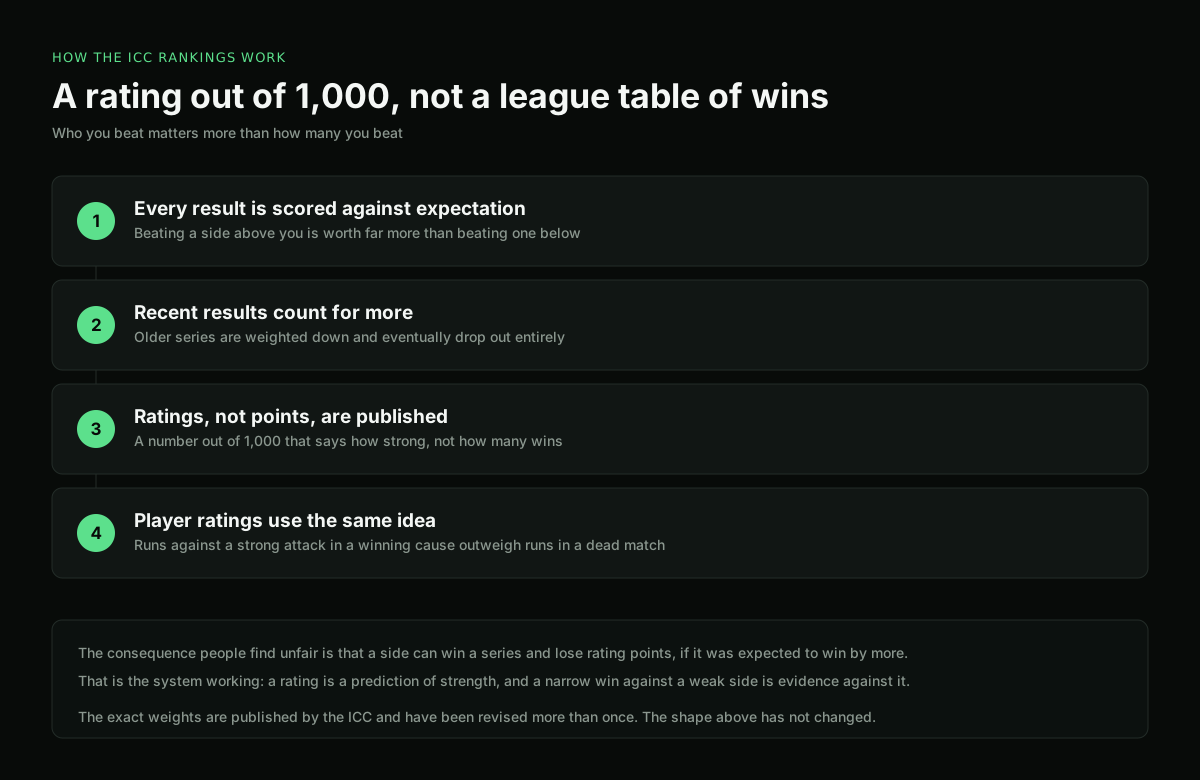
A rating is a single number, conventionally out of 1,000, that represents how strong the system currently believes a side to be. It is not a count of anything. It is closer to a chess rating than to a points table, and it works on the same principle.
Two sides play. The system already has an expectation about the result, derived from the gap between their ratings. If the result matches the expectation, very little changes. If it does not, the ratings move — and they move further the more surprising the result was.
That is the whole mechanism. Everything else is weighting.
Why a win can cost you points
This is the property people find outrageous and it is the system working exactly as designed.
Suppose the top-ranked side plays the ninth-ranked side at home. The expectation is a comfortable series win — say 3-0 or 3-1. If the result is 2-1, the top side has won and has also performed below what its rating predicted. Its rating falls slightly, and the weaker side's rises.
Nothing unfair has happened. The rating is a prediction of strength, and a narrow win over a much weaker side is genuine evidence that the prediction was too high. A table that awarded points for the win would tell you who had won recently. A rating tells you who is likely to win next.
What is weighted, and how
Three weightings, in order of size.
Opposition strength. The dominant factor. Beating the side ranked first is worth several times beating the side ranked ninth, and losing to the ninth costs far more than losing to the first.
Recency. Results from the current period count at full weight; older results are discounted and eventually leave the calculation altogether. The window is a few years, which is why a side that was excellent five years ago carries none of it.
Series and match structure. Test ratings are computed from series results rather than individual matches, which is why a drawn series against a stronger side can move a rating more than two wins against a weaker one.
| Factor | Effect on the rating |
|---|---|
| Beating a much stronger side | large gain |
| Beating a much weaker side | small gain, or a loss if narrow |
| Losing to a much stronger side | small loss |
| Losing to a much weaker side | large loss |
| A result from four years ago | little or nothing |
The player rankings work the same way
Player ratings use the same idea applied to individual performances, and the weightings are where the disagreements start.
A batter's rating rewards runs, and rewards them more when they came against a higher-rated bowling attack, in a match the side won, in conditions where runs were hard to come by. A hundred against the top-ranked attack on a seaming pitch in a winning cause is worth a great deal more than a hundred in a dead rubber on a flat one.
A bowler's rating works identically in reverse: wickets, weighted by whose, at what cost, in what match situation.
The consequence is that player rankings do not match the averages table, and are not supposed to. A player can lead the rankings while sitting third on the averages, because the rankings are asking a different question — how well are you playing now, against the standard of opposition you are facing.
What the rankings are bad at
Three honest limitations, and all three come up every year.
Small samples. A side that plays four Tests in a cycle has a rating built from four results. It is more volatile and less meaningful than one built from twenty, and nothing in the system flags the difference.
Uneven schedules. Boards choose their own fixtures. A side that plays mostly at home, mostly against weaker opposition, has a rating computed from a different diet than one touring constantly, and the system corrects for opposition strength but not for how many home Tests somebody arranged.
Format separation. The three formats have separate rankings, which is correct, and it means a "number one side" is only ever number one at one thing. Headlines routinely drop the qualifier.
The top-ranked Test side beats the ninth-ranked side 2-1 at home. What is the most likely effect on its rating?
A rating is a prediction of strength. The expectation for that fixture was a comfortable win, and a 2-1 result is evidence that the rating overstates the side. Winning and losing rating points at the same time is the system behaving correctly.
Why a new side starts where it does
A team entering the rankings has no results, and a system built on expectation needs a starting number.
New entrants are given a provisional rating and a qualifying period — a minimum number of matches before the rating is published at all. The provisional figure is deliberately low, on the reasonable assumption that a side new to the format is not yet strong, and it rises quickly if the results say otherwise.
That produces one recurring complaint. An Associate side that beats a Full Member gains a great deal of rating for it and is still ranked well below sides it has beaten, because a single result cannot outweigh a sparse record. The system is being cautious rather than dismissive, and the caution reads as the second thing.
Why they exist at all
The rankings do real work beyond providing an argument.
They seed tournaments and determine qualification for some of them, which means a rating can decide whether a side plays in a global event. They determine the composition of some fixture cycles. And in the Test championship era they sit alongside a points system that answers a different question — who has done best over this cycle, rather than who is strongest now.
Those two answers diverge often, which confuses people. A side can top the championship table and sit second in the rankings without any contradiction: one is a record of a period, the other is an estimate of current strength.
- Counts wins and losses
- Every win is worth the same
- Resets each season
- Says who has done best
- Scores results against expectation
- A win is worth what beating that side is worth
- Carries forward and decays
- Says who is likely to win next
- A rating estimates strength; a table records results
- Opposition quality is the dominant weighting, then recency
- Winning narrowly against a weak side can cost rating points, correctly
- Player ratings weight runs and wickets by context, so they do not match averages
The short version
The ICC rankings answer "who is strongest right now", not "who has won most recently". Every counter-intuitive thing about them — the win that costs points, the draw that gains them, the player ranked above somebody with a better average — comes from that single choice.
For the tiebreaker that decides tournaments when ratings are not involved, see net run rate explained, and for what a batting average measures on its own, batting average is not runs per innings.