Strike rate means nothing without the format beside it
A strike rate of 75 is exceptional in one format and unplayable in another. What the number measures, what it ignores, and the only way to read it.
Strike rate is the simplest number in cricket and the most frequently quoted out of context. It is runs per hundred balls faced. That is all it is, and the whole difficulty is that the same figure means opposite things depending on which format produced it.
strike rate = (runs ÷ balls faced) × 100
A strike rate of 100 means a run a ball. Our strike rate calculator will do it for you, though this is one you can do in your head.
The same number, three verdicts
| Strike rate | In a Test | In an ODI | In a T20 |
|---|---|---|---|
| 45 | normal | very slow | unusable |
| 60 | brisk | slow | unusable |
| 75 | rapid | below par | slow |
| 90 | extraordinary | around par | below par |
| 140 | never happens | extraordinary | good |
| 180 | never happens | never happens | outstanding |
Read across any row and you can see the problem. A career strike rate quoted without its format is not a statistic, it is a decoration.
What it ignores
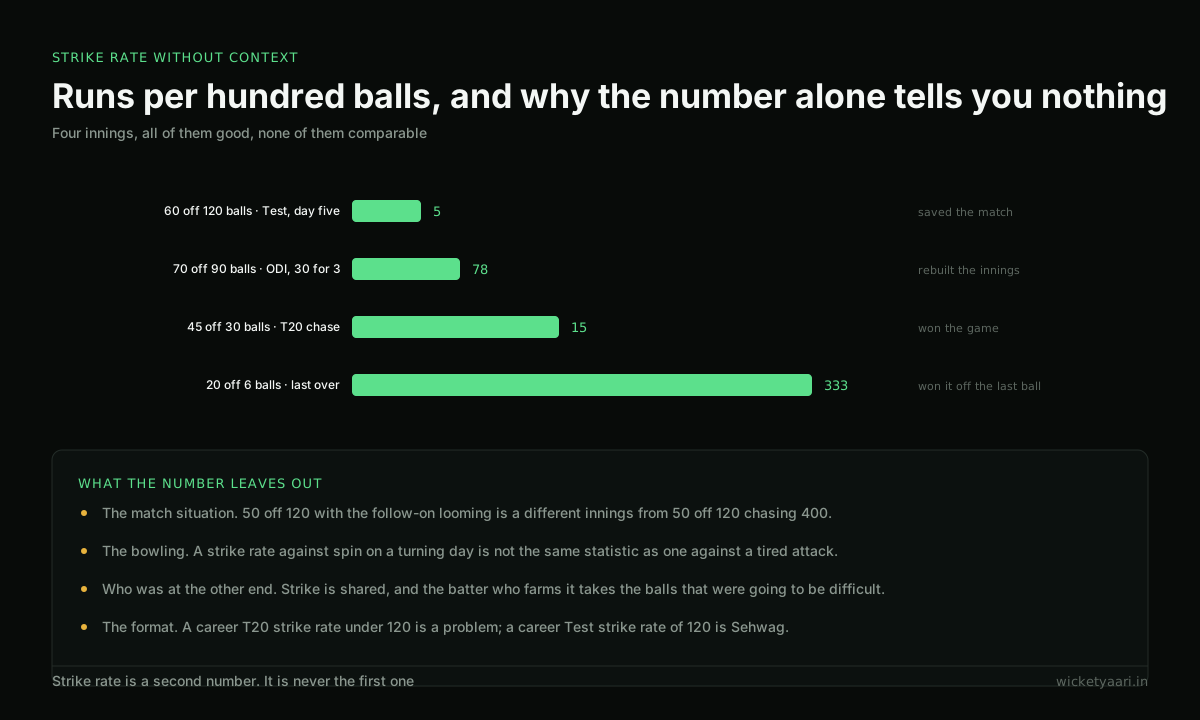
Strike rate says nothing about getting out. A batter who scores 20 off 10 balls and then holes out has a strike rate of 200 and has probably cost their side the game. A batter who scores 20 off 40 and stays in through a collapse has a strike rate of 50 and may have saved it.
That is why strike rate is read next to batting average, never instead of it. Average measures how long you last. Strike rate measures how fast you go while you last. Neither is a player.
It also ignores match situation entirely. Twenty off forty balls at 40 for 4 is a different innings from twenty off forty balls chasing eight an over, and the number is identical.
Why Test strike rates crept up
Test strike rates have been rising for thirty years, and the reason is not that batters got braver. Two things changed underneath them.
The first is that one-day and then Twenty20 cricket taught a generation of players shots that used to be considered reckless, and taught them well enough that the risk came down. A ramp is only a gamble if you have not practised it ten thousand times.
The second is that captains started declaring earlier and chasing results on flat pitches, which changed what a Test innings is for. Scoring at three an over used to be the point. Now it is often the obstacle.
A career strike rate of 75 is quoted with no format attached. In which format would that be exceptional?
75 in a Test is rapid, in an ODI it is below par, and in a T20 it is unusable. A strike rate without its format is a decoration, not a statistic.
Bowling has the mirror image
Bowlers get a strike rate too, and it measures something else entirely: balls per wicket. A bowling strike rate of 50 means a wicket every fifty deliveries.
Lower is better, which is the reverse of batting, and the two numbers share a name for no good reason other than history. If someone quotes a strike rate of 45 and you are not sure which one they mean, the direction of the compliment will tell you.
For runs conceded per over, the number you want is economy rate, which is the bowling equivalent of a batting strike rate rather than of a bowling one.
Balls faced is the hidden variable
The number that quietly decides whether a strike rate is information or noise is the one nobody quotes: how many balls it was measured over.
| Runs | Balls | Strike rate | Worth quoting? |
|---|---|---|---|
| 12 | 6 | 200.00 | no |
| 45 | 30 | 150.00 | for that innings |
| 900 | 700 | 128.57 | for a season |
| 9,000 | 7,000 | 128.57 | for a career |
The bottom two rows carry the same figure and completely different weight. A strike rate over six balls is a coin landing heads once; a strike rate over seven thousand is a description of a player.
Whenever a strike rate is quoted at you without the volume behind it, the omission is usually doing work.
Strike rate against the phase, which is the number nobody publishes
The figure that would actually settle arguments is a batter's strike rate broken down by phase, and it is almost never quoted.
A T20 opener striking at 140 has faced most of their balls with two fielders out. A finisher striking at 140 has faced most of theirs with five out, against yorkers, in the last four overs. These are not the same skill and the two numbers are not comparable, but they sit in the same column of every scorecard and every tournament summary.
The same is true across a Test innings. Scoring at 45 per hundred balls on the first morning against a moving new ball is a different act from scoring at 45 on the fourth afternoon against a spinner and a defensive field. One is survival, the other is a failure to accelerate, and the career figure averages them into a number that describes neither.
| Phase | What a good T20 strike rate looks like | What is actually being tested |
|---|---|---|
| Overs 1-6 | 130 to 145 | intent against the new ball, with the field up |
| Overs 7-15 | 115 to 130 | working gaps against spin, without losing wickets |
| Overs 16-20 | 170 and above | hitting to a set field, under a clock |
The dot ball, which is the honest version
If you want one number that tells you more than strike rate, it is dot-ball percentage: the share of deliveries a batter faces without scoring.
It is more useful because it is harder to hide behind. A batter can reach a strike rate of 130 with four sixes and sixteen dots, or with twenty singles and five twos. The first has taken enormous risk and left their partner facing the difficult bowler; the second has controlled the innings. Strike rate cannot tell them apart. Dot percentage can, immediately.
It is also what bowlers are actually trying to produce. A death bowler's plan is not to avoid boundaries — that is not available against a good batter — it is to convert four of six balls into nothing and accept the damage on the other two.
Where the number genuinely does work alone
Two cases, and only two.
Across a whole career, in one format, over hundreds of innings. At that sample size the situations average out, and a career T20 strike rate of 150 against one of 120 is a real difference in how the two players bat.
Within the same innings, comparing two batters at the same time. Two players at the crease together, facing the same attack in the same conditions, have their strike rates measured against an identical situation. That comparison is fair, and it is the one broadcasters should show more often than they do.
Everywhere else, the number needs the other three: how many balls, against whom, in what situation.
The only way to read it
Three things, always together:
- The format, because the scale changes completely.
- The balls faced, because a strike rate of 200 off 6 balls is noise.
- The average, because scoring fast while getting out constantly is not a
contribution.
Where it turns up here
Strike rate is one of the statistics the Higher or Lower puzzle rotates through. On the days it comes up, the pairs are drawn from the same broad era on purpose, because asking whether a 1970s Test opener struck faster than a modern T20 specialist is not a question, it is a formality.
- Runs per hundred balls, and the scale changes completely by format
- Balls faced decides whether the number is information or noise
- It says nothing about getting out, so it is read next to the average
- Bowling strike rate is balls per wicket, and lower is better
The short version
Runs per hundred balls. Useless without the format. Useless without the balls faced. Useless without the average beside it. Useful, with all three.