The first Cricket World Cup, 1975, and the format it proved
Sixty overs a side, in whites, with a red ball, and a final that finished after nine at night. It turned one-day cricket from a county gimmick into the sport's biggest event.
The first Cricket World Cup was played in England in June 1975. Eight teams, sixty overs a side, played in white clothing with a red ball, in daylight. West Indies won.
It is the moment one-day cricket stopped being a county experiment and became the format that would pay for the sport for the next thirty years.
- Eight teams, sixty overs a side, played entirely in daylight in whites
- West Indies beat Australia in a final that finished at 8.43pm
- It proved a global one-day tournament was commercially viable
- Everything about how it looked has since changed; the idea has not
What it looked like
| 1975 | A modern World Cup | |
|---|---|---|
| Overs per side | 60 | 50 |
| Clothing | whites | coloured |
| Ball | red | white |
| Time of day | daylight only | day-night |
| Teams | 8 | 10 to 14 |
| Fielding restrictions | none | three powerplay phases |
No fielding restrictions at all is the one that surprises people. Captains could put everybody on the boundary from ball one, and some did. The powerplay was invented later precisely because that made for poor cricket.
The final
West Indies made 291 for 8. Clive Lloyd scored 102 from 85 balls, which in 1975 was an extraordinary rate for a fifty or sixty over game.
Australia were bowled out for 274, with five run outs — a record for a World Cup final that says more about the pressure than about the fielding. The match finished at 8.43 in the evening, in the last of the English June light, having started at eleven in the morning.
What was the over limit in the first World Cup?
Sixty overs a side, reduced to fifty in 1987 when the tournament moved to the subcontinent, where shorter daylight hours made sixty overs impractical.
Why sixty became fifty
The 1987 World Cup was the first held outside England, in India and Pakistan. Daylight there is shorter and less reliable than an English June, and sixty overs a side could not be completed in a day.
Fifty overs was adopted as a practical accommodation and never went back. A scheduling constraint in 1987 fixed the length of the format permanently.
What it proved
Three things, in order of how much they mattered.
That a global tournament worked. Cricket had no world championship of any kind before this. Test series were bilateral and there was no way for a side to be world champion at anything.
That one-day cricket could carry an occasion. Sixty overs invented in 1963 to fill county grounds was suddenly the vehicle for a final at Lord's in front of a full house.
That the money was there. Which is precisely the observation Kerry Packer made two years later, with consequences the establishment did not enjoy.
- 1963Limited overs inventedEnglish counties, trying to sell tickets
- 1975The first World CupEight teams, sixty overs, West Indies win
- 1979The secondWest Indies win again, with Viv Richards making 138
- 1983IndiaThe result that made cricket a mass television sport in India
- 1987Fifty oversThe tournament moves to the subcontinent and shortens permanently
The match everybody actually remembers
Not the final. In the group stage, India batted their full sixty overs against England and finished on 132 for 3. Sunil Gavaskar opened and scored 36 not out from 174 balls.
The reasons have been argued about ever since — that India had no realistic chance of chasing 335, that Gavaskar was making a point, that he simply could not get the ball away. What is not in doubt is that it demonstrated the format had a problem the Laws did not yet solve: with no fielding restrictions and no requirement to attack, a side could decline to play the game.
Eight years later India won the whole thing, which is a more useful lesson about how fast a cricketing culture can move than any tactical one.
What the tournament nearly did not have
The 1975 competition happened because the International Cricket Conference could not agree on anything else, and because Prudential Assurance paid for it.
Eight teams took part: the six Test nations of the day, plus Sri Lanka and East Africa, who were not Test nations. South Africa were absent, having been excluded from international cricket in 1970. The whole thing ran for a fortnight in June, in England, because England was the only country whose season could absorb it and whose grounds could host it.
Everything about the presentation was Test cricket with a shorter clock. Sixty overs a side, white clothing, a red ball, no fielding restrictions of any kind, and a start time that assumed the match would finish in daylight. Bowlers had a twelve-over limit. Nobody wore a helmet.
| 1975 | The modern tournament |
|---|---|
| 60 overs | 50 overs |
| Red ball, white clothing | White ball, coloured clothing |
| No fielding circle | Three powerplay phases |
| 8 teams, 15 matches | 10 teams, 48 matches |
| Two weeks | Six weeks |
The final, which ran until nightfall
West Indies made 291 for 8, built on 102 from Clive Lloyd off 85 balls, which in 1975 was an astonishing rate of scoring for a batter who was not slogging.
Australia were bowled out for 274 in the 59th over. Five of their batters were run out, three of them by Viv Richards fielding at square leg, which remains the single most remembered piece of fielding in the tournament's history. The match finished at 8.43 in the evening, in near darkness, in front of a full house at Lord's.
The ground had been full since the morning and thousands were locked out. That detail is what convinced the administrators, more than the cricket did: a one-day tournament could fill Lord's for a fortnight and sell out a final, and the Test season had not managed that in years.
One more thing the tournament established without meaning to: the idea that a one-day international could be a bad match and still be a good product. The group stage produced some dire cricket, including an innings where an opener batted through all sixty overs for 36 not out, and the tournament sold out anyway. That lesson — that the event carries the format, not the other way round — is the one administrators have been acting on ever since.
What it started
The two-week experiment produced consequences that took decades to arrive.
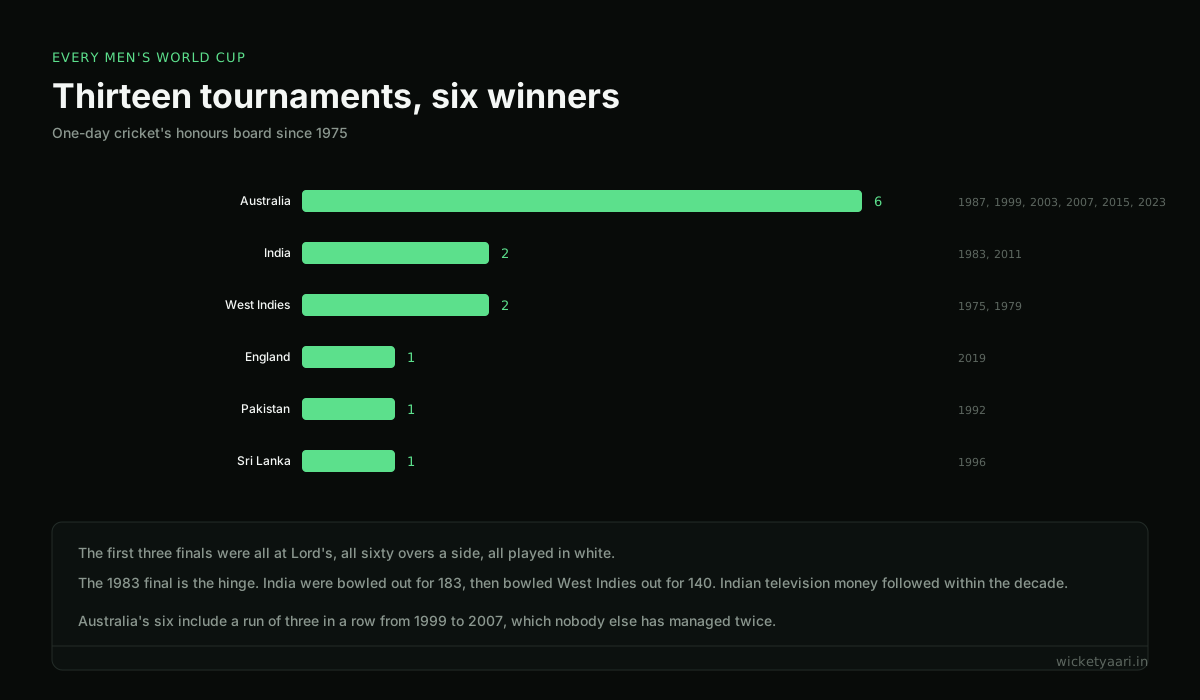
The 1979 tournament was almost identical. The 1983 tournament, won by India against every expectation, is the one that moved the sport's centre of gravity to the subcontinent — Indian television audiences, Indian sponsorship, and eventually Indian control of the game's finances all trace to that afternoon at Lord's.
The 1987 tournament left England for the first time, went to India and Pakistan, and reduced the format to fifty overs a side because the shorter daylight in the subcontinent could not accommodate sixty. That change was logistical, not tactical, and it is the length the format has kept ever since.
What has not changed
The structure. A group stage followed by knockouts, a final at a major ground, and a trophy that means something no bilateral series can.
Every argument about how many teams should be included, how long the tournament should be, and whether Associates deserve a place, has been running since 1975 and has never been settled.
- Eight teams, sixty overs, whites and a red ball, entirely in daylight
- West Indies beat Australia; five Australians were run out in the final
- Sixty became fifty in 1987 for daylight reasons and never went back
- It proved a global tournament worked, which is why everything followed
For the format it created, see one-day international cricket explained.