World Series Cricket, and the two years that built modern cricket
Refused broadcast rights, a television executive signed fifty of the world's best players instead. Most of what looks normal about televised cricket came out of it.
In 1977 an Australian television executive who could not buy cricket broadcasting rights bought the players instead. World Series Cricket lasted two seasons, was called a circus, and invented most of what cricket now takes for granted.
- Kerry Packer signed around fifty leading players after being refused rights
- Coloured clothing, white balls, floodlights and helmets all date from it
- It ended in 1979 when the establishment granted him the rights
- Players went from poorly paid amateurs-in-practice to professionals
Why it happened
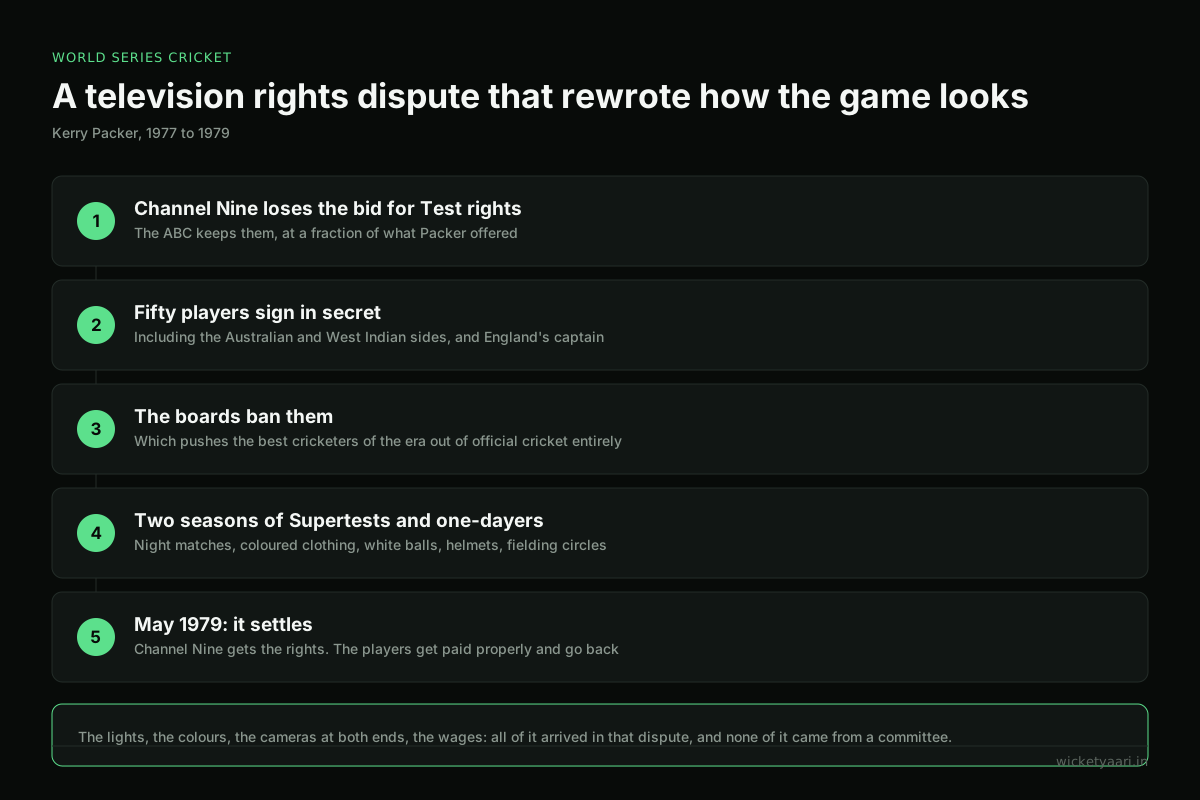
Packer's Channel Nine bid for exclusive Australian television rights and was turned down by the Australian Cricket Board, which renewed with the public broadcaster for less money.
Rather than bid again, Packer signed the players. Within months he had most of the Australian side, most of the West Indies side, and leading players from England, Pakistan and South Africa on private contracts.
The establishment banned them from official cricket. That ban was challenged in the English High Court, which found it an unreasonable restraint of trade — a judgment with consequences well beyond cricket.
What it invented
- 1977Coloured clothingSo players could be told apart under lights on television
- 1977White ballsBecause a red ball is invisible on a night broadcast
- 1977Floodlit cricketMatches timed for a television audience rather than a working day
- 1977Drop-in pitchesBecause the grounds Packer could hire were football stadiums
- 1977Helmets as standardBouncers from the fastest attacks ever assembled, on unfamiliar surfaces
- 1978Multiple camera anglesCameras at both ends, which nobody had bothered with before
- 1978Stump microphonesThe sound of the game, which had never been broadcast
Almost every item on that list was ridiculed at the time as gimmickry. Every one is now unremarkable.
Why was coloured clothing introduced for World Series Cricket?
Two sides in whites are hard to tell apart on a night broadcast. The commercial merchandise came much later; the original reason was purely televisual.
The cricket itself
It was, by most accounts, brutally hard. The West Indian pace attack of the period bowled at the world's best batters on drop-in pitches of uncertain quality, with no restrictions on short-pitched bowling worth the name.
Several players have said the standard was higher than the Test cricket happening alongside it, for the simple reason that most of the best players were in one competition and not the other.
The helmet became standard equipment during those two seasons, and it is not a coincidence.
What it cost the players
The signed players were banned from Test and first-class cricket for the duration. Several never played for their country again, and a few were effectively finished at international level by the time it was resolved.
For West Indian players in particular the calculation was straightforward: their board could not match what Packer offered, and several of them had families to support on wages that would not have covered a mortgage in England. The moral argument about loyalty was being made largely by people who were not being asked to choose.
How it ended
In 1979 the Australian Cricket Board granted Channel Nine the rights. World Series Cricket folded, the players returned, and the innovations came with them.
The board got its players back. Packer got what he had wanted in the first place. And cricket got a broadcast format, a night-time audience and a professional player market it had not asked for.
- Players paid modestly, most with second jobs
- Daylight, whites, red ball
- One camera end, no stump sound
- Boards set the terms unilaterally
- A professional market with negotiated contracts
- Floodlights, colours, white ball for limited overs
- Both ends, stump microphones, replays
- Boards negotiate, and have done since
What players were actually paid before
The numbers are the argument, and they are worth stating plainly.
An Australian Test cricketer in the mid-1970s received a match fee in the region of two hundred Australian dollars. A full home summer might produce a few thousand. Almost every player had a job outside cricket, and the ones who did not were usually being quietly supported by a sponsor or an employer who gave them time off.
Meanwhile the Australian Cricket Board sold the broadcast rights, filled the grounds, and ran a profitable sport. The players were not being cheated by anybody's contract — they were being paid what the game had always paid, which was an amateur wage for what had long since become a professional job.
Packer's offer was several times a player's annual income for a season's work. That is why fifty of them signed, in secret, including the captains of Australia and England. It was not disloyalty. It was arithmetic.
The bans, and the court case
The response from the boards was to ban every player who had signed, from Test cricket and from county cricket, which would have ended most of their careers.
Three players took the Test and County Cricket Board to the High Court in London. In Greig v Insole, the court found the bans were an unreasonable restraint of trade and void. The boards lost, and were left with a large costs bill and no way to stop the competition.
That judgment is the legal foundation of the modern player market. Every franchise contract, every player choosing a T20 league over a national commitment, and every argument about central contracts sits downstream of a finding that a governing body cannot ban somebody for taking a better offer.
The West Indian and Australian players who signed did so knowing they might never play a Test again. Several of them were at the peak of careers that would have finished with a hundred caps, and the ban was not a bluff — it was enforced for two full seasons and cost real players real records that are simply missing from the books.
What it looked like at first
The opening matches were played at showgrounds and football stadiums, because the state associations controlled the cricket grounds and would not rent them out. Crowds were poor in the first season. The press called it a circus. The Australian Cricket Board ran a parallel Test series against India with a side picked from whoever was left, and it sold reasonably well.
The second season changed it. Night matches at the Sydney Cricket Ground drew crowds that the official cricket was not getting, the West Indian side was the best in the world and was playing in it, and the television coverage was demonstrably better than anything the ABC had produced. Cameras at both ends, stump microphones, replays, on-screen graphics: all of it was invented here because Packer needed the product to be watchable.
The uncomfortable part
Packer's motive was commercial throughout. He was not reforming cricket; he was acquiring an asset, and the players signed for money rather than principle.
That the result was better cricket, better paid players and a better broadcast is a fact and not a justification anybody involved offered at the time. It is worth remembering when the next dispute arrives dressed as vandalism, which is roughly how franchise leagues were described in 2008.
- A rights dispute, not a reform movement, and it worked anyway
- Coloured kit, white balls, floodlights, helmets and stump mics all came from it
- The court found the retaliatory ban an unreasonable restraint of trade
- Two years of chaos permanently professionalised the sport
For where this sits in the wider arc, see the history of cricket in ten moments.