Powerplays explained, format by format and phase by phase
The fielding restrictions that shape every white-ball innings, why they exist, and what each phase is actually asking a captain to decide.
A powerplay is a period when fewer fielders are allowed outside the thirty-yard circle. That single restriction is what makes limited-overs cricket look different from Test cricket, and every tactical convention in white-ball cricket descends from it.
- Fewer fielders outside the circle means gaps, which means the batting side attacks
- ODIs have three phases; T20 has one at the start
- The restriction is a floor on run rate, not a licence to slog
- Every phase is a trade between risk now and wickets later
What the circle is
A thirty-yard semicircle at each end, joined by lines parallel to the pitch, forms an oval on the field. Fielders are counted as inside or outside it, and the powerplay rules cap how many may be outside.
There is also a permanent rule that at least four fielders, plus the bowler and keeper, must be inside during non-powerplay overs in an ODI, which is why a completely defensive field is not available even at the death.
One-day internationals: three phases
| Overs | Fielders allowed outside the circle |
|---|---|
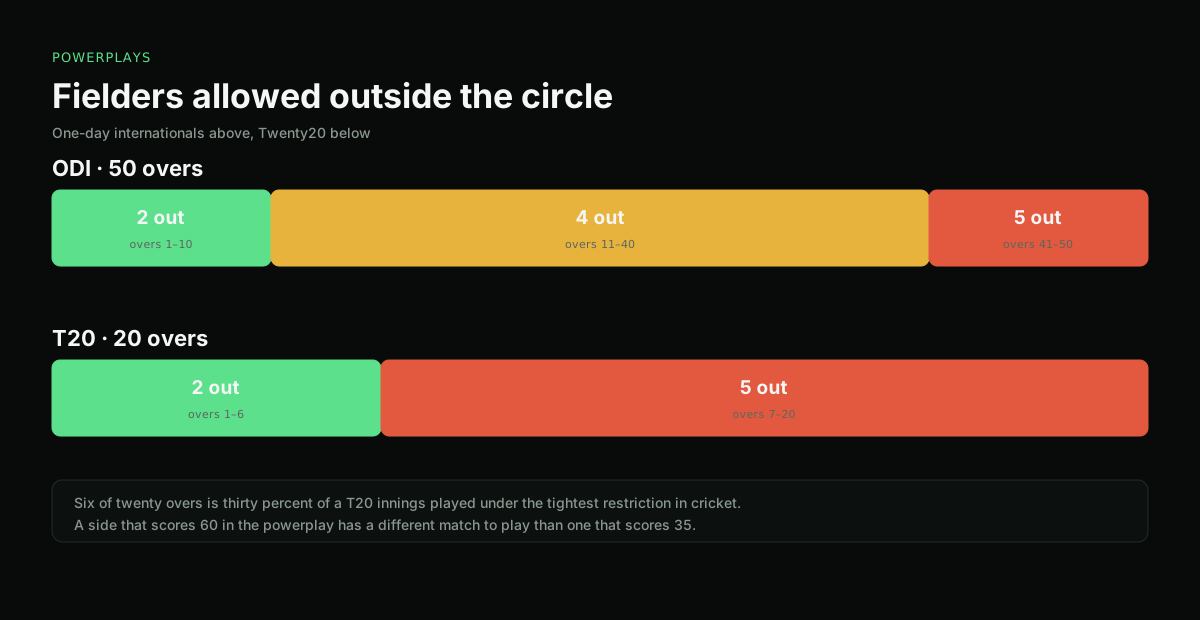
| 1–10 | 2 |
| 11–40 | 4 |
| 41–50 | 5 |
The shape that produces is familiar to anyone who watches ODIs: an aggressive opening ten, a consolidation phase through the middle where singles are the currency, and an acceleration at the death when the field spreads but the batting side has wickets to spend.
The middle phase is where most ODIs are actually decided, and it is the least watched.
In an ODI, how many fielders may be outside the circle during the final ten overs?
Five in overs 41 to 50. It is the loosest restriction in the innings and still tighter than a Test field, which is why death bowling is so difficult.
Twenty20: one phase, and it decides the innings
The T20 powerplay is the first six overs, with two fielders allowed outside the circle. After that, five.
Six overs out of twenty is thirty percent of the innings played under the tightest restriction in cricket. A side that scores 60 in the powerplay has a different game to play than one that scores 35, and the gap is very hard to recover because the field never comes back in.
What the restriction is actually asking
Not "hit out". The powerplay creates gaps, and gaps reward placement more than power. The best powerplay batters are not always the biggest hitters; they are the ones who find the two undefended regions consistently.
The corresponding bowling question is whether to attack or contain. With only two fielders out, a bowler cannot protect both boundaries, so most attack — a wicket is the only thing that genuinely slows a powerplay down.
- Gaps in the outfield
- A field that cannot cover both sides
- The best scoring conditions of the innings
- A rate that is hard to make up later
- Catchers in front of the wicket
- No protection if you mistime
- The highest chance of losing a wicket
- An innings that can end in six overs
What happens when rain shortens the innings
Powerplay overs scale with the innings. They are not fixed blocks that survive a reduction — that would hand a side chasing 25 overs the same six-over powerplay proportionally worth twice as much.
The scaling is set out in the playing conditions as a table rather than a formula, and it rounds in the batting side's favour at the margins, but the shape is simple: the shorter the innings, the fewer powerplay overs, roughly in proportion.
| Innings length | Approximate first-phase length |
|---|---|
| 50 overs | 10 |
| 40 overs | 8 |
| 30 overs | 6 |
| 20 overs | 4 |
The consequence catches sides out in rain-affected chases. A revised target arrives, the required rate is calculated, and the powerplay everyone was planning to attack in is now two overs shorter than it was ten minutes ago.
The catching fielders nobody mentions
There is a second restriction inside the first powerplay of a one-day innings, and it is the one that actually shapes the opening overs: a minimum number of fielders must be in catching positions — close enough to take a catch, in front of or behind the wicket, in the circle.
Without it a captain could satisfy the letter of the powerplay by putting every fielder on the circle edge, saving singles, and conceding nothing. The catching requirement forces a slip or a short cover to exist, which is why the first ten overs still look like cricket rather than a containment exercise.
It is also why the new ball is worth taking risks against. There is a genuine gap behind the fielders in that phase, and the batter who survives it is batting against a field that is about to spread.
The phase that decides more matches than the powerplay
Watch where matches are actually lost and it is rarely the first six overs.
In T20 the powerplay produces around a third of the runs and a quarter of the wickets, and the score at the end of it is a poor predictor of the final total. The middle overs, when the field spreads and the spinners come on, are where a side either keeps a wicket in hand for the death or does not.
There is a second reason, and it is about who is bowling. The powerplay is bowled by a side's two best new-ball options. The middle overs are bowled by the fifth bowler, the part-timer and whoever the captain is hiding, because the frontline attack is being saved for the death. A batting side that survives the opening spell is not facing the same attack any more, and the sides that win consistently are the ones that recognise the change and cash in during it rather than waiting for the last five overs like everybody else.
The reason is arithmetic.The reason is arithmetic. The powerplay is six overs with two fielders out; the death is five overs with five out. A wicket in the middle costs you a set batter in the phase where the field is at its most spread and every ball is worth the most. Losing the powerplay by ten runs is recoverable. Losing two wickets in the twelfth and thirteenth overs usually is not.
Why the ODI rules keep changing
The ODI powerplay has been rewritten several times: batting powerplays that the batting side could choose, bowling powerplays, five fielders out, four fielders out. Every version was an attempt to rebalance a format that kept drifting towards batting.
The current settings arrived alongside two new balls, which removed reverse swing and made the death phase harder for bowlers than any powerplay rule ever did. The restrictions have been tightened to compensate.
The phase nobody defends well
The overs immediately after a powerplay ends are the ones where most sides lose their way in both directions. The field goes out, the run rate drops, and a batting side that was accelerating has to decide whether to consolidate or keep going.
Watch that transition rather than the first six overs and you will see the match being decided more often than not.
- Fewer fielders outside the circle creates gaps, which is the whole mechanism
- ODIs: 2 out for ten overs, then 4, then 5
- T20: 2 out for six overs, then 5 for the rest
- The overs just after a powerplay ends decide more matches than the powerplay does
For what else separates the formats, see Test, ODI and T20. For the fielding limit that has nothing to do with powerplays, see what counts as a no-ball.