The rise of the West Indies, and the fifteen years nobody beat them
Between 1980 and 1995 West Indies did not lose a Test series. The four-man pace attack is the famous part; the reason it worked has been widely misread.
Between 1980 and 1995 the West Indies did not lose a Test series. Not one, home or away, against anybody. It is the longest period of dominance any team has managed in any format, and it has never been close to matched.
- Fifteen years without losing a Test series, from 1980 to 1995
- Four fast bowlers, no specialist spinner, and a slow over rate that was legal
- Clive Lloyd built it after a humiliation in Australia in 1975-76
- Nobody successfully copied it, because almost nobody had four of that quality at once
Where it started
Australia beat West Indies 5-1 in 1975-76, with Lillee and Thomson bowling fast and short at a side that had no answer. Clive Lloyd's conclusion was not that his batters needed to be braver. It was that he needed four bowlers of that kind himself.
Within four years he had them, and then he had replacements for them, and then replacements for those.
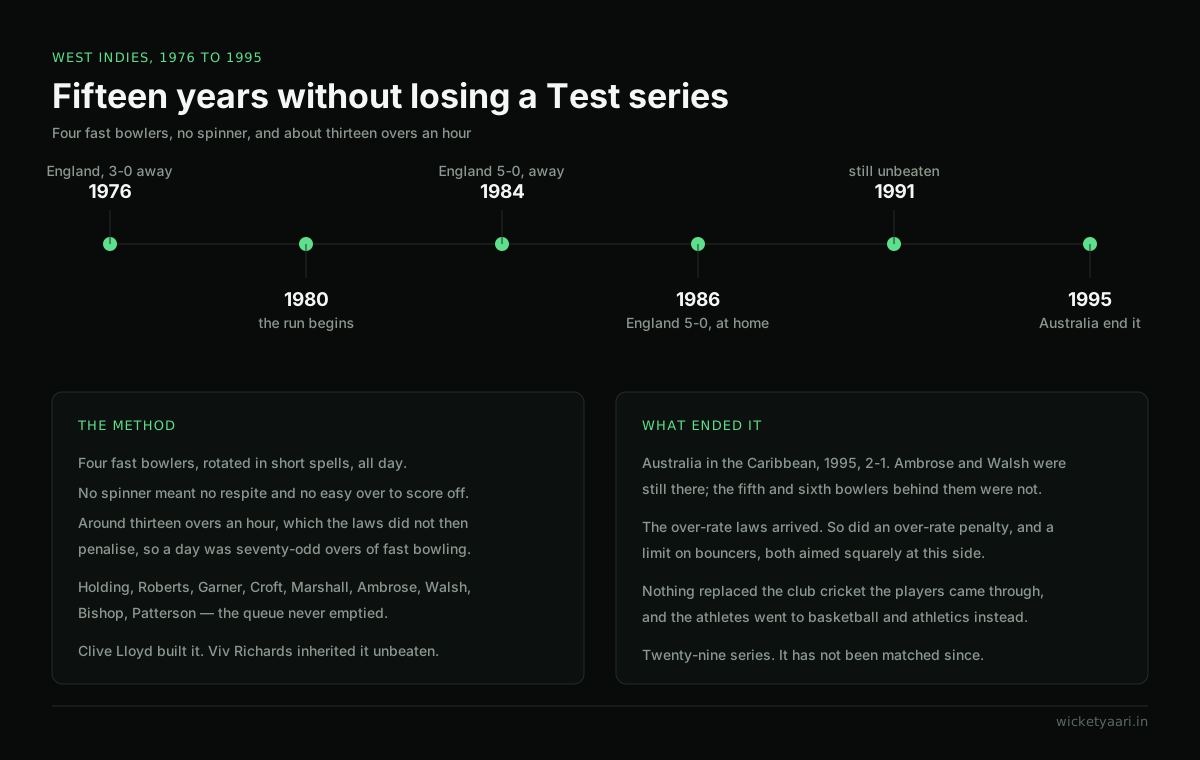
- 1975Beaten in Australia5-1, and the strategy is decided in response
- 1976EnglandHolding takes fourteen at The Oval; the era effectively begins
- 1980The streak startsNo Test series lost, anywhere, for fifteen years
- 1984The blackwashEngland beaten 5-0 in England
- 1986And againEngland beaten 5-0 in the Caribbean
- 1995AustraliaBeaten at home; the streak finally ends
The attack, and its depth
The names people remember are Roberts, Holding, Garner, Marshall, Croft, Ambrose, Walsh, Bishop, Patterson. That is nine genuinely fast bowlers across the period, and at no point were more than four playing at once.
The depth is the part that gets missed. Any other side losing its best fast bowler to injury lost its attack. West Indies replaced one great bowler with another for fifteen years.
What it was actually built on
Not just pace. Three other things, and all of them are less discussed.
Over rates. Four fast bowlers cannot bowl ninety overs in a day. West Indies routinely bowled twelve or thirteen an hour, which meant fewer overs, more rest between spells, and bowlers operating at full pace all day. The penalties that exist now did not then.
Batting. Greenidge, Haynes, Richards, Lloyd, Richardson. Sides remember being frightened by the bowling and forget being buried by the batting first.
Fielding. The slip cordon of that era took catches that other teams did not, which is what converts hostile bowling into wickets.
How many specialist spinners did the great West Indies sides usually play?
Four fast bowlers and no specialist spinner was the standard XI, with part-time spin from batters if needed. It is why over rates were so low and why the tactic was so hard to copy.
Why nobody copied it
Because it required four bowlers of genuine international quality at the same time, plus replacements, plus the batting to make it matter.
Australia in the 1990s came closest with McGrath and Gillespie but paired them with Warne, which is a different model entirely. Every other side that tried four seamers found that the third and fourth were not good enough, and a fast bowler who is not fast enough is simply a bowler giving away runs.
- Four fast bowlers
- Intimidation
- Raw pace
- No spinner
- Twelve overs an hour, entirely legally
- An opening pair averaging over forty
- A slip cordon that dropped almost nothing
- Bowlers of that quality in reserve, for fifteen years
The 1976 tour that set it up
The run is usually dated from 1980, but the decision that produced it was made in England in 1976.
Tony Greig, England's captain, said before the series that he intended to make West Indies "grovel". Whatever he meant by it, the word landed exactly as badly as it reads, and Clive Lloyd's side won the series 3-0 with a bowling attack that had abandoned any pretence of balance. Michael Holding took 14 wickets at the Oval on a pitch that offered nothing.
Lloyd had already reached the conclusion the year before, watching Australia's Lillee and Thomson dismantle his batting: four fast bowlers, no spinner, and enough of them to rotate. 1976 was the first full demonstration and it worked so completely that he never changed it again.
Malcolm Marshall, who many judges rate the best of all of them, did not play in the 1976 series at all. He was nineteen and third in the queue.
Why nobody successfully copied it
Every side of the era tried some version and every side found the same wall.
You need eight of them, not four. Fast bowling breaks down. A four-man pace attack requires a queue of replacements ready to walk in mid-series without the standard dropping, and no other country produced them at that rate for that long.
You need batting that does not need protection. Greenidge, Haynes, Richards and Lloyd meant the bowlers were rarely defending a small total, so they could attack from the first over of every innings. A side with the same attack and a fragile top order becomes a side that bowls beautifully and loses.
You need over rates nobody polices. Thirteen overs an hour was the price of four bowlers operating at full pace all day. The over-rate penalties introduced afterwards make the method mathematically expensive in a way it was not then.
| What sides copied | What they could not copy |
|---|---|
| Four seamers | Four seamers, plus four more in reserve |
| Short-pitched bowling | Batting that scored fast enough to make it safe |
| Aggressive fields | An over rate nobody could punish |
Viv Richards took over the captaincy in 1985 with the run already six years old and did not lose a series either, which is a harder thing than starting one. He retired in 1991 having never captained a losing series side, and the record went another four years after that before Australia finally took it in the Caribbean.
What happened to the production line
The collapse after 1995 was not a cricketing failure and it did not happen on the field.
The club structure that produced the players thinned out. Cable television brought American sport into Caribbean homes, and the best athletes in a region of six million people started choosing basketball and track. Central contracts arrived late and were disputed. Board finances were poor and the relationship between the board and the players has been openly hostile more often than not since.
The output is the measurable part: from a side with four world-class fast bowlers and four more waiting, to a side that has struggled to field two, inside about fifteen years. Nothing that has been tried since has restored it, and the reasons are mostly outside cricket's control.
How it ended
Australia beat them in the Caribbean in 1995. By then Marshall, Garner, Holding and Roberts were long retired, Ambrose and Walsh were carrying the attack alone, and the production line had stopped.
The reasons for that stopping — funding, other sports, the fragmentation of a region into separate boards — are argued about still, and no era has replaced it.
- Fifteen years without losing a Test series, which nobody else has approached
- Nine great fast bowlers over the period, never more than four at once
- Low over rates and an outstanding top order mattered as much as the pace
- Nobody copied it because almost nobody ever had four of that quality at once
For the players from that side in our dataset, see Viv Richards and Malcolm Marshall. For the era's wider context, see the history of cricket in ten moments.