One-day international cricket explained, and its identity problem
Fifty overs a side, the format that invented the World Cup and now sits awkwardly between the two everybody argues about. What it does that neither of the others can.
A one-day international is fifty overs per side, finished in a day. It is the format the World Cup is played in, the format that made cricket a television sport, and the one whose future is questioned most often.
- Fifty overs, one innings each, a result guaranteed except for rain
- Three powerplay phases give the innings a shape the other formats lack
- Two new balls removed reverse swing and made death bowling far harder
- It is the only format where pacing an innings is the central skill
The shape
| Overs per side | 50 |
| Maximum per bowler | 10 |
| Balls | two new white balls, one from each end |
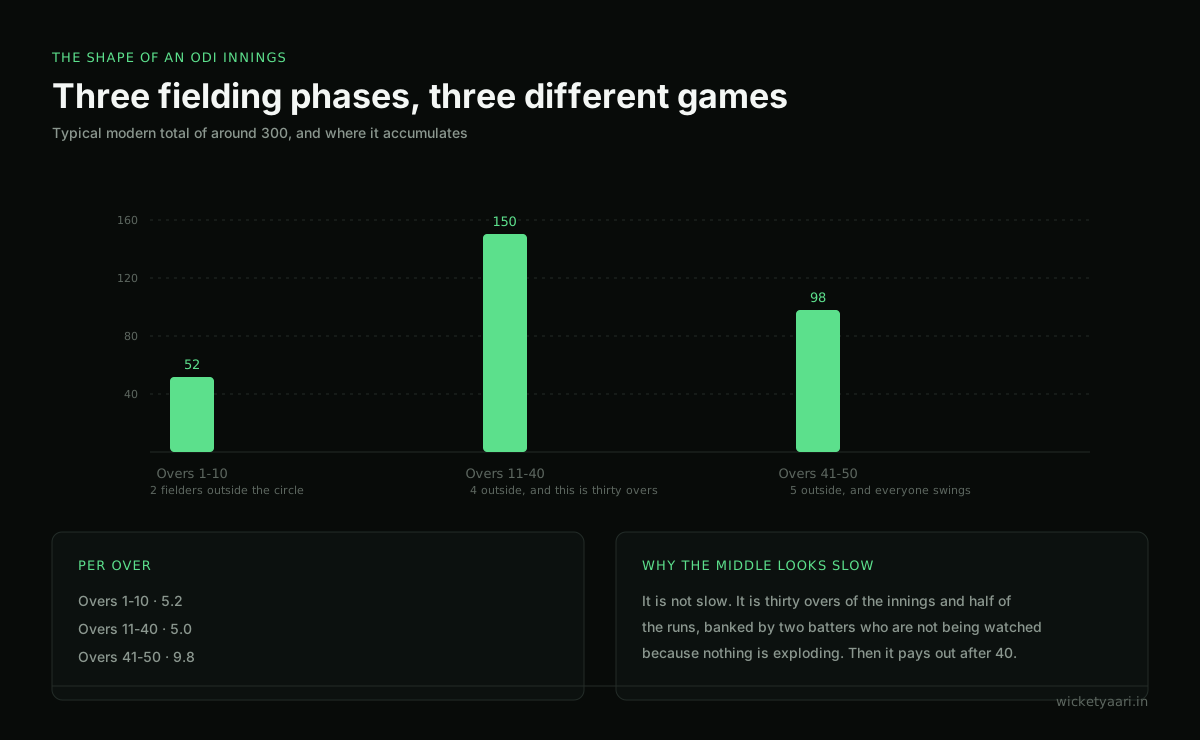
| Powerplays | overs 1–10, 11–40, 41–50 |
| Fielders outside the circle | 2, then 4, then 5 |
| Typical winning score | 280 to 330 |
| Rain | handled by Duckworth-Lewis |
Ten overs per bowler means five bowlers minimum, and the fifth bowler is the weakness most sides plan around. It is why all-rounders are valued more in this format than in either of the others.
The thing only ODIs have
Pacing.
A T20 innings is 120 balls and there is barely time to build anything. A Test innings has no clock at all. A fifty-over innings has both a hard limit and enough time to construct something, which means the batting side must continuously decide how much risk to take now against how much capacity it keeps for later.
That decision, repeated for three hours, is the format's actual skill. It is why an ODI hundred off 110 balls can be a better innings than one off 90, depending entirely on what happened around it.
Why do ODI sides value all-rounders more than T20 sides do?
A fifty-over innings needs fifty overs from a maximum of ten each, so at least five bowlers must bowl. A part-time fifth bowler is the standard weakness, and an all-rounder removes it.
The two new balls, and what they cost
Since 2011 each innings uses two new balls, one from each end. The intention was to keep the white ball visible under lights, because a single white ball discolours badly.
The consequence was that neither ball is ever more than about twenty-five overs old, which is nowhere near old enough for reverse swing. An entire bowling discipline disappeared from the format.
Death bowling became a contest of yorkers and slower balls rather than movement, totals rose, and the fielding restrictions have been tightened repeatedly to compensate.
The two innings are not the same game
Batting first and batting second in a one-day international are different sports played under the same regulations, and the difference is information.
The side batting first is guessing. It has to decide what a par score is on this pitch, against this attack, in these conditions, without knowing any of it for certain until the second innings tells them. Every acceleration decision — when to attack, when to consolidate — is made against an estimate.
The side batting second knows the number. Every over it can compute exactly what is required, and the required rate turns a vague plan into arithmetic. That is worth something real, which is why captains overwhelmingly choose to chase when conditions are even.
What runs the other way is pressure and the pitch. Chasing 320 with the required rate climbing is a specific kind of unpleasant that setting 320 is not, and in day-night matches the ball can do more under lights than it did in the afternoon. The advantage of knowing the target is real, and it is not unconditional.
| Batting first | Batting second |
|---|---|
| Has to estimate par | Knows the target exactly |
| Can bat to a plan | Bats to a rate |
| Sets the scoreboard pressure | Absorbs it |
| Unaffected by dew | Frequently decided by it |
There is a further wrinkle nobody planned. Two new balls, one from each end, means no ball is ever more than twenty-five overs old, and reverse swing needs a ball older than about forty. The format therefore removed its own late-innings weapon and then wondered why totals climbed.
Fifty overs is the length that argues with itself
An ODI is long enough to require a plan and short enough to punish one, and the result is a format that behaves like two different sports joined in the middle.
The first fifteen overs and the last ten are recognisably T20 cricket with a harder ball. The thirty overs between them are recognisably a shortened Test innings: two set batters, a spread field, singles, and a bowling side trying to buy a wicket rather than prevent runs. A player who is excellent at one of those and ordinary at the other is a difficult selection, and most modern squads are built by finding people who are merely good at both.
The dew factor, which decides matches nobody discusses
In a large part of the cricket-playing world, evening matches are settled by moisture on the outfield.
Dew makes the ball wet and heavy. A wet ball does not grip for a spinner, does not swing for a seamer, and skids on to the bat. In venues where the dew arrives reliably, the side bowling second is bowling with a bar of soap, and everybody knows it before the toss.
This is why you see captains choose to chase almost automatically at some grounds, and why a total that looked commanding at the innings break gets overhauled with overs to spare. It is not that the chasing side batted exceptionally. It is that the conditions changed between innings, and the format has no mechanism to compensate for it.
Duckworth-Lewis adjusts for rain. Nothing adjusts for dew, and dew probably decides more one-day matches than rain does.
The identity problem
The complaint is that ODIs are neither one thing nor the other: not the technical examination of a Test, not the three-hour product of a T20. Bilateral series outside World Cup years often draw small crowds and less attention than either.
The counter-argument is that the World Cup remains cricket's largest event by some distance, and that the format's middle overs demand a skill the other two never test.
Both are true. The format is fine every four years and struggles in between, which is a scheduling problem rather than a design one.
- The World Cup, still cricket's biggest event
- Pacing an innings across three hours
- Requiring five genuine bowlers
- Chases that build over hours
- Bilateral series in a crowded calendar
- Competing with T20 for an evening audience
- Keeping bowlers relevant with two new balls
- Holding attention when nothing is at stake
Watching the middle overs
Overs 11 to 40 are where ODIs are decided and where most people look away. Four fielders are out, boundaries are hard, and the contest is about strike rotation: whether the batting side can keep the scoreboard moving without risk, and whether the bowling side can build enough dot balls to force one.
A side that is 150 for 2 after 30 overs has usually won the middle. A side that is 150 for 5 has usually lost it, whatever the run rate says.
- Fifty overs, ten per bowler, three powerplay phases
- Pacing is the format's unique skill and nothing else tests it
- Two new balls removed reverse swing and raised totals permanently
- The World Cup is thriving; the bilateral calendar is the real problem
For the fielding rules that give the innings its shape, see powerplays explained.