The first Women's Cricket World Cup, 1973, two years before the men's
England beat Australia at Edgbaston in a tournament organised by a businessman and a cricket administrator, funded privately, and largely forgotten.
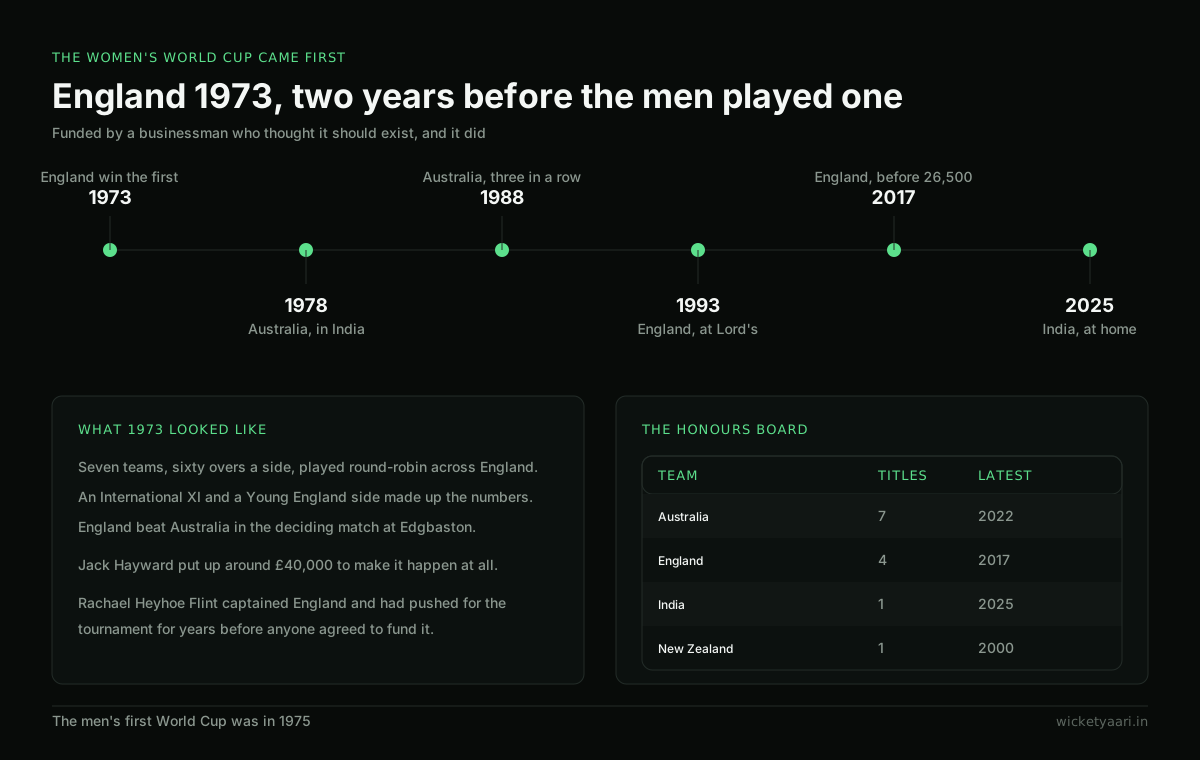
The first Cricket World Cup of any kind was the women's tournament held in England in 1973. It happened two years before the men's, and almost nobody mentions it.
- Held in England in 1973, two years before the first men's World Cup
- Seven teams, sixty overs a side, a round robin with no knockout
- England won; Enid Bakewell scored 118 in the deciding match
- Funded privately by Sir Jack Hayward, because no board would pay for it
How it happened
The idea came from Rachael Heyhoe Flint, England's captain, and was funded by Sir Jack Hayward, a businessman she persuaded to underwrite it.
No cricket board proposed it, organised it or paid for it. The Women's Cricket Association ran it on a private donation, which is the only reason it exists at all.
The format
Seven teams, sixty overs a side, played as a round robin with no semi-finals or final. The team topping the table won.
That structure meant the last scheduled match, England against Australia at Edgbaston, happened to be the decider. It was not designed as a final; it just turned out that whoever won it would top the table.
| 1973 women's | 1975 men's | |
|---|---|---|
| Teams | 7 | 8 |
| Overs | 60 | 60 |
| Structure | round robin | groups then knockout |
| Winner | England | West Indies |
| Funding | a private donor | commercial sponsorship |
Which World Cup came first?
The women's tournament in England in 1973 predates the men's by two years, and was organised privately because no board would fund it.
The deciding match
England needed to beat Australia at Edgbaston to top the table. Enid Bakewell made 118, England posted 279 for 3, and Australia fell short.
Bakewell was a schoolteacher who had taken time off work to play. Several of the England side were unpaid, and some had contributed to their own costs. That is what winning a World Cup looked like in 1973.
Who played in it
Seven teams, and the list is stranger than a modern tournament's: England, Australia, New Zealand, Trinidad and Tobago, Jamaica, Young England, and an International XI made up of players from countries without a full side.
Two of those are Caribbean islands entered separately, because there was no West Indies women's team at the time. Young England was a development side. The International XI existed because the organisers wanted seven teams and could only find five real ones.
That is what building a global tournament from nothing actually looks like, and it is worth remembering when people describe the modern women's game as having appeared suddenly.
How a tournament gets organised with no money
There was no international body funding women's cricket in 1973, no broadcast deal to sell, and no sponsor queueing up. What there was, was a Women's Cricket Association running on subscriptions and a businessman who could be persuaded.
Jack Hayward was a philanthropist who had already funded a series of unlikely British causes. He put up around forty thousand pounds, which covered flights, accommodation and the trophy, and asked for very little in return. Without that cheque there is no tournament, and the first World Cup in cricket of any kind is the men's competition two years later.
The teams paid their own way in other respects. Players took unpaid leave from their jobs. Several of them washed their own kit between matches. The matches were played at club and county grounds around England — Hove, Edgbaston, Exmouth, Dartford — because the Test grounds were not offered and would not have been filled.
The format, which was strange and sensible
Seven teams, round robin, sixty overs a side, no knockout. Whoever topped the table won, which meant the tournament could theoretically have been decided a week early with a dead final. It was not, and the last match was the decider by accident of scheduling rather than design.
Two of the seven teams did not represent countries. An International XI was assembled from players whose national sides could not travel, and Young England made up the numbers. That would look absurd in a modern competition and it was the only way to get seven fixtures on the board.
| 1973 | The modern tournament |
|---|---|
| 7 teams, two of them invitational | 8 teams, all national |
| 60 overs | 50 overs |
| Round robin, no final | Group stage plus semi-finals and a final |
| Club and county grounds | Test grounds and full houses |
| Funded by one man | Funded by broadcast rights |
The trophy itself was a small one and the prize money was nothing. What the players took away was a fixture list: a reason for national associations to organise tours, select squads and keep records, which is the machinery a sport needs before it can have a history at all.
What took fifty years to arrive
The 1973 tournament proved the cricket worked. Everything else took decades.
Equal match fees, professional contracts, dedicated broadcast slots, a standalone T20 World Cup, and crowds that fill a Test ground all arrived between 2017 and 2025 — the 2017 final at Lord's in front of 26,500 is usually cited as the hinge, and the 2020 T20 final at the Melbourne Cricket Ground drew 86,174, the largest crowd ever to watch a women's cricket match.
The lesson administrators drew, eventually, was the same one the 1975 men's tournament taught: put the matches somewhere people can get to, at a time they can watch, and tell them it is happening. None of that was tried for the first forty years after 1973.
Why it was forgotten
Three reasons, and they compound.
No board owned it. Because it was privately funded, no institution had an interest in commemorating it.
No television. Very little footage exists. A tournament without archive disappears from the record in a way one with archive does not.
The men's tournament arrived two years later with sponsorship, a Lord's final and full coverage, and became "the" World Cup in ordinary usage.
- A private donor
- Amateur players, some paying their own way
- Almost no broadcast footage
- A round robin ending by coincidence in a decider
- Commercial sponsorship
- Paid professionals
- Full television coverage
- A final at Lord's
Rachael Heyhoe Flint
England's captain did not only play in the tournament; she conceived it, lobbied for it, found the money for it and then led the side that won it.
She later became the first woman elected to the MCC committee, at a club that had refused women membership for two centuries. The tournament and the membership fight were the same campaign conducted by the same person over about thirty years.
What changed since
Women's cricket became professional in stages, decades later: central contracts in England and Australia through the 2010s, the Women's Premier League and equivalent franchise competitions in the 2020s, and match fee parity at the international level in several countries.
The tournament that started all of it was paid for by one man who was persuaded over a conversation, and its winning centurion went back to teaching.
- 1973, England, seven teams, sixty overs, privately funded
- It predates the men's World Cup by two years
- Enid Bakewell's 118 decided it, in a match that became a final by accident
- It was forgotten because no institution owned it and almost no footage exists
For the tournament that followed, see the first Cricket World Cup, 1975.