How cricket helmets went from optional to compulsory
For a century batters faced fast bowling bare-headed, and the argument was about courage rather than physics. It took forty years and a death to settle it.
Cricket spent about a hundred and forty years asking people to face a hard ball at ninety miles an hour without protecting their heads, and treating anybody who suggested otherwise as faintly embarrassing.
- The first regular helmet use in top-level cricket came in the late 1970s
- The objection was cultural, not practical: a helmet looked like fear
- Standards, grilles and neck protectors were added over the following decades
- The change from normal to compulsory came after serious injury and a death
Before helmets
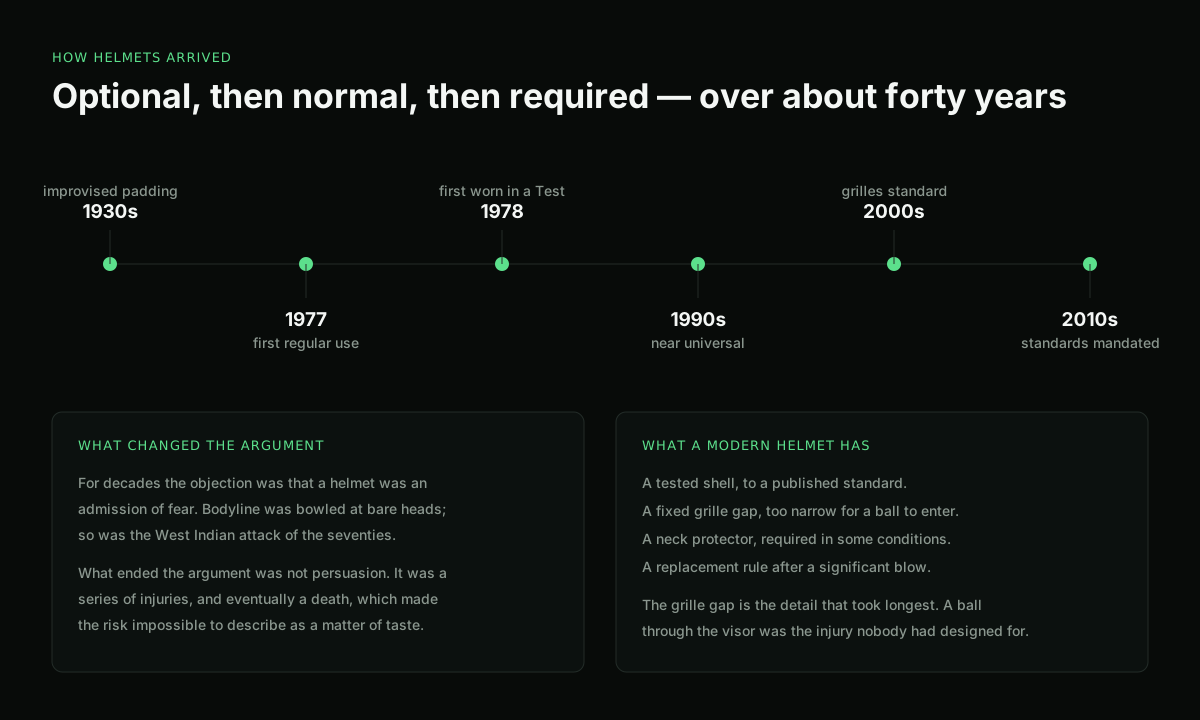
Bodyline was bowled at bare heads. So was the West Indian pace attack of the 1970s and 1980s. Batters wore a cap, and the protection available to them was their eyesight and their reflexes.
There were improvisations. Patsy Hendren wore a padded cap of his wife's making in the 1930s. Individual players tried motorcycle helmets and scaffolding of various kinds. None of it took, partly because the equipment was poor and partly because the culture treated the whole subject as a character question.
The injuries were not hidden. Players were hit, players were hospitalised, and several careers ended because somebody could no longer face short bowling. It was understood as a hazard of the trade rather than a problem with a solution.
The late 1970s
Helmets entered the professional game properly around 1977 and 1978, and World Series Cricket is a large part of why.
Packer's competition put the best fast bowlers in the world on hard, quick pitches in front of television cameras, with no board to tell anybody what to wear. The cricket was faster and more hostile than the official version, and players started protecting themselves. Dennis Amiss was among the first to wear one regularly. Graham Yallop is generally credited with the first helmet worn in a Test match, in 1978, against the West Indies.
The reaction was mockery, and it lasted about a decade. Commentators who had played without helmets were reliably scornful; players who wore them were said to be advertising their fear. The argument was never about whether a helmet worked.
The slow normalisation
Through the 1980s the helmet went from unusual to common to unremarkable, and it did so player by player rather than by any rule.
Two things drove it. Fast bowling was faster and more sustained than in any previous era, and the equipment got better: lighter shells, better fitting, and grilles that let a batter see.
By the 1990s a batter facing pace without a helmet was the exception, and by the 2000s it had effectively stopped. Nothing required it. The culture had simply changed, which is how most equipment changes in cricket have happened.
| Era | Status | What drove the change |
|---|---|---|
| Before 1977 | essentially none | culture treated it as cowardice |
| 1977-1985 | a minority, and mocked | faster cricket, better equipment |
| 1985-2000 | the norm for pace | the mockery stopped working |
| 2000-2014 | universal in practice | grilles and lighter shells |
| Since 2014 | mandated, to a standard | injury data, and one death |
What made it compulsory
Voluntary adoption had taken it to nearly a hundred per cent. What it had not done was standardise the equipment, and that turned out to matter.
The specific failure was the gap between the peak of the helmet and the top of the grille. A ball could pass through it. Several players were struck that way, and the injuries were exactly the ones the helmet existed to prevent.
Phillip Hughes died in November 2014 after being struck on the neck, below the helmet, playing a first-class match in Sydney. The blow was not one any helmet then in use was designed to protect against, and it is important to say that no equipment change would clearly have prevented it.
What followed was a rapid tightening of everything adjacent. Testing standards became mandatory in professional cricket in several countries from 2015. Helmets had to meet a published specification. Grille gaps were fixed. Neck protectors appeared, and became required in some conditions. Rules were written about replacing a helmet after a significant blow, and about wearing one when keeping up to the stumps or fielding close in.
What a modern helmet has to do
Four things, and each of them exists because of a specific failure.
A tested shell that meets a published standard, rather than a manufacturer's claim. Testing is done to the impact energies a first-class delivery actually produces.
A fixed grille gap narrow enough that a ball cannot enter, checked as part of the standard rather than left to the fitting.
A neck protector, attached at the rear, for the blow that killed Hughes. Adoption has been mixed and it is required in some competitions and conditions.
A replacement rule. A helmet that has taken a significant impact is compromised in ways that are not visible, and is retired.
The argument that has not gone away
Helmets are not universal even now. Batters facing spin frequently take them off, and some prefer a cap against medium pace.
The case for allowing that is real: a helmet is hot, it restricts peripheral vision slightly, and against slow bowling the risk it protects against is close to absent. The case against is that a top edge from a sweep is not a slow-bowling risk, and it is exactly how several serious injuries have happened.
Most competitions now require a helmet against pace and permit the choice against spin, which is a compromise nobody defends on principle and everybody accepts in practice.
- It looks like fear
- Real players did without
- It will slow the game down
- Batters will play recklessly
- It looked unfamiliar
- Real players were also concussed
- It did not
- They did, and the hook shot changed permanently
The fielders nobody protected
Batters were the argument for forty years. The fielders standing two yards from the bat were an afterthought.
Short leg and silly point are the two most dangerous positions in cricket and are occupied, traditionally, by the youngest member of the side. For most of the game's history the protection was a shin pad and a box. Helmets for close catchers arrived later than for batters and were resisted for the same reasons.
Wicketkeepers standing up to the stumps came later still. A keeper takes deflections off the edge from a metre away, which is less time than a batter has against a fast bowler, and the equipment question was only taken seriously once the batting argument had already been settled. Competitions now require helmets in both positions, and the phrase that made it possible was the same one that ended the batting debate: this is a safety rule, not a character test.
What it changed about batting
The helmet did not only prevent injuries. It changed the sport.
A batter who cannot be seriously hurt by a short ball plays it differently. The hook and the pull became percentage shots rather than acts of bravery, batters stood taller and further forward against pace, and the bouncer went from a weapon that could end a career to one that concedes six as often as it takes a wicket.
Some of the bouncer limits in the modern Laws exist because the helmet made the short ball less dangerous and therefore more common, and the game had to decide how much of it it wanted. That is a strange chain of consequences for a piece of protective equipment, and it is the clearest example in cricket of safety changing tactics rather than just outcomes.
- Regular use began in the late 1970s, against loud objection
- Adoption was cultural and voluntary long before it was required
- What compulsion added was a standard, not the habit
- The helmet changed how the short ball is bowled and played, not just how safe it is
The short version
Cricket took forty years to move from the first helmet to a required one, and almost none of that time was spent on engineering. The argument was about what a batter was supposed to be willing to risk, and it ended the way those arguments usually end.
For the field setting that made head protection a live question in the first place, see Bodyline and the law it changed. For the attack that made the short ball an all-day proposition, see the rise of the West Indies, and for where the bouncer limits sit in the Laws now, what counts as a no-ball.For the field setting that made head protection a live question in the first place, see Bodyline and the law it changed.