Test, ODI and T20: what actually differs beyond the overs
The three formats are not the same game at different lengths. The ball, the fields, the value of a wicket and the point of an innings all change.
People describe the three formats as long, medium and short. That is the least interesting difference between them. Change the length of an innings and you change what a wicket is worth, and once a wicket is worth something different, everything downstream changes with it.
- The real variable is the price of a wicket, not the number of overs
- Ball, field restrictions and the value of a maiden all differ
- The same player has three legitimate averages and they are not comparable
- Tests are the only format where a draw is a result worth playing for
The headline differences
| Test | ODI | T20 | |
|---|---|---|---|
| Innings each | two | one | one |
| Overs | unlimited | 50 | 20 |
| Ball | red or pink, one per innings | two white balls | one white ball |
| Fielders outside the circle | unrestricted after the first overs | 4 or 5, by phase | 5 after the powerplay |
| A draw possible | yes | no | no |
| Par run rate | around 3.5 | around 6 | around 9 |
Why a wicket costs more in a Test
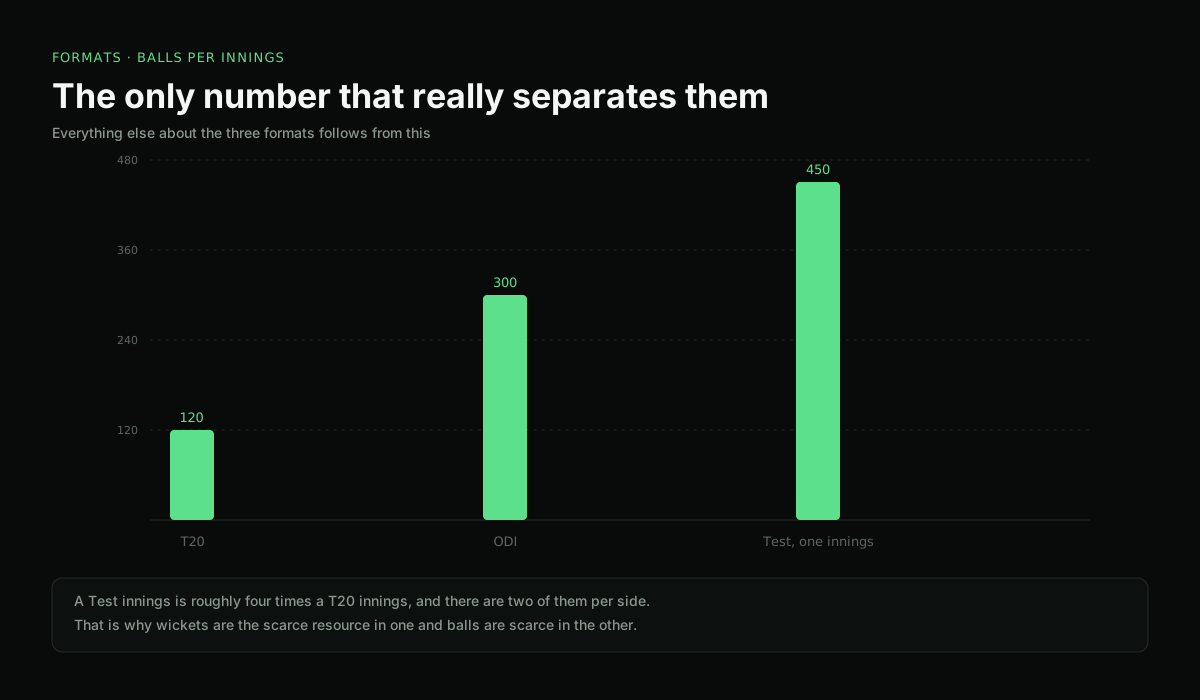
In a Test you have ten wickets and effectively unlimited time. Time is not the constraint; wickets are. That single fact produces the forward defensive, the leave, the nightwatchman and the willingness to bat for a day without scoring quickly.
In a T20 you have ten wickets and 120 balls. Now balls are the constraint and wickets are comparatively cheap. A batter who is out on 20 off 10 has done something defensible. In a Test that innings is a failure.
The ball changes everything about bowling
Tests use one ball per innings, red or pink. It goes soft, it reverses if the conditions allow, and a bowler's plan can run for twenty overs.
ODIs use two new white balls, one from each end. Neither gets old enough to reverse, which is a rule change that quietly removed a whole discipline from the format and is one reason death bowling became so hard.
T20 uses one white ball for 120 balls. It stays hard, it does not swing for long, and the contest becomes about variation rather than movement.
Why is reverse swing so rare in modern one-day internationals?
Two new balls means each is only about 25 overs old at the end of an innings. Reverse swing typically needs a ball considerably older than that.
What an innings is for
This is the difference nobody states explicitly, and it explains most tactical confusion.
A Test innings exists to build a position. Runs matter, but so does time taken and the state of the ball and pitch when the other side bats. A team can correctly bat slowly.
An ODI innings exists to post or chase a total across a known number of overs, with wickets in hand as the resource that lets you accelerate. This is also exactly what Duckworth-Lewis models.
A T20 innings exists to maximise runs within 120 balls, and wickets matter mainly as a means to that end. A side that finishes 150 for 3 has usually left runs out there.
- In a Test, sustained pressure and a plan working
- Six dot balls as a building block
- Economy rates around 2.5 are normal
- In a T20, a spell of exceptional bowling that will be talked about
- Six dot balls as an event
- Economy rates around 7 are good
Why the same player has three averages
A batter averaging 45 in Tests, 38 in ODIs and 28 in T20s has not got worse. The number is answering a different question each time, because the divisor and the job are different.
Test averages reward occupation. T20 averages are close to meaningless without strike rate beside them, because a finisher's job includes getting out.
The same skills, priced differently
No skill is useful in one format and useless in another. What changes is the price the format puts on it, and the price is what moves players in and out of sides.
Defence is worth almost everything in a Test and close to nothing in a T20. A batter who can leave forty balls in a row is a Test opener and a T20 liability.
Clean hitting is worth everything in a T20 and is a bonus in a Test. It is not that Test cricket does not want sixes, it is that it will not pay for them with wickets.
Accuracy is worth more in white-ball cricket, where a wide is a run and a rebowl. Movement is worth more in a Test, where a bowler has six overs to set a batter up rather than six balls.
Fielding has become non-negotiable in both, and it is the one area where the short formats genuinely raised the standard of the long one. Test sides now field like one-day sides because the players learned it somewhere else.
| Skill | Test value | ODI value | T20 value |
|---|---|---|---|
| Leaving the ball | very high | moderate | none |
| Strike rotation | moderate | very high | high |
| Six-hitting | useful | high | essential |
| Bowling maidens | high | moderate | almost irrelevant |
| Reverse swing | high | low | low |
The fielding restrictions are the mechanism that enforces all of this. A Test captain may put all eleven fielders wherever he likes; an ODI captain may not have more than four or five outside the circle depending on the phase; a T20 captain has six overs where only two may be out. Those numbers are the format, and every difference in how the three games are played can be derived from them plus the length of the innings.
The player who cannot be all three
The three-format cricketer is rarer than the schedule pretends, and the reason is physical rather than technical.
A fast bowler's body has a fixed number of overs in it. Playing all three formats means bowling in ten months of the year across three different workloads, and the players who try it break down with a predictability that boards have started planning around. Central contracts now routinely specify formats rather than availability.
For batters the constraint is technical rather than physical: the trigger movements, the shot selection and the risk tolerance that make a good T20 batter are almost exactly the habits a Test opener spends a career suppressing. Some players switch cleanly. Most are better at two of the three, and selectors have stopped pretending otherwise.
The thing only Tests have
A draw. Not a tie — a draw is different — but a result in which neither side won and both may have played well.
It is the reason a Test can be gripping on the fifth afternoon with nobody able to win, and it is the single hardest thing to explain to somebody who arrived through T20. A format where survival is a legitimate goal produces a kind of tension the other two structurally cannot.
- Wickets are the scarce resource in a Test, balls are scarce in a T20
- Two new balls removed reverse swing from one-day cricket
- Averages across formats answer different questions and do not compare
- Only Tests have a result where nobody wins and it was still worth watching
If you want to see how differently the same player performs across them, the player list carries Test and one-day records side by side.