Twenty20 cricket explained, and why it took over
Twenty overs a side, invented by English counties to sell tickets, now the format that funds the sport. What actually changes when an innings is 120 balls long.
Twenty20 is twenty overs per side, finished in about three hours. It was invented in 2003 by English county administrators trying to get people to come to grounds after work, and it is now the format most of professional cricket is organised around.
- Twenty overs, 120 balls, about three hours
- Wickets are cheap and balls are scarce, which reverses Test cricket's economics
- A six-over powerplay is thirty percent of the innings
- Every convention in T20 follows from those two facts
The basic shape
| Overs per side | 20 |
| Balls per innings | 120 |
| Maximum per bowler | 4 overs |
| Powerplay | first 6 overs, 2 fielders out |
| After the powerplay | 5 fielders out |
| Typical winning score | 160 to 200 |
| Duration | around 3 hours |
The four-over cap on bowlers matters more than it looks. A captain cannot simply bowl his best bowler more; he must decide when those four overs happen, which is the central tactical question of the format.
What actually changes
The constraint flips. In a Test you have ten wickets and effectively unlimited time, so wickets are the scarce resource. In a T20 you have ten wickets and 120 balls, so balls are scarce and wickets are comparatively cheap.
Everything else follows:
- A batter out for 20 off 10 has done a job. In a Test that is a failure
- A maiden over is an event rather than a building block
- A team finishing on 160 for 2 has usually left runs unscored
- Bowlers are judged on economy rate
as much as wickets
A T20 side finishes on 155 for 2. What does that most likely mean?
With ten wickets and only 120 balls, finishing with eight in hand usually means the batting side was too cautious. Wickets are the resource you are meant to spend.
The three phases
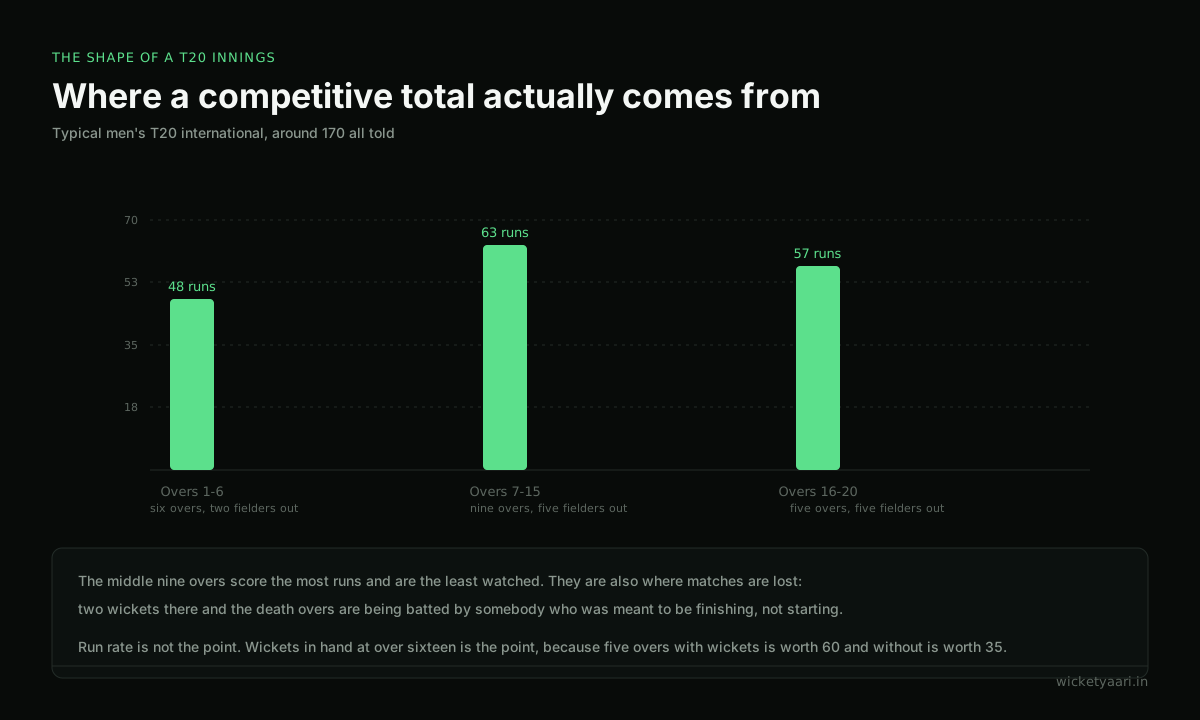
Powerplay, overs 1 to 6. Two fielders outside the circle. Thirty percent of the innings played under the tightest field restriction in cricket. A side that scores 60 here has a different match to play than one that scores 35. See powerplays explained.
Middle, overs 7 to 15. The field goes out. This is where spinners bowl and where most matches are quietly won or lost, usually by whichever side rotates strike better rather than whichever hits more boundaries.
Death, overs 16 to 20. Set batters, spread field, and bowlers with nowhere to hide. It is the hardest bowling in cricket and the reason yorkers and slower balls became specialisms.
Why it took over
Three reasons, none of them cricketing.
It fits an evening. Three hours, after work, finished before the last train.
It fits television. A fixed slot with predictable advertising breaks is worth far more per hour than a five-day match that might end early.
It fits a league. Short matches mean many matches, which means a season, a table, and franchises with assets. That is the model the IPL built and everybody copied.
- Occupation and patience
- Building an innings over hours
- Bowlers who create pressure over spells
- Averages
- Intent and placement
- Making a decision every ball
- Bowlers who survive four overs
- Strike rates and phase economy
What a T20 side actually is
Eleven players, and the job descriptions do not match any other format.
Two openers whose task is the powerplay, and whose value is measured almost entirely in the first six overs. A T20 opener striking at 125 is a problem even if they average 40.
Three or four middle-order batters who have to be able to do two opposite things: rebuild after two early wickets, and accelerate from ball one if the start was good. The player who can only do one is a specialist in a side with no room for specialists.
A finisher, who may face fifteen balls or none, and who is picked on what they do in the last three overs rather than on any average.
Four or five bowling options, of which at least two must be able to bowl at the death and at least one must be able to bowl in the powerplay. The fifth bowler is usually a batter who bowls, and the fifth bowler is where most matches leak.
That is why the all-rounder is worth so much more in T20 than anywhere else. A side that gets twenty overs of bowling from five specialists has one fewer batter than a side that gets the same twenty overs from four specialists and a part-time sixth. Every squad is built to solve that arithmetic.
What twenty overs does to a bowler
The obvious constraint is four overs. The interesting one is that a bowler can be taken out of the attack by the situation rather than by the captain.
A bowler who goes for sixteen in their first over will frequently not bowl again that innings, because the captain has three other options and no time to be loyal. That is unimaginable in Test cricket, where a bad spell is a session's problem rather than a career's, and it shapes how bowlers approach the first over of a spell: there is no settling in.
The same pressure works on selection. A bowler who is expensive in two matches out of six will lose their place to somebody with a lower ceiling and less variance, because the format punishes the bad day far more than it rewards the exceptional one.
The tactics that only exist here
The impact substitute, where a competition allows it, lets a side field twelve players in effect — one specialist batter and one specialist bowler swapped at the innings break. It changes selection more than it changes matches: sides can pick a batter who cannot field and a bowler who cannot bat.
Match-ups are the reason a bowler appears for one over and disappears. Sides know which batters struggle against leg spin or left-arm pace, and the bowling order is now determined by who is on strike rather than by any plan set before the innings.
Holding a wicket back is the T20 version of batting time. A side eight down in the sixteenth over cannot attack, however many runs are required, which is why you see teams turn down singles to keep a set batter on strike rather than exposing a tail-ender to the last four overs.
Bowling the sixth bowler early is the containment version: get the weakest over out of the way while the field is up and the batters are still setting, rather than at the death where it costs twelve.
The criticism, and the honest answer
The standard complaint is that T20 damages technique and shortens attention spans. Some of it is true: shot selection that works in twenty overs does not work in five days, and young players now learn the reverse sweep before the forward defensive.
The honest counter is that T20 funds everything else. Test cricket in most countries is subsidised by white-ball revenue, and the players who make Test cricket possible are paid largely by franchise leagues. The formats are not in competition for money; one pays for the other.
- 120 balls makes balls scarce and wickets cheap, which inverts Test economics
- Six-over powerplay, four overs per bowler, three distinct phases
- It won because it fits an evening, a broadcast slot and a league season
- It funds the formats that criticise it
For what separates all three formats, see Test, ODI and T20. For how the money reshaped the calendar, see the IPL explained.