The Hundred explained, and why England invented another format
A hundred balls a side, sets of five, and ends changing every ten. What actually differs from a Twenty20 match, and the reason a new format was built at all.
England already had a twenty-over competition when it built a hundred-ball one. The rules that differ are small; the reason for the whole exercise was not about cricket at all.
- A hundred balls an innings, delivered in sets of five
- The bowling end changes every ten balls, not every six
- A bowler may send down up to twenty balls, the equivalent of four overs
- The men's and women's competitions were double-headers from day one
What actually differs
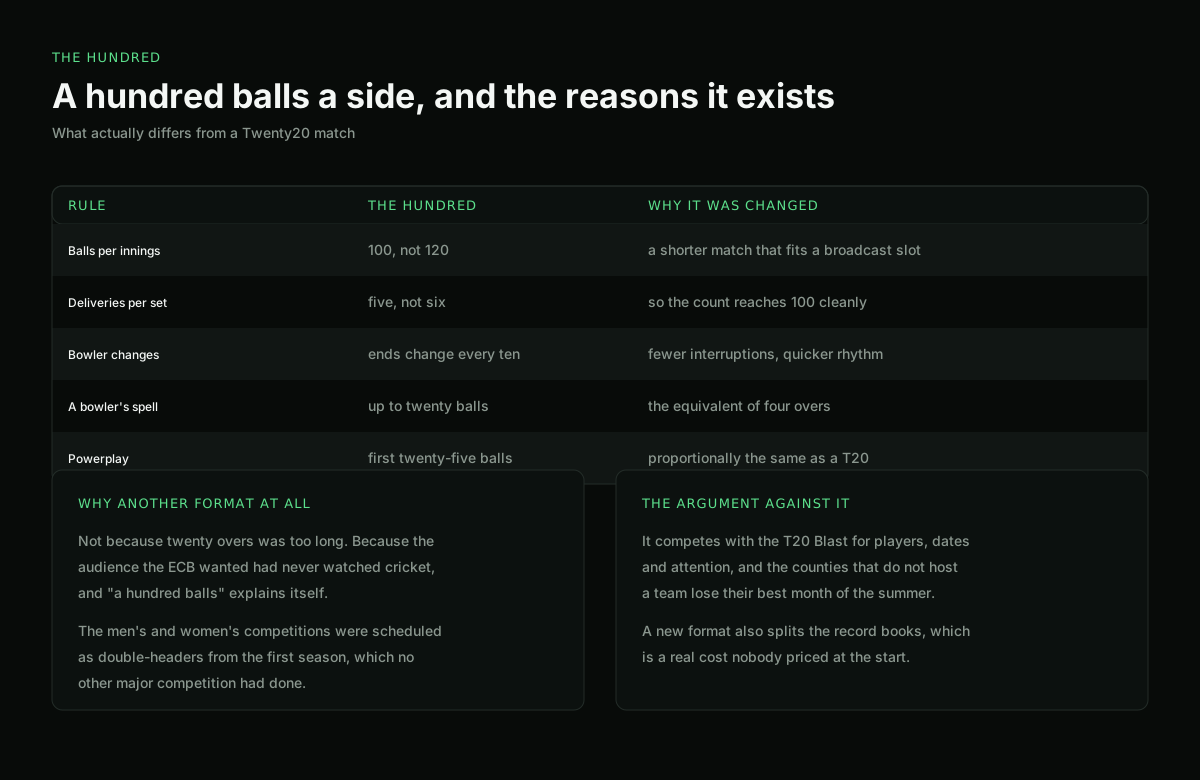
A hundred balls rather than a hundred and twenty, so a match finishes about twenty minutes sooner. Sets of five rather than overs of six, so the count divides cleanly into a hundred. The bowling end changes every ten balls, which means a bowler can deliver two consecutive sets from the same end.
A bowler's maximum is twenty balls, which is four overs by another name. The powerplay is the first twenty-five balls, which is proportionally the same share of the innings as six overs of a T20.
Read down that list and the honest summary is that it is a Twenty20 match with the arithmetic changed.
Why build it
The stated reason was an audience the ECB did not have: people who had never watched cricket, would not sit through three hours, and did not know what an over was.
"A hundred balls" explains itself to somebody who knows nothing. "Twenty overs" does not, because it requires you to already know that an over is six balls. That is the entire pitch, and whatever else is true about the competition, it is a coherent piece of reasoning.
The second reason was commercial and less often stated. A new competition with eight city teams could be sold to a broadcaster as a new property, free of the county structure and its eighteen clubs, and scheduled in the school holidays.
The double-headers
The thing The Hundred did that no other major competition had done is schedule the women's matches alongside the men's from the first season, at the same grounds, on the same tickets, with the same broadcast.
That is the most consequential decision in the whole project. Crowds for women's domestic cricket in England went from hundreds to tens of thousands essentially overnight, because the audience was already in the ground.
Whether the format needed to exist is arguable. Whether that scheduling decision was right is not, and every other country has since been working out how to copy it.
The argument against it
Three objections, and all three are real.
It competes with the T20 Blast. England now runs two domestic T20-shaped competitions in the same summer, for the same players, with the same overseas market. One of them has to lose.
Ten counties do not host a team. Eight city franchises means ten of the eighteen first-class counties get nothing, and lose their best players for the month of the summer when people actually attend.
It splits the records. A hundred-ball innings is not a T20 innings, so the statistics do not combine. Every new format does this and the cost is only visible a decade later.
The set of five, and why people find it awkward
The one rule that genuinely confuses newcomers is the thing that was supposed to make it simple.
An over is a unit people can see: six balls, then the fielders change ends. A set of five is a unit that does not correspond to anything on the field, because the ends change after two of them. So a viewer sees five balls, then five more from the same bowler at the same end, then a change — which is harder to follow than an over, not easier.
The scoreboard shows balls remaining rather than overs, which does help. But the claim that sets of five simplify the game is the weakest part of the original case, and it is the part that gets defended least often now.
Does the format change the cricket
Slightly, and less than the rule list suggests.
The ten-ball end change is the one genuine tactical difference. A captain can give a bowler two sets from the same end back to back, which means a specialist can bowl ten consecutive deliveries at a new batter — something a T20 over structure makes impossible.
Everything else behaves as T20 does. Scoring rates, the shape of an innings, the value of wickets in hand at the death: all recognisably the same game, because a hundred balls and a hundred and twenty balls are not different enough to produce different cricket.
The Hundred changes the bowling end every ten balls instead of every six. What does that make possible that a T20 over structure does not?
Two sets of five from the same end are consecutive deliveries by the same bowler at the same end. In a T20 the ends alternate every over, so a bowler cannot deliver twelve in a row.
- A format for people who do not watch cricket
- Simpler to understand
- A new competition, not a replacement
- Equal billing for the women's game
- Drew an audience that largely already did
- Marginally, and the sets of five confuse people
- It displaced the Blast in the calendar
- This one worked, completely
The eight teams
Birmingham Phoenix, London Spirit, Manchester Originals, Northern Superchargers, Oval Invincibles, Southern Brave, Trent Rockets and Welsh Fire.
None of them is a county. That was deliberate: a Lancashire team and a Yorkshire team carry a century of baggage and a defined support, and the ECB wanted franchises that a newcomer could pick without inheriting an argument. It also meant no county could claim the brand as its own.
The cost is that the names mean nothing to anybody who already followed cricket, which is a trade the project made knowingly and has been criticised for ever since.
What happened to the Blast
The T20 Blast still runs, still involves all eighteen counties, and is still well attended.
What it lost is the window. The Blast is now played around The Hundred rather than through the summer, which means group matches in May on cold evenings and a finals day pushed to September. A competition that was the counties' most reliable revenue has been moved to accommodate one they mostly do not play in.
That is the specific grievance behind most county opposition, and it is a scheduling complaint rather than a philosophical one.
Where it stands now
The competition has been sold in part to private investors, with franchise stakes bought by IPL owners and others, which puts it on the same commercial footing as the leagues it competes with.
That changes the question. The Hundred no longer has to justify itself as a format experiment; it has to work as a business against the SA20, the ILT20 and the Blast, and the hundred-ball rule is now the least important thing about it.
- A hundred balls in sets of five, with ends changing every ten
- Built for an audience that did not know what an over was
- The women's double-headers are the part that unambiguously worked
- Ten counties host nothing and lose their players for the best month
The short version
A Twenty20 match with the arithmetic changed, invented to explain itself to people who had never watched cricket, and now judged as a business rather than a format. The scheduling decision it made about women's cricket outlasts every argument about the rules.
For the format it is a variation of, see Twenty20 cricket explained, and for the competition it is measured against commercially, the IPL explained.