Sunil Gavaskar by the numbers, and the first ten thousand
10,122 Test runs and 34 centuries, made against the fastest bowling in history, without a helmet, opening the batting for a side that mostly lost.
Sunil Gavaskar was the first batter to reach 10,000 Test runs, and he did it opening the batting against the West Indian pace attack of the 1970s and 1980s, without a helmet, for a side that was rarely winning.
- 10,122 Test runs at 51.12, from 125 Tests
- The first player to reach 10,000 runs in Test cricket
- 34 centuries, which was the record for nearly twenty years
- 774 runs in his debut series, against West Indies, at 154.80
The record
| Format | Matches | Runs | Average | Span |
|---|---|---|---|---|
| Tests | 125 | 10,122 | 51.12 | 1971-1987 |
| ODIs | 108 | 3,092 | 35.13 | 1974-1987 |
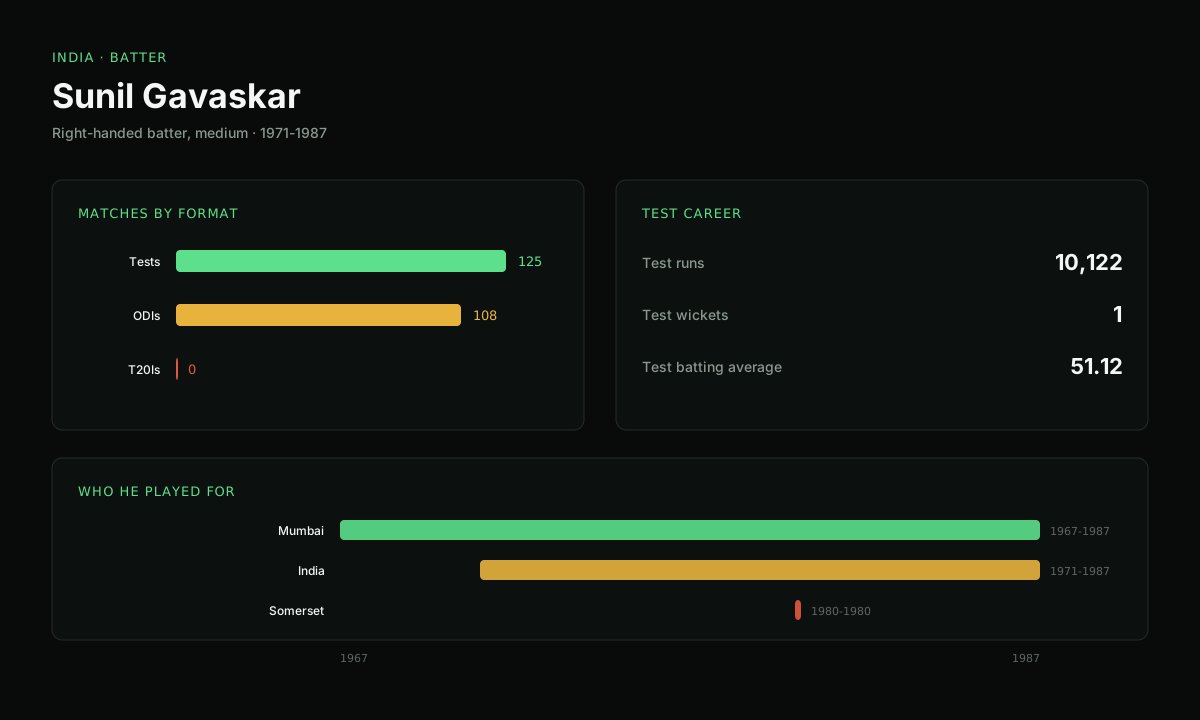
The full record is on his player page.
The debut series
West Indies, 1971. He missed the first Test through injury, played four, and scored 774 runs at 154.80 with four centuries and a double century.
It remains the highest aggregate by anybody in a debut series and it is not close. He was 21, India won the series — their first ever in the Caribbean — and the standard he set in those four matches shaped how he was regarded for the next sixteen years.
What opening meant in that era
The context is the entire story and it is easy to lose.
For most of his career, opening the batting against the best sides meant facing Holding, Roberts, Garner, Marshall, Croft, Lillee, Thomson, Imran and Willis, on uncovered or poorly covered pitches, in an era before helmets were normal, with no limit on bouncers per over and no restriction on how many fielders could be placed behind square on the leg side.
He wore a skullcap late in his career and a helmet almost never. His technique was built for it: a very tight defence, extremely close to the body, playing late, leaving anything he could.
He scored 13 of his 34 centuries against West Indies, which is more than anybody has scored against that attack.
The 36 not out
The counter-example everybody raises, and it is a fair one.
In the first World Cup match India played, in 1975, he batted through all sixty overs against England for 36 not out, in a chase of 335. India finished on 132 for 3.
It was not a tactical decision that made sense then or now, and he has never satisfactorily explained it. It also sits oddly against a one-day record that includes an unbeaten 103 in a World Cup and a strike rate that was normal for the period.
The innings is remembered because it is inexplicable rather than because it was typical.
Ten thousand
He passed 10,000 Test runs in 1987 against Pakistan at Ahmedabad, the first player to do it.
The milestone matters less for the number than for what it established: that a career could be long enough and consistent enough to reach it. Nine batters have passed 13,000 since; at the time, 10,000 was a boundary nobody had approached.
He also finished with 34 Test centuries, passing Bradman's 29, and that record stood until Tendulkar passed it in 2005.
The technique
Textbook, and it is worth stating what that means rather than using it as a compliment.
He played extremely straight, with the bat coming down from over off stump. His head was still and his weight went into the ball. He left a great deal, and his judgement of what to leave outside off stump was as good as anybody's.
What made it work against the fastest bowling was that everything happened very late and very close to the body. A batter who plays the ball under their eyes has removed most of the time available for it to deviate, which is the same principle behind the forward defensive and which he applied more rigorously than almost anybody.
The span narrows this one enormously. Very few players in the dataset debuted in 1971.
Sunil Gavaskar — First to ten thousand Test runs, and he faced the great West Indian attacks without a helmet. Full record
The record he did not want
He faced more deliveries per run than almost any batter of his standing, and the slow scoring was the standing criticism of him throughout his career.
The defence is straightforward. India's middle order for most of the 1970s was not capable of rebuilding from 20 for 3, and an opener who got out cheaply was handing the match away rather than merely losing his wicket. Batting time was the job, and he did it.
The criticism is also straightforward. Test matches are won by scoring faster than the opposition, and a side whose best batter scored at forty per hundred balls struggled to force results even when it was on top.
Both are true and they describe the same fact from opposite sides. He batted for a team that could not afford him to get out, and the team could not afford to be that cautious.
The captaincy, and the one after it
He captained India in 47 Tests across two spells, winning nine, in a period when India rarely won away and often did not try to.
The 1983 World Cup — the tournament that changed Indian cricket's finances — was won under Kapil Dev, with Gavaskar in the side. The two had an uneasy relationship and the captaincy passed between them more than once, which was normal for Indian cricket of the period and unhelpful for both.
His most significant contribution off the field came later: he was among the first prominent voices arguing that Indian players should be paid properly, and he became one of the most influential commentators and administrators in the sport.
The last innings
Bangalore, March 1987, against Pakistan, on a pitch that had broken up by the third day and on which nobody could bat.
India needed 221. Gavaskar made 96, on a surface where the next-highest score in the innings was 26, before being caught behind. India lost by 16 runs.
It is regularly named among the best innings played by an Indian batter and it was his last. A player whose career began with 774 runs in the Caribbean ended it with 96 on an unplayable pitch in a losing cause, which is a reasonable summary of what he spent sixteen years doing.
- 10,122 runs at 51.12
- 34 centuries
- 125 Tests
- A debut series of 774 runs
- Opening, against four fast bowlers, without a helmet
- 13 of them against West Indies
- In a side that won 24 of them
- At 21, in the Caribbean, before any of the rest
The technique that got copied
The stance and the trigger movement he used became the default coaching model in India for two decades, which is a legacy most players do not get.
A whole generation of Indian batters were taught to play late, close to the body, with a high elbow and a very straight bat, on the reasoning that the method had demonstrably worked against the fastest bowling anybody had faced. Some of them were suited to it and some were not.
The unintended cost is a familiar one. A coaching orthodoxy built around one player's method produces batters who defend well and score slowly, and India's scoring rates through the 1980s and early 1990s reflect that.
Where he sits in our dataset
Difficulty tier 1 on the player list, and one of the cleanest puzzles to close because of the span. India, batter, 1971 to 1987 has exactly one answer, and the debut year is the giveaway.
- The first player to 10,000 Test runs, and 34 centuries when the record was 29
- 774 runs in his debut series, the highest by anybody
- 13 centuries against the West Indian pace attack, more than anybody managed
- A 36 not out in a World Cup that nobody has ever explained
The short version
He opened the batting for sixteen years against the fastest bowling the sport has produced, mostly without a helmet, mostly for a side that lost, and finished as the first player to 10,000 runs. The conditions are the record; the number is what survived them.
For the attack he faced most often, see the rise of the West Indies, and for the equipment he mostly declined, how cricket helmets went from optional to compulsory.