The forward defensive, and why every coach teaches it first
It is the least glamorous shot in cricket, and every attacking shot on the front foot turns out to be a version of it with the hands released through the ball.
The first thing anybody is taught with a bat in their hands is a shot that scores no runs. There is a reason for that, and it is not tradition.
- Head over the ball, front foot to the pitch, bat close to the pad
- Every front-foot attacking shot is this one with the hands released
- It reduces the distance the ball can deviate before it arrives
- Soft hands mean the ball drops rather than carrying to a fielder
The five elements
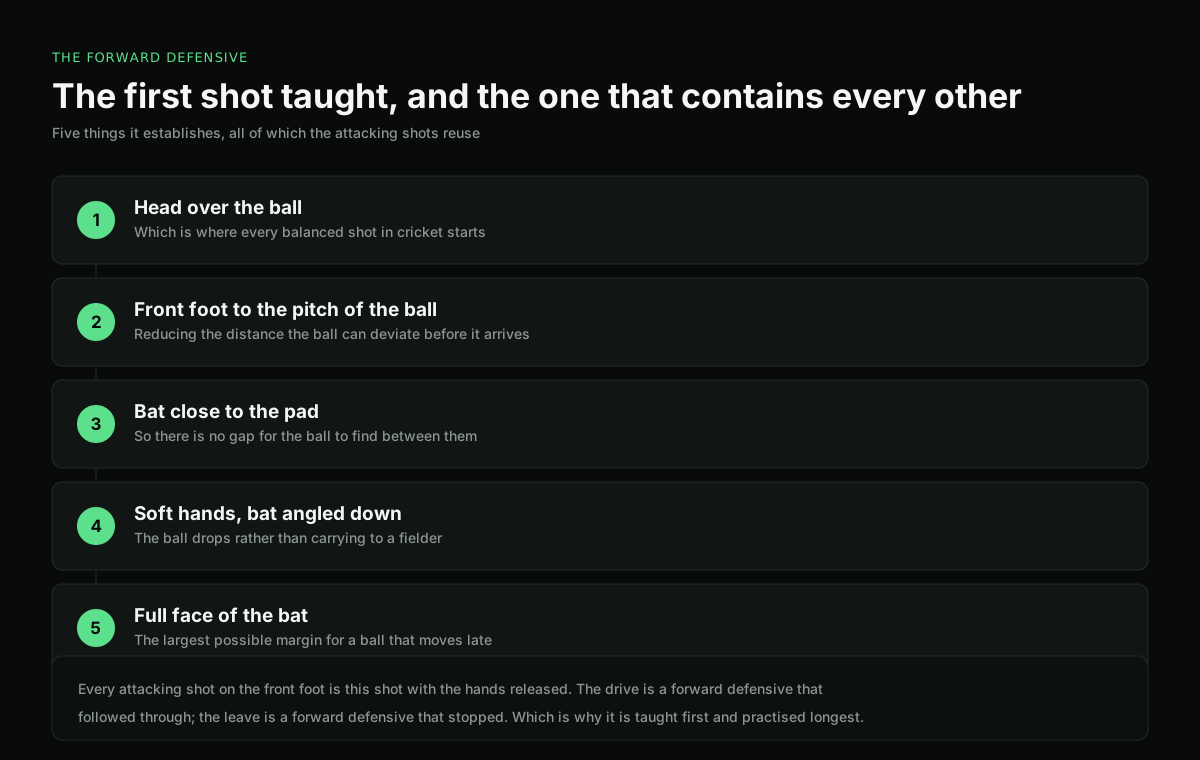
Head over the ball. The head is the heaviest part of the body and it decides where the weight goes. A head that leads towards the line of the ball takes the body with it; a head that falls away takes the balance with it.
Front foot to the pitch of the ball. Not just forward — towards where the ball is going to land. This is the element that does the actual work, and the reason is geometrical rather than about power.
Bat close to the pad. No gap between bat and pad means nothing can go through the gate, which is the most common way a defensive shot fails.
Soft hands, bat angled down. The bottom hand relaxes on impact, the ball loses its energy into the bat rather than rebounding, and it drops at the batter's feet rather than carrying to a close catcher.
Full face of the bat. The largest possible surface presented to a ball that may still move late.
Why getting to the pitch matters so much
This is the part that is worth understanding properly, because it explains most of what good batters do.
A ball that seams or spins deviates after it pitches. How far it deviates by the time it reaches the bat depends on how much distance there is between the pitch of the ball and the bat.
A batter who plays from the crease gives the ball a metre or more to deviate. A batter who gets their front foot to the pitch gives it a few centimetres. The ball is doing exactly the same thing in both cases; the batter has removed most of its opportunity to matter.
That is why "get forward" is the universal instruction against seam and spin, why a batter stuck on the crease looks so vulnerable, and why the front-foot movement is drilled before anything else.
| Where the batter plays it | Distance for the ball to deviate | Result |
|---|---|---|
| Right to the pitch | a few centimetres | almost no movement matters |
| A stride forward | maybe thirty centimetres | manageable |
| From the crease | a metre or more | a good delivery beats the bat |
| Back foot, late | the full distance, but with time to see it | works against short bowling |
Every other front-foot shot is this one
The drive is a forward defensive in which the hands were released through the ball instead of stopping. Same head position, same front foot, same full face — the only difference is that the bat kept going.
The leave is a forward defensive that decided not to complete. The batter has gone through the same movement and withdrawn the bat.
The front-foot push into the covers for a single is a forward defensive with a slightly firmer bottom hand.
That is why coaches spend so long on it. Getting the base right means four shots work rather than one, and getting the base wrong means all four fail in the same way.
What it protects against
Three specific dismissals, and a good forward defensive is the answer to all of them.
Bowled through the gate. A gap between bat and pad, which the shot closes by definition.
Caught at slip off the outside edge. Soft hands mean an edge drops short of the cordon rather than carrying, which is why the same edge is caught off one batter and not another.
Leg before wicket. Getting the front foot to the pitch means the impact is far enough down the pitch that a projection has a long way to travel, and the further the impact from the stumps the more likely the ball is shown to be missing.
When it is the wrong shot
It is not universal, and treating it as universal is its own problem.
Against genuine pace, short of a length, going forward is dangerous. The ball arrives before the movement completes and the batter is on the front foot to something climbing at their gloves. That is a back-foot situation.
In a T20, the forward defensive is a shot with almost no place. A batter defending in the fourteenth over is discarding a delivery, and discarding deliveries is how T20 innings fail.
Against a spinner turning it sharply, playing forward without getting all the way to the pitch is worse than staying back, because the batter has half a metre of turn to deal with and no time to see it.
The judgement about when to play forward and when to go back is what separates professional batters from good club ones, and it is made in about a fifth of a second.
Why does getting the front foot right to the pitch of the ball reduce the effect of seam movement?
Deviation happens after the ball pitches, and it accumulates over distance. Playing close to the pitch of the ball removes most of that distance, so the same amount of movement produces a much smaller effect at the bat.
- A shot that scores nothing
- Defensive and passive
- The boring part of batting
- Stopping the ball
- Removing the ball's opportunity to deviate
- Forcing the bowler to change length
- The base every attacking shot is built on
- Killing the energy so it does not carry to a fielder
The trigger movement
Before any of the five elements there is a movement most batters make as the bowler loads up, and it is what makes the rest possible.
A trigger is a small preparatory step — usually back and across towards off stump, sometimes a press forward — taken in the moment before release. Its purpose is to get the body moving so that the batter is not starting from stationary when they have to commit.
Starting from stationary is slow. A batter who has already begun moving can go forward or back from that position far more quickly than one who has to overcome inertia first, and against genuine pace that difference is most of the available time.
Different batters trigger differently and some barely trigger at all, but every professional does something. Watching for it is one of the more interesting things to do during a slow session, and it is invisible unless you are looking for it.
What it does to the bowler
A batter who defends well is not merely surviving. They are applying pressure of their own.
A bowler whose good-length ball is being met in the middle of the bat, right at the pitch, has nothing working. They will pitch it up further to try to induce a drive, which is when the scoring shots become available, or drop shorter, which brings the back-foot shots into play.
That is the mechanism behind the whole idea of batting time in a Test. The defensive shot is not passive: it is the instrument that forces a bowler off their length, and the runs come from the delivery that follows.
- Head over the ball, front foot to the pitch, no gap between bat and pad
- Getting to the pitch removes most of the ball's chance to deviate
- The drive, the leave and the push are all this shot with one thing changed
- It is the wrong shot against genuine pace short of a length, and in a T20
The short version
The forward defensive is taught first because it is not one shot. It is the posture, the footwork and the hands that four other shots are built from, and a batter who has it has the base for everything else.
For the shots that use the same base to score, see the sweep, the reverse sweep and the switch hit, and for what the bowler is trying to do about it, the yorker and why it is hard to bowl.