Rahul Dravid by the numbers, and the balls nobody counted
13,288 Test runs at 52.31, and more deliveries faced than any batter in the history of Test cricket. The second number explains the first.
Rahul Dravid faced more deliveries in Test cricket than any batter in the sport's history. That statistic is a better description of the career than the run total, and it is the one almost nobody quotes.
- 13,288 Test runs at 52.31, from 164 Tests
- More balls faced in Test cricket than anybody who has played it
- 210 catches, the most by a non-wicketkeeper
- He kept wicket in one-day cricket for years so India could play an extra batter
The record
| Format | Matches | Runs | Average | Span |
|---|---|---|---|---|
| Tests | 164 | 13,288 | 52.31 | 1996-2012 |
| ODIs | 344 | 10,889 | 39.16 | 1996-2011 |
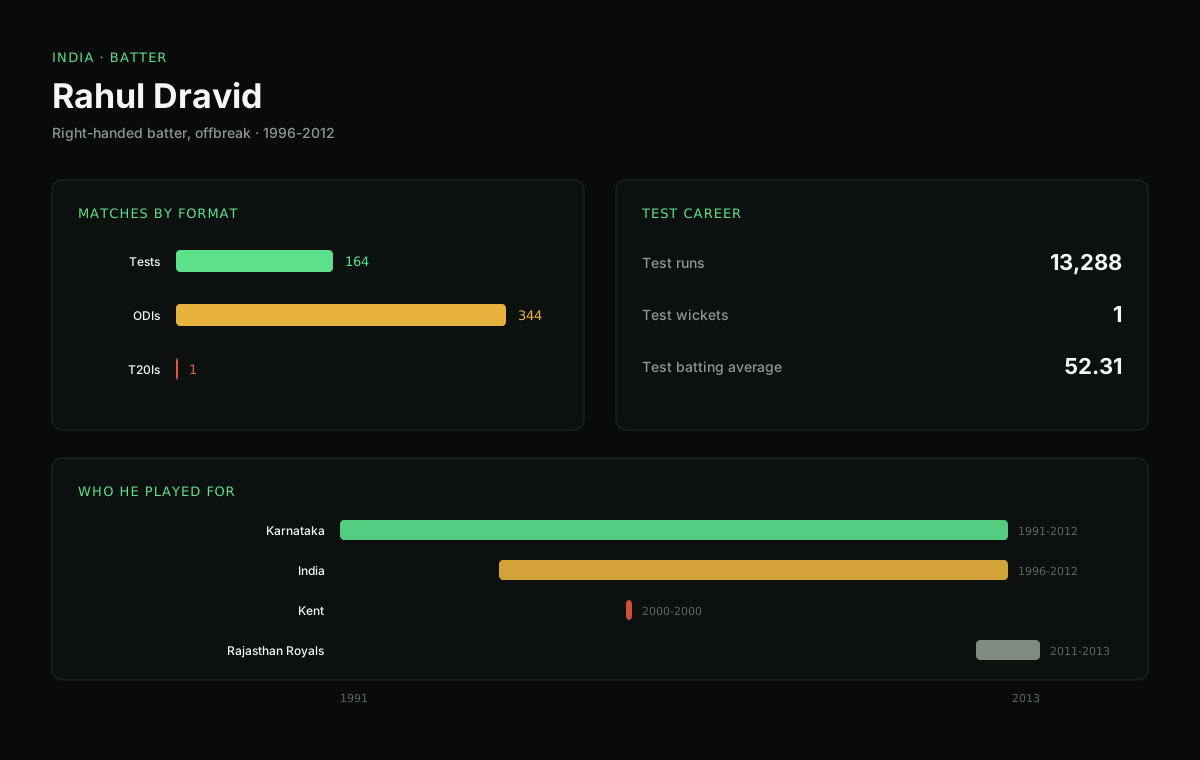
The full record is on his player page.
The balls faced
Over 31,000 deliveries in Test cricket. Nobody else has faced that many.
The number matters because of what facing a delivery costs. Every ball is a chance to be dismissed, a decision to be made, and a small amount of concentration spent. A batter who faces 31,000 of them has made 31,000 individual judgements at international level without the option of a bad one.
It also explains the run total. He did not score especially fast — a career strike rate in the low forties — so 13,288 runs required an enormous quantity of time at the crease. That time is the achievement rather than a side effect of it.
Number three
He batted at three for most of his career, which is the position that gets the worst of every situation.
If an opener falls in the first over, the number three faces the new ball with the seam standing proud and the field at its most attacking, with nothing established. If the openers put on 150, the number three arrives against a soft ball and a tired attack and is expected to convert.
Dravid did the first far more often than the second, in a side whose openers were inconsistent for large parts of his career, and the average of 52.31 was built mostly in the first situation.
Away from home
The record that separates him from most of his contemporaries is the overseas one.
He averaged more away from home than in India, which almost no subcontinental batter of his era did, and he scored centuries in Australia, England, South Africa, New Zealand and the West Indies. The technique — very close to the body, playing extremely late, leaving a great deal — was built for conditions where the ball moves, and it moved less in India than anywhere else.
Adelaide in 2003 is the innings usually cited: 233 in the first innings and 72 not out in the second, in a match India won, in a series they drew, in Australia, against an attack including McGrath, Gillespie and Lee.
The keeping
For several years in one-day cricket he kept wicket, badly by specialist standards and well enough to be worth it.
The reasoning was squad construction: a keeper who batted in the top six let India play an extra batter or an extra bowler. Somebody had to volunteer for a job that would damage their batting and their reputation, and he did.
It is the clearest available illustration of what his team-mates and coaches consistently describe: a player who did whatever the side needed at some cost to himself, repeatedly, without making it a subject.
The catches
210 catches in Test cricket, which is the most by anybody who was not a wicketkeeper.
Slip fielding is a specialist skill and it is unglamorous. It requires standing still for six hours, concentrating on every delivery, and reacting in under half a second a handful of times a day. The consequence of a lapse is a dropped catch that everybody sees.
The same qualities that produced 31,000 balls faced produced 210 catches, which is not a coincidence.
Country and role narrow it to about six. The Tests column and the span separate them.
Rahul Dravid — Faced more balls than anyone in Test history. Took more catches than any outfielder before him. Full record
Eden Gardens
The 180 at Eden Gardens in 2001, in a partnership of 376 with VVS Laxman, is the innings most people who watched Indian cricket in that era name first.
It is worth being precise about what it was. Laxman made 281 and got the headlines, correctly. Dravid batted at number six that innings — having been moved down so Laxman could bat three — and stayed with him for the entire fourth day.
Somebody had to not get out at the other end for a day and a half. That was the job, he did it, and India won a Test after following on for only the third time in history.
The match is covered in full in Eden Gardens 2001.
The nickname, and what it obscures
He was called The Wall, which is accurate about the defence and misleading about everything else.
A batter who scores 13,288 Test runs is not merely blocking. He had a full range of strokes, was among the best players of spin of his generation, and scored at a rate that was ordinary rather than slow. The reputation for obduracy came from what he did in the situations that got remembered — the rearguards, the fourth innings, the partnerships that saved matches — because those are the innings a side remembers when it survives.
It also obscured the one-day record. 10,889 runs at 39 in a format he was repeatedly said to be unsuited for, plus 344 matches, plus several years keeping wicket, is not the record of a player who could not adapt.
The label stuck because it was useful, and because a batter who is famous for not getting out is easier to describe than one who did four different jobs.
What he did afterwards
He coached India's under-19 and A sides for several years, deliberately declining higher-profile roles, and then took the senior job.
The under-19 work is the part that has had the most effect: a generation of Indian players came through a system he ran, and the consistent report from them is that the emphasis was on process rather than results and on preparing players who could handle failure.
That is an unglamorous coaching philosophy which matches the batting exactly.
- 13,288 Test runs
- An average of 52.31
- 210 catches
- A one-day keeping record
- 31,000 deliveries of individual decisions
- Built mostly from 20 for 2 rather than 150 for 1
- Six hours of standing still, every day, for sixteen years
- A job nobody wanted, taken for squad balance
The one-day reinvention
The most under-appreciated part of the record is that he was dropped from India's one-day side, retooled his game, and came back as an important part of it.
The criticism in the late nineties was straightforward: too slow, too orthodox, not built for the format. His answer was to develop a scoring game based on placement and running rather than power, take the keeping gloves to justify a place, and bat anywhere from three to seven as required.
He finished with 10,889 one-day runs and a World Cup final appearance in 2003. In 1999 he scored 461 runs in the World Cup, the most by anybody in that tournament, including a 145 in a partnership of 318 with Ganguly.
Players who are told they do not fit a format usually do not end up leading its run charts.
Where he sits in our dataset
Difficulty tier 1 on the player list, and one of the harder Indian batters of his era to separate from his contemporaries on the early columns.
Country, role and a 1996 to 2012 span leave Ganguly, Laxman, Tendulkar and Dravid in play. The Tests column is what finishes it: 164 is a number only one of them has.
- More deliveries faced than any batter in Test history
- He averaged more away from home than in India, which was rare for his era
- 210 catches, the most by a non-keeper, from the same quality that produced the runs
- He kept wicket in ODIs for years to solve somebody else's selection problem
The short version
The run total is a consequence of the balls faced, and the balls faced are the career. He occupied an end for sixteen years, in the position that gets the worst of every situation, and did it better away from home than at it.
For the match his most famous innings came in, see Eden Gardens 2001, and for the middle order he batted in, Sourav Ganguly by the numbers.