Rohit Sharma by the numbers, and three one-day double centuries
Nobody else has scored one double century in a one-day international and been able to do it twice. He has three, and a Test career that started properly at 32.
Rohit Sharma has scored three double centuries in one-day international cricket. The rest of the sport has produced a handful in total. That single record is the clearest statement about what he does with the format.
- Three ODI double centuries, including 264, which is the highest score in the format
- 4,301 Test runs at 40.57, in a career that only became a Test career at 32
- Five hundreds in a single World Cup, in 2019, which is a record
- He captained India to the 2024 T20 World Cup
The record
| Format | Matches | Runs | Average | Span |
|---|---|---|---|---|
| Tests | 67 | 4,301 | 40.57 | 2013-2025 |
| ODIs | 273 | 11,168 | 48.76 | 2007- |
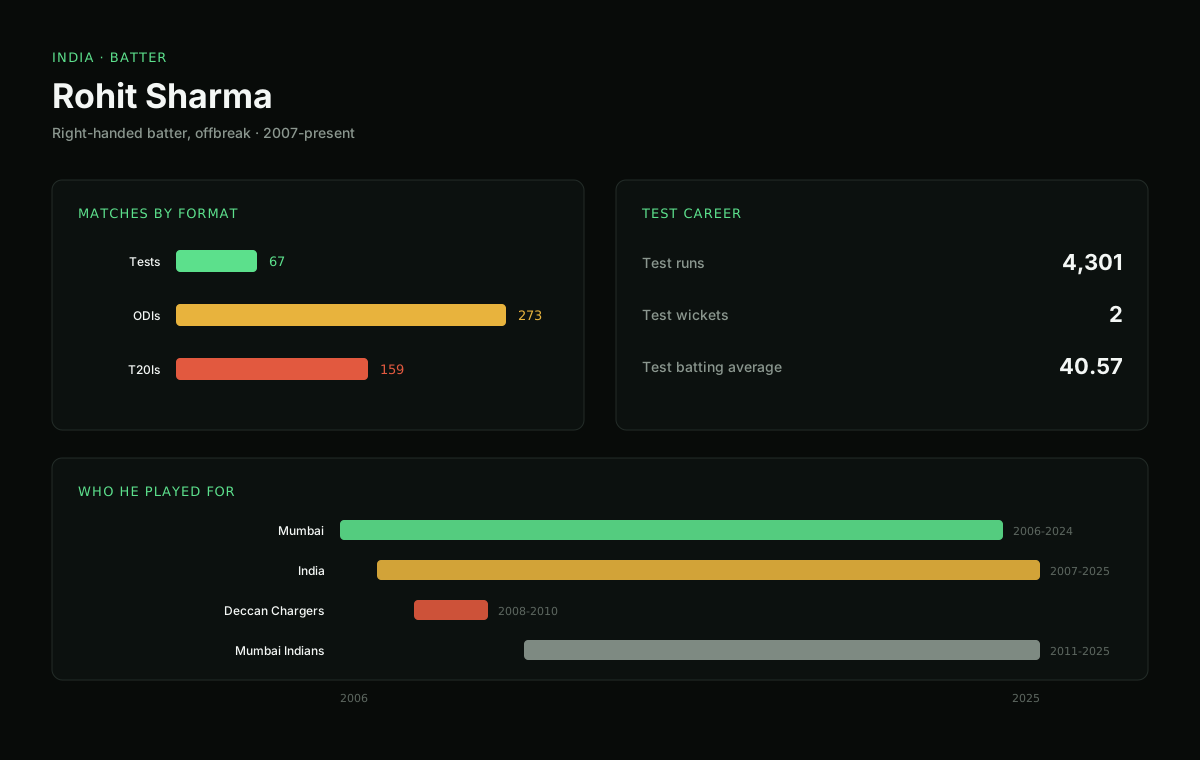
The full record is on his player page.
The 264
Kolkata, November 2014, against Sri Lanka. He scored 264 from 173 balls, with 33 fours and 9 sixes.
It is the highest individual score in the history of one-day international cricket and the margin over second place is substantial. He also has 209 against Australia in 2013 and 208 not out against Sri Lanka in 2017.
Three double centuries in a format where reaching 150 is a notable innings. Nobody else has more than one.
Why he can do it and others cannot
The mechanism is worth stating because it explains the whole career.
He starts extremely slowly. A Rohit Sharma one-day innings frequently reads 20 from 30 balls at the ten-over mark, which is slow enough that commentators start discussing it. Then the acceleration is not gradual — it is a step change, and the last 100 of a double century typically comes in about forty balls.
That works because he hits the ball later and with less effort than almost anybody. The pull shot off the front foot and the lofted drive over extra cover both come from a very still base, and neither requires him to be fully set in the way most batters do.
The cost is that when it does not come off, he is out for 15 from 25 and it looks careless. The double centuries are the same method succeeding.
The Test career that started at 32
He played Test cricket sporadically from 2013 in the middle order, averaging in the high thirties, and was in and out of the side for six years.
In 2019 India moved him to open the batting in Tests. He scored 176 and 127 in his first match in the position, 212 in the next, and averaged over 60 as a Test opener for the following three years.
That is a substantial finding: a batter regarded as a limited-overs specialist and a middle-order underachiever became a very good Test opener at 32, in the position generally considered the hardest in the format.
His overall Test average of 40.57 includes six years of middle-order failure and the opening years are much higher.
The five hundreds came against South Africa, Pakistan, England, Bangladesh and Sri Lanka, in a single tournament, opening the batting. Nobody had scored more than three in a World Cup before, and the record has stood since.
The 2019 World Cup
Five centuries in a single World Cup, which nobody had done, and 648 runs in the tournament.
India lost the semi-final to New Zealand having been 5 for 3 in the chase, which is a result that had nothing to do with him and is the reason the tournament is remembered in India the way it is.
The captaincy
He captained India to the 2024 T20 World Cup, which was India's first global title in eleven years, and retired from the format immediately afterwards.
He also captained in the 2023 World Cup final, which India lost to Australia at Ahmedabad after winning ten consecutive matches, and in the 2025 Champions Trophy, which India won.
The captaincy style is consistently described in the same terms: relaxed in public, attacking in the field, and willing to make selection decisions that were unpopular. Under him India batted with a good deal more intent in one-day cricket than under his predecessor, which is the clearest tactical signature.
Country and role narrow it. An open final year and a T20I column above 150 close it quickly.
Rohit Sharma — The only batter with three double centuries in one-day internationals. Full record
The T20 record
159 T20 internationals, which was the record for a long period, and five centuries in the format.
He is one of a very small number of players to have scored international centuries in all three formats and to have played more than 150 matches in one of them. The volume is a function of when he played: T20 internationals were scheduled far more heavily from 2015 onwards.
The IPL record
Five titles as captain of Mumbai Indians, which is the most by any captain in the competition.
That is a substantial record on its own and it is the reason he was considered for the India captaincy at all. Franchise captaincy is not international captaincy, and a side that wins five titles in a competition designed to prevent dynasties has been run well over a long period.
The style transferred: relaxed in public, attacking with the ball, and a willingness to back players through poor runs of form that most captains would drop them for.
What the averages leave out
A Test average of 40.57 places him well below the batters he came up with, and it is the number that will be quoted.
The honest version has two halves. As a middle-order Test batter between 2013 and 2019 he averaged in the high thirties and was frequently dropped. As a Test opener from 2019 he averaged substantially more and scored heavily in India, Australia and England.
A career average that combines a failed role and a successful one describes neither, which is a recurring problem with career figures and is unusually stark here.
- 40.57 in Tests
- A limited-overs specialist
- A slow starter
- Below his contemporaries
- High thirties in the middle order, much higher as an opener
- Three ODI double centuries and a Test opening record
- Which is the mechanism, not a flaw
- In the role he was tried in for six years
The six-hitting
He has hit more sixes in international cricket than almost anybody, and the shot he hits most of them with is the pull.
That is unusual. Most prolific six-hitters clear the ground straight or over midwicket off the front foot; his signature is a pull off genuine pace, played very late, that goes flat over deep square leg. It is a low-risk shot for him and a high-risk shot for almost everybody else, which is the clearest technical thing that separates him.
It also explains the slow starts. The pull requires the batter to have read the bowler's pace, and reading it takes twenty balls.
Where he sits in our dataset
Difficulty tier 1 on the player list, and one of the small number of players in it whose final year is still open.
The T20I column is what identifies him. A player with more than 150 T20 internationals and a substantial Test record is a very short list.
- Three one-day double centuries, including 264, the highest score in the format
- A Test career that only worked once he opened, at 32
- Five centuries in the 2019 World Cup, a record
- The 2024 T20 World Cup as captain, India's first global title in eleven years
The short version
He holds the highest score in one-day history and two more double centuries nobody else has managed, and he became a good Test opener at an age when most batters are finishing. The career average will always understate the second part.
For the format his record belongs to, see one-day international cricket explained, and for what an opener is actually for, what an opening batter is actually for.