Sachin Tendulkar by the numbers, and what they cannot show
200 Tests, 15,921 runs at 53.78, and a hundred international centuries. The records are the least interesting thing about a career that lasted twenty-four years.
Sachin Tendulkar played 200 Test matches, which is more than anybody else, and scored 15,921 runs in them, which is also more than anybody else. Those two sentences are the least informative things you can say about the career.
- 200 Tests, 15,921 runs at 53.78, across twenty-four years
- 463 one-day internationals, and the first double century in the format
- A hundred international centuries, a figure nobody else is near
- Debuted at sixteen against an attack that included Imran, Wasim and Waqar
The record
| Format | Matches | Runs | Average | Span |
|---|---|---|---|---|
| Tests | 200 | 15,921 | 53.78 | 1989-2013 |
| ODIs | 463 | 18,426 | 44.83 | 1989-2012 |
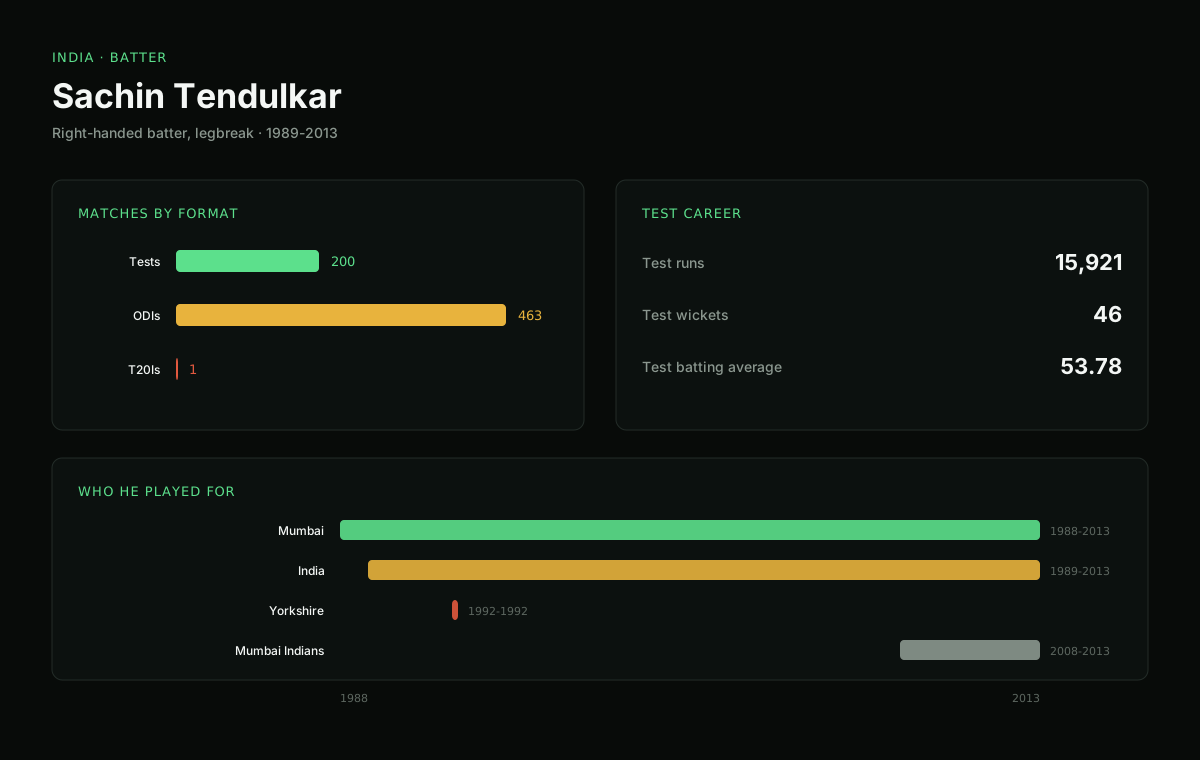
The full record is on his player page, which also shows which of our puzzles he has appeared in.
The debut, which explains the rest
He was sixteen years old on Test debut, in Karachi in November 1989, against Pakistan.
The bowling attack was Imran Khan, Wasim Akram, Waqar Younis and Abdul Qadir. Waqar was also making his debut. Tendulkar made 15, was hit on the nose by a bouncer in a later match of the series, declined to leave the field, and made 57 not out in the fourth Test at Faisalabad.
That is not a colour anecdote. A sixteen-year-old surviving that attack, in Pakistan, in 1989, established a set of expectations in India that he then lived under for twenty-four years without a break.
What twenty-four years actually requires
The longevity is the achievement people find easiest to state and hardest to appreciate.
To play 200 Tests you must be selected for roughly fifteen years of continuous international cricket, survive the injuries that end most careers around thirty, and remain good enough that dropping you is never seriously discussed. Tendulkar did that while carrying a tennis elbow injury that cost him most of 2004 and 2005 and required surgery.
He also did it across four distinct eras of the sport: the uncovered-pitch tail end of the eighties, the nineties when India rarely won away, the 2000s when they started to, and the T20 era he barely played in.
The batters closest to him on total runs played 164 and 168 Tests. That gap of thirty-two matches is around three years of Test cricket, and it is the single largest reason the totals list looks the way it does.
What the average does and does not say
53.78 is an excellent Test average and it is not the highest of his generation. Kallis averaged 55.37 and Sangakkara 57.40.
The comparison people actually want is against pressure rather than against figures, and no statistic captures it. Tendulkar batted for a country where his dismissal was a national event, in an era when Indian cricket had no other reliable batter for large stretches of the nineties, and in a format where a bad year is public for twelve months.
What the average does tell you is that he did not decline much. His figures in the last four years of his career are lower than his peak but not embarrassing, which for a batter in his late thirties who had been playing since sixteen is unusual.
The hundred hundreds
One hundred international centuries — 51 in Tests and 49 in one-day cricket.
The number is remarkable partly because it required both formats. Nobody scores a hundred Test centuries; nobody scores a hundred ODI centuries. It required a career long enough and consistent enough in both, which is why the record is not close to being approached.
The last one took a year. He reached 99 in March 2011 during the World Cup and did not reach 100 until March 2012, in Dhaka, in a match India lost. The year in between was one of the more uncomfortable periods in Indian sport, and it is the clearest illustration of what carrying that expectation was actually like.
The one-day career people forget
The Test record gets the attention and the one-day career was, in some respects, the more influential one.
He opened the batting in ODIs from 1994, which was not the plan and was tried as an experiment when an opener was injured. It reshaped how the format was played: before it, openers survived the first fifteen overs; after it, they used them.
He scored the first double century in one-day international history in 2010, at 37 years old, against South Africa. That record has since been beaten several times, which says something about how the format changed and nothing about the innings.
18,426 ODI runs at 44.83, with 49 hundreds, would be a career for anybody. It is the half of his record that gets mentioned second.
This is the row the Cricketer board would show you. Country and role narrow it quickly; the Tests column does the rest.
Sachin Tendulkar — The only cricketer with a hundred international centuries. Debuted at sixteen and finished twenty-four years later in his two hundredth Test. Full record
Where the numbers stop
Three things the record cannot show.
He batted at three or four for most of it, in a side whose top order was frequently unreliable, which means a disproportionate share of his innings began with the score under 30.
He was the wicket every side planned for. Attacks bowled differently to him. Fields were set for him specifically. That is true of every great batter and it was true of him for longer than anybody.
He was never captain for long. Two spells, neither successful, and he stepped away from it. The batting record was built without the captaincy that usually comes with that seniority, which is unusual and was a deliberate choice.
- 15,921 Test runs
- 200 Tests
- An average of 53.78
- A hundred hundreds
- The number of innings that began at 20 for 2
- Twenty-four years of being the wicket to get
- An era with no other reliable Indian batter
- The year it took to score the last one
The comparison that will not settle
Every argument about him eventually becomes an argument about somebody else, and the honest position is that the comparison is not decidable.
Against Lara, the case is volume and consistency against peak. Lara scored 375 and then 400 not out, and made 153 not out at Bridgetown in a chase of 308 that remains the single most admired innings of the era. Tendulkar has more runs, more matches, and no innings anybody agrees is the best of the period.
Against Kallis and Ponting, it is a question of role. Kallis averaged more and also bowled; Ponting captained a side that won everything and averaged nearly as much. Both played in stronger teams, which cuts both ways: less pressure, and less opportunity to be the difference.
Against Bradman, there is nothing to say. 99.94 is not a number the modern game produces and comparing eras that far apart is a category error.
What the argument reveals is that "the best" is asking for a single ranking of things that are not on one scale. Tendulkar has the strongest case on longevity and volume, and that is a real thing to be best at.
Where he sits in our dataset
He is a difficulty tier 1 in the WicketYaari player list: the most recognisable cricketer in the dataset, and one of the few whose alias list has to include several nicknames.
He is also one of the easiest puzzle answers to close out, and for an unusual reason: the Tests column. Two hundred is a number nobody else has, so a player who gets country, role and era correct and then sees 200 has finished.
- 200 Tests and 15,921 runs, both records, both products of longevity as much as quality
- Debuted at sixteen against Imran, Wasim, Waqar and Qadir
- A hundred international centuries, requiring both formats to be exceptional
- Opened in ODIs from 1994 and changed how the format's first fifteen overs were played
The short version
The totals are records of duration as much as of quality, and both parts are the point: he was good enough to be picked at sixteen and good enough to still be worth picking at forty. Nobody else has managed the second half of that sentence.
For the middle order he batted in, see Sourav Ganguly by the numbers, and for what a batting average is actually measuring, batting average is not runs per innings.