Shaun Pollock by the numbers, and an economy rate of 2.39
421 Test wickets at 23.11 with an economy rate of 2.39, plus 3,781 runs, from an all-rounder who almost never bowled a bad ball in seventeen years.
Shaun Pollock took 421 Test wickets and conceded 2.39 runs an over doing it, which is the lowest economy rate of any bowler with 400 wickets in the modern era. He also scored 3,781 Test runs, which puts him in the all-rounder conversation.
- 421 Test wickets at 23.11, with an economy rate of 2.39
- 3,781 Test runs at 32.31, batting at seven or eight
- 393 one-day wickets at an economy under 3.7
- He bowled fast-medium and hit the same spot for seventeen years
The record
| Format | Matches | Wickets | Average | Runs |
|---|---|---|---|---|
| Tests | 108 | 421 | 23.11 | 3,781 |
| ODIs | 303 | 393 | 24.50 | 3,519 |
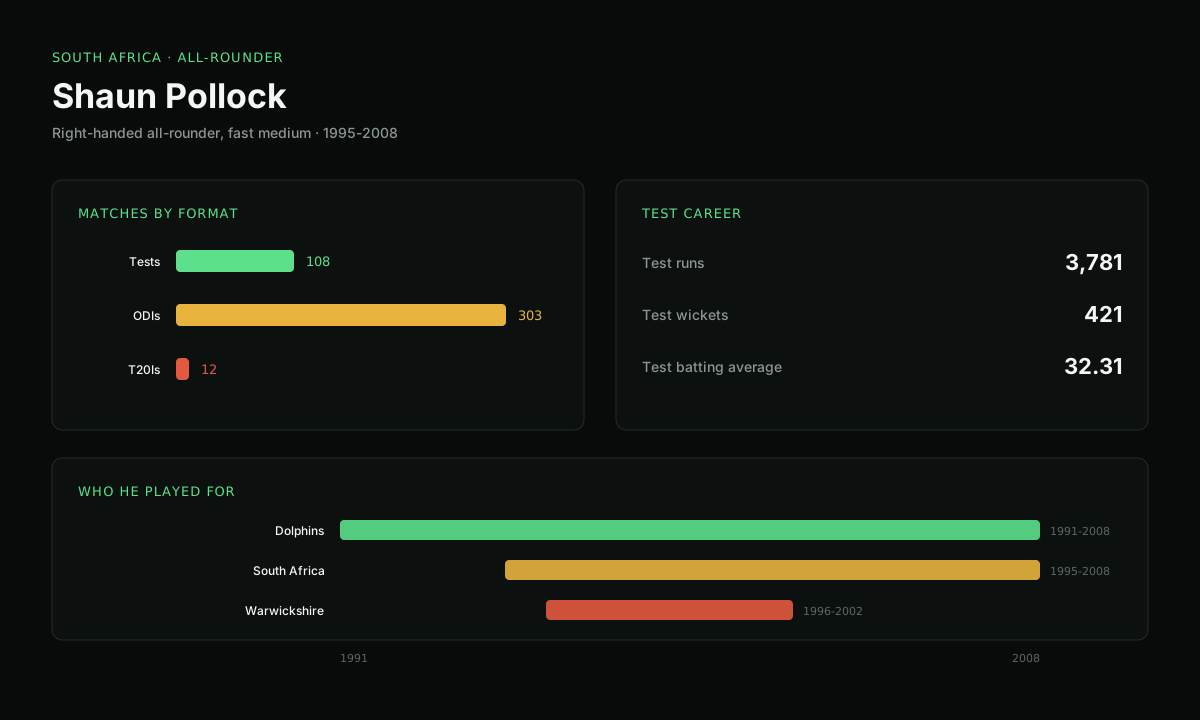
The full record is on his player page.
The economy rate
2.39 runs an over across 108 Tests. Nobody with 400 or more wickets in the last fifty years has conceded less except Curtly Ambrose.
The mechanism was accuracy of a kind that is difficult to describe without sounding dull. He bowled fast-medium, around 135 kilometres an hour, on a length just short of driveable, on or immediately outside off stump, with movement off the seam in either direction, and he did it every delivery for seventeen years.
A batter facing him had nothing to leave and nothing to hit. That is the whole of it, and it is the hardest thing in bowling to sustain.
The comparison with his own attack
South Africa in that period had Allan Donald, then Makhaya Ntini, then Dale Steyn and Morne Morkel. Pollock was the constant.
He operated as the control bowler while somebody else attacked — which is the same role that made Glenn McGrath so valuable — except that Pollock also took 421 wickets doing it, and batted at seven.
The comparison people make is with McGrath and it holds up. McGrath averaged 21.64 and Pollock 23.11; McGrath conceded 2.49 an over and Pollock 2.39; and Pollock scored 3,000 more runs.
The batting
3,781 runs at 32.31, with two centuries, batting at seven or eight.
On the batting-average-above-bowling-average test he clears it by 9.2 runs, which is a comfortable pass and puts him behind Kallis and Imran among the all-rounders of his general era but ahead of Kapil Dev and Hadlee.
The batting was orthodox and straightforward: he played straight, drove well, and was a genuinely difficult wicket for a number seven. South Africa's totals frequently depended on a seventh-wicket partnership involving him.
He also kept the job through a period in which South African cricket was restructuring its selection around transformation targets, which was politically contested and made the captain's position harder than a results table suggests.
The captaincy
He captained South Africa in 26 Tests and 97 one-day internationals, taking over after the Hansie Cronje match-fixing scandal.
That is the context that matters and it is easy to skip. Cronje was banned for life in 2000 for accepting money from bookmakers, and South African cricket was left with a captaincy vacancy, a credibility problem and a dressing room that had to work out what had happened. Pollock took the job at 26.
He led the side to the 2003 World Cup, which South Africa hosted and went out of in the group stage, on a Duckworth-Lewis miscalculation in the final match — the team misread the par score and drew a game they needed to win. He was replaced shortly afterwards.
The 2003 World Cup
The specific incident is worth stating because it is one of the more consequential administrative errors in the sport.
South Africa needed to beat Sri Lanka in the last group match to qualify. Rain was coming. The team had a Duckworth-Lewis sheet in the dressing room and Mark Boucher, at the crease, understood the target on it to be the score required to win.
It was the score required to tie. He blocked the last ball of the over, rain ended the match, and South Africa were eliminated from a World Cup they were hosting by one run.
Pollock was captain and lost the job.
What the wickets were made of
Two deliveries, bowled at the same pace from the same place.
The stock ball held its line or moved a fraction away, on a length just short of driveable outside off stump. The wicket-taking ball was the one that came back off the seam, and because the two were indistinguishable in the air, a batter playing for one was beaten by the other.
That is the same method McGrath used and it requires the same thing: the willingness to bowl the identical delivery for thirty overs and wait. Pollock, being a bowler who also batted and fielded at slip, did it while carrying a bigger workload than most.
The family
His father Peter Pollock played Test cricket for South Africa and his uncle Graeme Pollock is generally regarded as the best batter the country has produced.
Graeme Pollock's Test average of 60.97 is the second-highest of anybody with more than twenty Tests, behind Bradman, and his career was ended at 26 by South Africa's isolation from international cricket.
That is the family context: a father who played, an uncle whose career was taken away by politics, and a nephew who played 108 Tests in the era after readmission.
Country and role narrow it. The wickets and runs columns together identify exactly one person.
Shaun Pollock — Four hundred Test wickets at an economy rate under 2.4, which nobody else has managed. Full record
- Donald, Steyn and the strike bowlers
- The 2003 World Cup exit
- An all-rounder who bowled
- Accuracy, described as dull
- 421 wickets at 23.11 from the control bowler
- 97 one-day internationals as captain after a scandal
- 3,781 runs, clearing the all-rounder test by nine runs
- An economy rate almost nobody has matched
The one-day record
393 wickets from 303 matches at 24.50, with an economy rate under 3.7, which was outstanding for the era.
He opened the bowling and frequently bowled at the death, which is two jobs, and he did both for a decade in the strongest one-day side South Africa has had. That team was consistently ranked first or second in the world and never reached a World Cup final, which is the sentence that attaches to every South African cricketer of the period.
He also batted in the top seven in one-day cricket for several years and scored over 3,500 runs, which makes his limited-overs record arguably the more complete of the two.
The action, and why it lasted
He bowled from a short, economical run-up with a high, upright action and almost no lateral movement in the delivery stride.
The consequence was a career of thirteen years with very few significant injuries, which for a bowler who also batted at seven and fielded every ball is unusual. It is the same pattern as Courtney Walsh: the bowlers who play longest are almost always the ones whose actions ask least of their bodies.
The trade-off is pace. He was fast-medium rather than fast, and his method depended entirely on accuracy and seam movement. It worked because he never lost the accuracy.
Where he sits in our dataset
Difficulty tier 1 on the player list. South Africa, all-rounder, 1995 to 2008 is a narrow field, and the wickets column separates him from Kallis.
- 421 Test wickets at 23.11, with an economy rate of 2.39
- 3,781 Test runs at 32.31, clearing the all-rounder test comfortably
- He took the captaincy at 26, immediately after the Cronje scandal
- 393 one-day wickets, at an economy rate under 3.7
The short version
He bowled the same delivery for seventeen years, conceded less than any bowler of his standing, took 421 wickets and scored nearly 4,000 runs. Almost none of it looked dramatic and all of it worked.
For the bowler he is most often compared with, see Glenn McGrath by the numbers, and for the definitions his record sits inside, what counts as an all-rounder.