Jacques Kallis by the numbers, and the case for the best all-rounder
13,289 Test runs at 55.37 and 292 Test wickets. Nobody else has been a top-order batter of that standard and a front-line seamer at the same time.
Jacques Kallis scored more Test runs than all but two batters and took nearly three hundred Test wickets. Those two records belong to different careers in almost everybody else, and he did both at once for eighteen years.
- 13,289 Test runs at 55.37, and 292 Test wickets at 32.65
- The batting average is higher than Tendulkar's, Lara's, Ponting's or Dravid's
- 200 Test catches, almost all at slip
- The strongest statistical case for the greatest all-rounder ever
The record
| Format | Matches | Runs | Average | Wickets |
|---|---|---|---|---|
| Tests | 166 | 13,289 | 55.37 | 292 |
| ODIs | 328 | 11,579 | 44.36 | 273 |
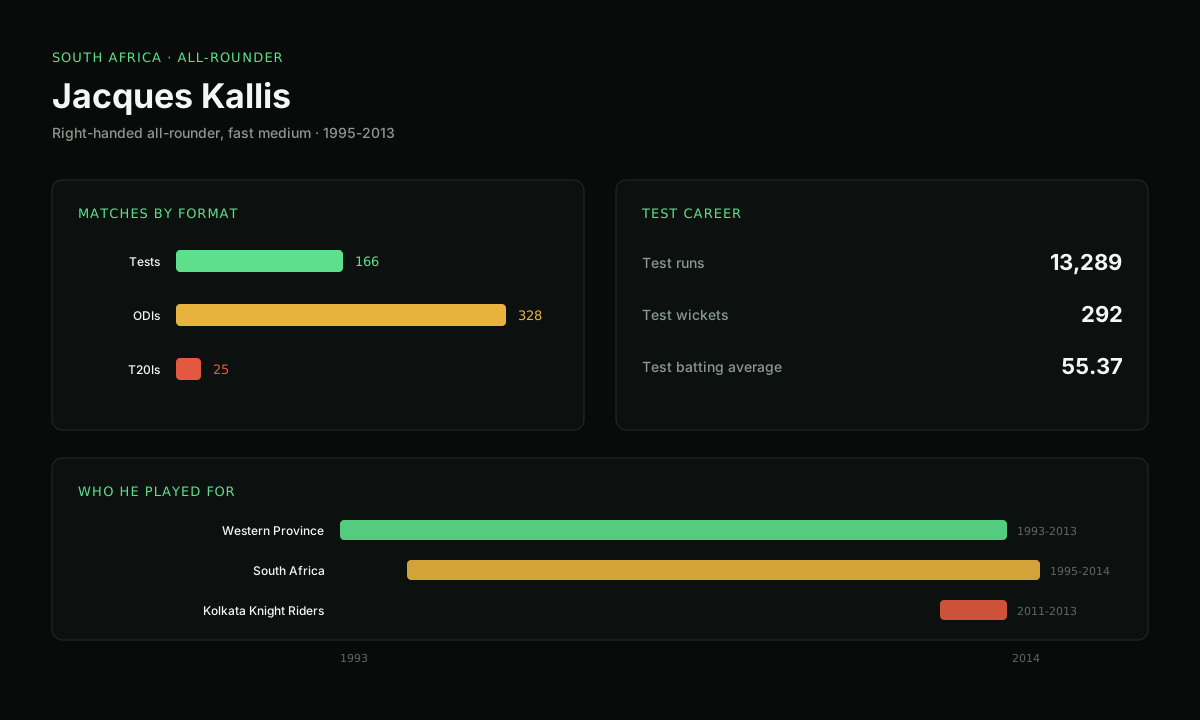
The full record is on his player page.
The average
55.37 is the second-highest of any batter with 10,000 Test runs, behind Kumar Sangakkara's 57.40.
It is higher than Tendulkar's 53.78, Ponting's 51.85, Lara's 52.88 and Dravid's 52.31. Sangakkara is the one modern batter above him, and he did not bowl.
That is the fact the argument starts from. Kallis's batting alone puts him in the top handful of Test batters ever, before any wicket is counted.
And then 292 wickets
He bowled genuine fast-medium — high 130s in his prime, with the ability to move the ball both ways — and he was South Africa's third or fourth seamer for most of his career.
292 Test wickets at 32.65 is the record of a useful front-line bowler rather than an occasional one. To put it in scale, it is more Test wickets than a number of bowlers who were their country's leading option for years.
He also bowled when it was needed rather than when it was easy. A great deal of his work came in partnerships-breaking spells on flat pitches, in the fourth or fifth bowler slot, which is where wickets are hardest to find.
Why the all-rounder argument is not close
The standard test for an all-rounder is whether the batting average exceeds the bowling average. Kallis clears it by 22.72 runs.
That margin is the largest of anybody with a comparable volume of both. The traditional rivals — Sobers, Imran, Botham, Hadlee, Kapil Dev — each have a case built on a different combination, and none of them has both a batting average above 55 and 292 wickets.
| Player | Batting average | Wickets | Margin |
|---|---|---|---|
| Kallis | 55.37 | 292 | very large |
| Sobers | 57.78 | 235 | large, with worse bowling figures |
| Imran Khan | 37.69 | 362 | large, from the bowling side |
| Kapil Dev | 31.05 | 434 | positive, from the bowling side |
| Botham | 33.54 | 383 | positive |
The counter-argument is not statistical. It is that the great all-rounders were match-winners in a way he was not, and that a player who never dominated a series the way Botham did in 1981 or Imran did repeatedly is a different kind of cricketer.
The bowling that gets forgotten
He was a genuine bowler in his twenties and became an occasional one in his thirties, and the two halves get averaged together into something that under-describes both.
In the early part of his career he bowled at pace close to 140 kilometres an hour, opened the bowling on occasion, and took five-wicket hauls. A back injury and the accumulated workload reduced that later, and he became a partnership-breaker bowling ten or twelve overs a day.
The 292 wickets are therefore mostly a young man's, taken while also batting at four and fielding at slip. Whatever the case against him on impact, the physical achievement is not in dispute.
The criticism
Two things get raised and both are worth taking seriously.
He scored slowly. A career Test strike rate in the mid-forties, in an era when that was ordinary and later became slow. A batter who occupies the crease for enormous periods without accelerating can cost his side the time to force a result, and it was said about him regularly.
He was accused of playing for himself. The specific charge was that he prioritised not getting out over the situation, and there are innings that support it. It is also the accusation made about every accumulator, and the 55.37 exists because he did not get out.
Neither criticism engages with the bowling, which is the part of the record that makes him unique.
The catching
200 Test catches, almost all at slip, which is the second-highest total by a non-wicketkeeper.
Slip fielding for eighteen years alongside a career as a top-order batter and a front-line seamer is a workload nobody else in the modern game has carried. It is also a job that requires the concentration to be sustained after bowling fifteen overs and before batting for six hours.
The role narrows it. The runs column and the wickets column together identify exactly one person.
Jacques Kallis — Thirteen thousand Test runs and nearly three hundred wickets. Nobody else has both. Full record
The one-day record
11,579 runs at 44.36 and 273 wickets. That is a top-order batter's record and a front-line bowler's record in the same career, again.
He was part of South African sides that were consistently among the best in the world in one-day cricket and consistently lost knockout matches, which is a piece of history that had nothing to do with him and attached itself to everybody who played in it.
He did win a World T20 with the Kolkata Knight Riders and two IPL titles, which is not what the record is remembered for.
- The best batting average of any 10,000-run batter
- 292 Test wickets from a fourth seamer
- 200 catches at slip
- Eighteen years of doing all three
- A slow strike rate for the era
- Never dominated a series the way Botham or Imran did
- South Africa lost the knockouts anyway
- Accusations of batting for the average
The side he played for
Context matters here in a way that mostly helps the argument.
South Africa through his career were consistently strong and never quite dominant. They had a fast bowling attack — Donald, Pollock, Ntini, Steyn, Morkel — that regularly meant Kallis was the fourth or fifth seamer, so his wickets came in spells that were not the main event.
They also lost knockout matches with a regularity that became a national subject. Kallis played in four World Cups and reached one semi-final, and none of that has anything to do with the individual record.
What the strong bowling attack does affect is his wicket total, and it affects it downwards. A bowler of his standard in a weaker side would have bowled more overs in better conditions and taken more wickets. 292 is what was available to him.
The last one
He scored 115 in his final Test innings, against India at Durban in December 2013, at 38 years old.
Scoring a century in a farewell Test is rare enough to be notable and entirely in character: a substantial, unhurried innings in a match South Africa needed to win, made without any evident sense of occasion.
Where he sits in our dataset
Difficulty tier 1 on the player list, and the role column is unusually useful for him: all-rounder plus South Africa plus a 1995 to 2013 span is close to a unique combination.
- 13,289 Test runs at 55.37, second only to Sangakkara among 10,000-run batters
- 292 Test wickets at 32.65 as a genuine third or fourth seamer
- 200 Test catches at slip, on top of both
- The statistical case for the greatest all-rounder is not close; the other case is about impact
The short version
Two complete international careers in one player, sustained for eighteen years. The batting alone would put him among the best ever; the bowling would have been a respectable career on its own; and he took 200 catches at slip while doing both.
For the definitions the argument turns on, see what counts as an all-rounder, and for the batting list he sits near the top of, most Test runs of all time.