Courtney Walsh by the numbers, and 519 wickets from durability
The first bowler to reach 500 Test wickets, taken across seventeen years and 132 Tests by somebody who almost never broke down and almost never bowled badly.
Courtney Walsh was the first bowler in history to take 500 Test wickets. He did it across seventeen years, in 132 Tests, mostly for a side that was declining, and he missed almost no cricket doing it.
- 519 Test wickets at 24.44, from 132 Tests
- The first bowler to reach 500 Test wickets
- He and Curtly Ambrose took over 900 Test wickets as a pair
- 43 Test ducks, which is also a record, and he was entirely relaxed about it
The record
| Format | Matches | Wickets | Average | Economy |
|---|---|---|---|---|
| Tests | 132 | 519 | 24.44 | 2.53 |
| ODIs | 205 | 227 | 30.47 | 3.83 |
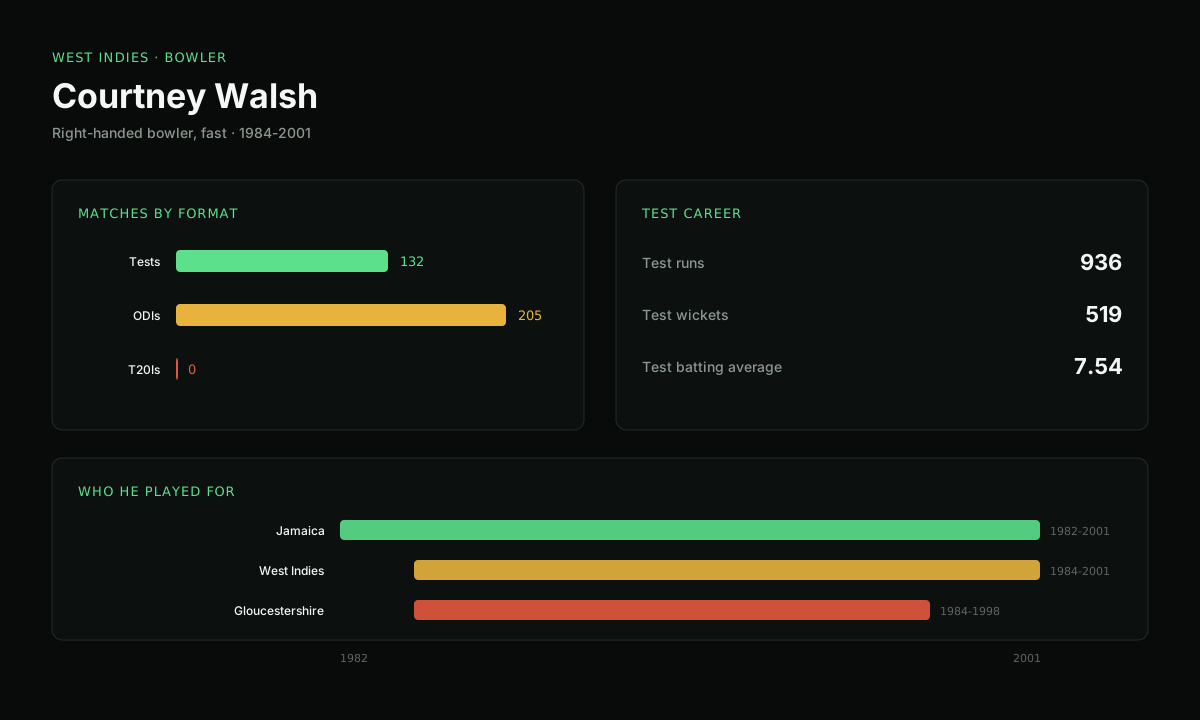
The full record is on his player page.
Reaching 500
He passed 500 Test wickets in March 2001 against South Africa, the first bowler to do it, and finished on 519 two months later.
The record lasted three years before Muralitharan passed it, and Warne shortly afterwards. Walsh's total is now sixth or seventh on the list depending on the year, and it was the first.
What made it possible is what the record is actually about: he played 132 Tests as a fast bowler, which at the time was a very large number, and he was fit for almost all of them.
The durability
Fast bowlers break down. The standard shape of a career is ten years with two or three long absences, and a decline in the early thirties.
Walsh bowled at close to full pace into his late thirties, missed very few matches through injury, and bowled more overs in Test cricket than any West Indian.
The explanation offered by everybody who watched him is a very economical, upright action with a long, easy run-up and nothing wasted. He also bowled well within himself for large parts of a spell, saving the effort deliveries for when a wicket was available.
The partnership with Ambrose
The two of them opened the bowling in 49 Tests together and took over 900 Test wickets in their careers.
They worked as a pair for the same reason all good new-ball pairs do: they were different. Ambrose was taller, bowled a fuller length from a higher release, and gave nothing away. Walsh was slightly quicker through the air, angled the ball in from wide of the crease, and used the bouncer more.
Neither of them gave a batter anything to score off, which meant a side facing them had to survive twenty overs before the third and fourth bowlers came on. For most of the 1990s the third and fourth bowlers were the weakness, and the two of them compensated for it.
What the average understates
24.44 is good and it is the highest average of the great West Indian fast bowlers, which reflects two things.
The first is the era. He bowled a large proportion of his overs in the 1990s, on flatter pitches, for a side whose batting was providing far smaller totals to defend than the sides Marshall and Holding bowled for.
The second is longevity. He played until he was 38, and the last two years of any fast bowler's career are the expensive ones. A career average includes them.
His figures through the middle of his career are comparable with anybody's.
The 43 ducks
He was dismissed for nought 43 times in Test cricket, which is the record.
His batting average is 7.54 and his highest score is 30 not out. He was, by any measure, one of the worst batters to play a substantial number of Test matches, and he was entirely comfortable with the fact.
The record is worth mentioning for one reason: it is only reachable by playing a very large number of matches, which is the same fact that produced 519 wickets. A bowler who bats at eleven for 132 Tests will accumulate ducks; one who plays 60 will not.
Jamaica, and the one that got away
His most famous single moment as a batter is a defensive shot he did not play.
Bridgetown, 1999, chasing 308 against Australia. West Indies were nine down with Brian Lara on 153 not out and Walsh at the other end. He survived five deliveries from Jason Gillespie, and Lara hit the winning runs.
It is regularly named the best Test innings of the modern era and the reason it finished the way it did is that the worst batter in Test cricket kept the strike out for five balls.
Country and role narrow it. The batting average column is the fastest route: very few Test cricketers averaged under eight.
Courtney Walsh — First bowler to five hundred Test wickets, and holder of the record for most Test ducks. Full record
The captaincy
He captained West Indies in 22 Tests in the mid-1990s, in the period immediately after the great side had broken up.
The results were poor and the circumstances were difficult: a board in dispute with its players, a batting order that had lost Richardson, Haynes and Greenidge, and a group in which the succession was contested.
He was replaced by Brian Lara. Neither of them had the players.
The over rate rule
He is one of the bowlers usually named in discussions about why the over-rate laws were tightened.
West Indian sides through the 1980s and early 1990s bowled around thirteen overs an hour with four fast bowlers, and the laws did not then penalise it. Walsh was part of the last of those attacks, and the penalties that exist now — points deductions, and a fielder brought inside the circle — were written in response to what those sides did.
The full account is in over rates and the penalties that finally changed them.
- Seventeen years without significant injury
- A very economical action
- Almost no bad spells across 132 Tests
- Being the first to 500
- Longevity, which is the same thing
- Rarely mentioned
- Consistency, which does not photograph
- A record that lasted three years
The one-day record
227 wickets from 205 matches at an economy rate of 3.83, in an era when that was a good figure for an opening bowler.
He and Ambrose bowled the first ten overs together for a decade, in a West Indian side that reached a World Cup semi-final in 1996 and lost it after being 165 for 2 chasing 208. That collapse is one of the more remembered in the tournament's history and neither of them had anything to do with it.
The coaching afterwards
He coached Bangladesh's bowlers and then their national side, and has worked with West Indies in various capacities since.
The consistent report from the bowlers he has worked with is about the same thing his own career was built on: the value of bowling the same ball repeatedly, and the discipline required to keep doing it when nothing is happening.
Where he sits in our dataset
Difficulty tier 1 on the player list. West Indies, bowler, 1984 to 2001 is a unique span, and the batting average of 7.54 is the giveaway if the wickets column is not enough.
- 519 Test wickets at 24.44, and the first bowler to 500
- 132 Tests as a fast bowler, with almost no injury absences
- 43 ducks, also a record, and reachable only by playing that many matches
- He survived five balls to let Lara win the best Test of the era
The short version
The record is a record of availability. He bowled at pace, well, for seventeen years, and was fit for almost every match his country played, which is the rarest thing in fast bowling and produced the first 500-wicket career in the sport's history.
For the bowler at the other end, see Curtly Ambrose by the numbers, and for the match his five balls decided, Brian Lara by the numbers.