Dale Steyn by the numbers, and the best strike rate of the modern era
439 Test wickets at 22.95, taken every 42 balls, which is the fastest strike rate of any bowler with 400 wickets in the history of the game.
Dale Steyn took a Test wicket every 42 balls. Nobody else with 400 Test wickets has been anywhere near that, and it is the number that settles most arguments about the fast bowlers of his era.
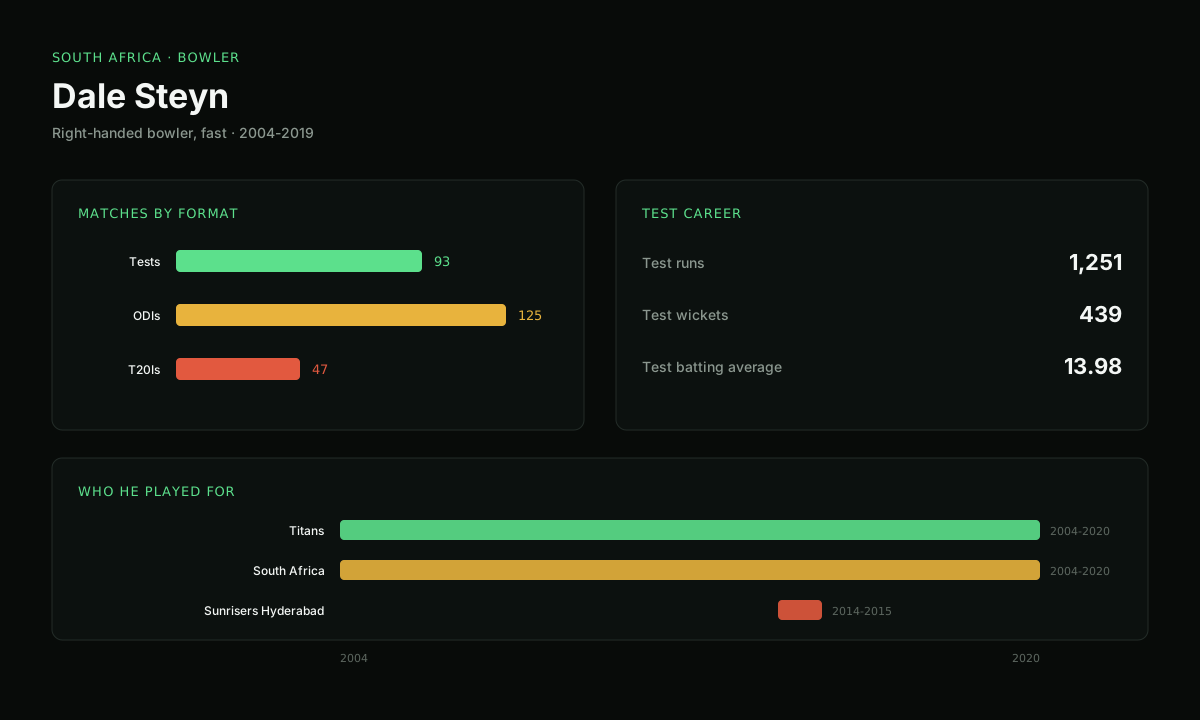
- 439 Test wickets at 22.95, from 93 Tests
- A strike rate of 42.3 balls per wicket, the best of anybody with 400 wickets
- He bowled genuine pace with late outswing, which is a rare combination
- Injuries cost him the last five years of what should have been a longer career
The record
| Format | Matches | Wickets | Average | Strike rate |
|---|---|---|---|---|
| Tests | 93 | 439 | 22.95 | 42.3 |
| ODIs | 125 | 196 | 25.95 | 30.8 |
The full record is on his player page.
The strike rate
42.3 balls per wicket is the number that matters and it needs a comparison to make sense.
Among bowlers with 400 or more Test wickets, the next-best strike rates are in the low fifties. McGrath took a wicket every 52 balls, Warne every 57, Anderson every 56. Steyn took one every 42.
A wicket every seven overs, sustained across 93 Tests, is a different kind of bowler from one taking a wicket every nine. It means a captain could bring him on expecting something to happen rather than expecting an end to be held.
The bowling average of 22.95 is also outstanding and is the less unusual of the two numbers. Several bowlers have averaged around 22; almost nobody has taken wickets that quickly while doing it.
The method
Genuine pace — consistently in the high 140s, occasionally above 150 — with late outswing to the right-hander.
That combination is rare because the two things fight each other. Swing requires a seam presented consistently and a slightly fuller length; pace tends to reduce the time the ball has to swing and encourages a shorter length. Bowlers who have both usually have them at different points in their careers.
He had them at once, from an aggressive, high-energy action, which is also why the body eventually broke down.
The aggression
The other thing everybody who faced him mentions is the attitude, and it was not decoration.
He bowled at the stumps, attacked from the first over of a spell, and looked for wickets rather than for control at every point. A bowler with a strike rate of 42 is by definition doing that: containing bowlers do not take wickets every seven overs.
The cost is an economy rate around three, which is high for a Test bowler of his standing. That is the trade and it was the correct one for the side he played in, which had Morkel and Philander to hold ends while he attacked.
What the shoulder actually was
The injury that ended the peak was a right shoulder problem first suffered while fielding in 2015, which recurred repeatedly and eventually required surgery.
Fast bowling injuries are usually in the back or the legs — stress fractures, side strains, hamstrings — and those have known recovery paths. A shoulder in a fast bowler's delivery arm is different: the joint takes the deceleration of the arm after release, thousands of times a season, and there is no way to bowl fast without loading it.
He came back several times, bowled at reduced pace, and broke down again. The last few years of the record are a bowler trying to find a version of himself that his shoulder would permit, and there was not one.
The injuries
He played 93 Tests. On the trajectory of his first ten years he would have played 140.
A series of shoulder and hamstring injuries from 2015 onwards reduced him to occasional appearances, and he retired from Test cricket in 2019 having played only a handful in the preceding four years.
That is the honest asterisk on the record. The strike rate is the best of anybody with 400 wickets and the total is the smallest of them, because his career ended around the age at which McGrath and Anderson were still adding to theirs.
The 2010 Nagpur spell
The single spell most often named is 7 for 51 against India at Nagpur in 2010, on a flat subcontinental pitch, with reverse swing.
The context is what makes it notable. Fast bowlers from outside the subcontinent have historically found India close to unplayable — slow surfaces, no bounce, no conventional swing, and batters who play spin better than anybody. He took 7 for 51 there and South Africa won by an innings.
His record in Asia generally is unusually good for a fast bowler, and it is built on reverse swing at pace rather than on anything the conditions gave him.
Country and role narrow it. The wickets column and a 2004 debut close it quickly.
Dale Steyn — Sustained ninety miles an hour with reverse swing for the best part of a decade. Full record
The attack he bowled in
South Africa through his peak had the best fast bowling attack in the world and it is part of the explanation for the strike rate.
Morne Morkel bowled from the other end at 145 kilometres an hour with steep bounce from a great height. Vernon Philander bowled at 130 and moved it both ways at a length no batter could leave. Neither was going to give a batter respite while Steyn rested.
That matters for a strike rate specifically. A bowler who attacks constantly needs somebody else to hold an end; if both bowlers attack, the runs come and the captain has to change something. South Africa could let Steyn attack every ball because Philander made the other end economical.
The comparison with Kumble or Muralitharan, both of whom bowled without that support, runs the other way.
The limited-overs record
196 one-day wickets at 25.95, and a T20 career that ran into his late thirties in franchise cricket after the international one had stopped.
He was among the better death bowlers of his generation before that phase became a specialism, and the same qualities applied: pace at the stumps, a yorker, and no interest in bowling defensively when a wicket was available.
South Africa's one-day sides of that period reached semi-finals and lost them, which is the sentence that attaches to every South African cricketer of the era regardless of what they individually did.
Where he sits among his contemporaries
The fast bowlers of that generation are usually listed as Steyn, Anderson, Broad, Philander, Johnson, Bumrah and Southee, and the comparison depends entirely on which number you use.
| Bowler | Wickets | Average | Strike rate |
|---|---|---|---|
| Dale Steyn | 439 | 22.95 | 42.3 |
| James Anderson | 704 | 26.45 | 56.7 |
| Stuart Broad | 604 | 27.68 | 57.6 |
| Vernon Philander | 224 | 22.32 | 50.8 |
Anderson has more than twice as many wickets across twice as many Tests. Philander's average is comparable. Neither took wickets at Steyn's rate, and the totals reflect longevity rather than potency.
- Larger wicket totals
- A career of twenty years
- Records that stand on volume
- An economy rate under three
- A wicket every seven overs
- A career of fifteen with five lost to injury
- The best strike rate of anybody with 400
- An economy rate around three, and the wickets
- 439 wickets at 22.95, with a strike rate of 42.3
- Genuine pace and late outswing at the same time, which is rare
- 7 for 51 at Nagpur, on a surface fast bowlers historically find unplayable
- Injuries cost him the last third of what the trajectory suggested
The short version
He took wickets faster than any bowler with a comparable career has managed, at an average in the low twenties, while bowling genuinely fast. The total is smaller than his contemporaries' because his body ran out before his method did.
For what a bowling strike rate actually measures, see bowling economy rate explained, and for the skill his best spells were built on, reverse swing explained.