Richard Hadlee by the numbers, and a bowling attack of one
431 Test wickets at 22.29, taken almost entirely without a supporting bowler at the other end, for a country that had won seven Tests before he arrived.
Richard Hadlee took 431 Test wickets at 22.29 for New Zealand, a country that had won seven Test matches in the forty-three years before he played and which won twenty-two while he did.
- 431 Test wickets at 22.29, from 86 Tests, and 3,124 runs at 27.16
- Five wickets in an innings 36 times, from 86 matches
- He bowled without a supporting seamer for almost his entire career
- New Zealand's Test record before and after him are different sports
The record
| Format | Matches | Wickets | Average | Runs |
|---|---|---|---|---|
| Tests | 86 | 431 | 22.29 | 3,124 |
| ODIs | 115 | 158 | 21.56 | 1,751 |
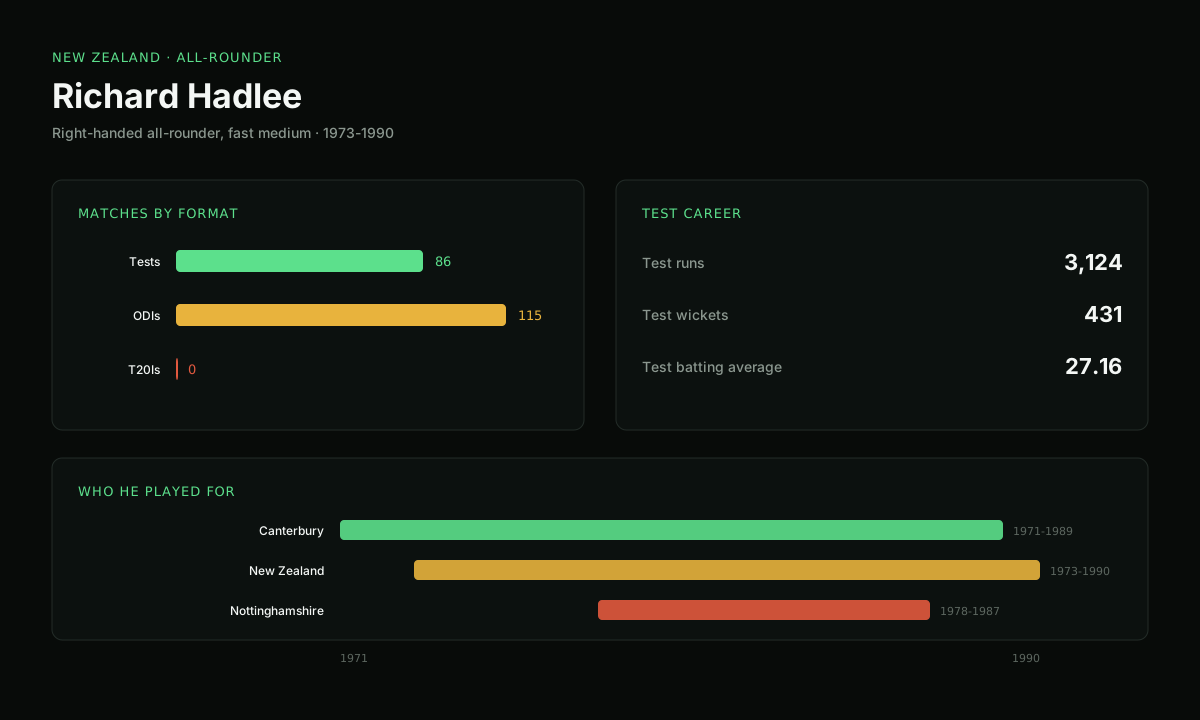
The full record is on his player page.
Five wickets a Test
431 wickets from 86 Tests is a rate of five a match, which is the highest of anybody with 400 or more.
He took five in an innings 36 times, from 86 matches. To put that another way: in more than four of every ten Tests he played, he took a five-wicket haul. Nobody with a comparable career has been close to that ratio.
The average of 22.29 makes the total meaningful. He was not accumulating over a long career — 86 Tests is not a long career by modern standards — he was taking wickets at a rate almost nobody has managed and doing it cheaply.
No support
The context that separates him from the other great fast bowlers of his era is the attack he bowled in.
Marshall bowled alongside Holding, Garner and Croft. Lillee had Thomson. Imran had Sarfraz and later Wasim and Waqar. Botham had Willis. Hadlee had, for most of his career, nobody.
That matters in two directions. A batting side facing one dangerous bowler can play him out and score at the other end, so his wickets came against batters who were not under pressure from anywhere else. And he had to bowl far more overs than a bowler in a four-man attack, because there was no obvious alternative when he needed a rest.
The output — five wickets a Test, at 22 — was produced under those conditions for seventeen years.
The method
Fast-medium with late outswing, off a shortened run-up he adopted in mid-career.
He reduced his run-up substantially in the early 1980s, on the reasoning that the last few strides added workload without adding pace. The wickets did not decrease and the number of overs he could bowl went up, which is one of the more sensible technical decisions any fast bowler has made.
The stock ball was full and moving away from the right-hander, bowled from close to the stumps. The wicket-taking ball was the one that came back, which is why so many of his dismissals were bowled or lbw.
What New Zealand were before and after
New Zealand played their first Test in 1930 and won their seventh in 1973, the year Hadlee debuted.
In the seventeen years he played, they beat every Test-playing nation, won series in England and Australia, and became a side that visiting teams prepared for. The 1985-86 series in Australia, won 2-1, included his 9 for 52 at Brisbane, which is still among the best innings analyses in the sport.
After he retired the side declined again, and it took until the 2010s for New Zealand to be consistently competitive.
It is the clearest single-player effect on a country's results in the history of the game, and the reason is arithmetic: a side needs twenty wickets, and for seventeen years New Zealand had somebody who could take ten of them himself.
The batting
3,124 runs at 27.16, with two centuries, batting at seven or eight.
The all-rounder test — batting average above bowling average — he clears by 4.87, which is the narrowest margin of the four great all-rounders of his era and still a clear pass.
He was a genuinely useful lower-order batter rather than a specialist, and in a side with limited batting depth that mattered more than the average suggests. New Zealand totals of that period frequently depended on him adding 40 at number eight.
The country column narrows this one enormously. Very few New Zealanders in the dataset played in that era.
Richard Hadlee — Nine for fifty-two at the Gabba, and the first to four hundred Test wickets. Full record
The comparison with the other three
Imran, Botham, Kapil Dev and Hadlee overlapped almost exactly, and the comparison depends on which discipline you weight.
| Player | Bowling average | Wickets per Test | Batting average |
|---|---|---|---|
| Richard Hadlee | 22.29 | 5.01 | 27.16 |
| Imran Khan | 22.81 | 4.11 | 37.69 |
| Ian Botham | 28.40 | 3.75 | 33.54 |
| Kapil Dev | 29.64 | 3.31 | 31.05 |
Hadlee is the best bowler of the four on both average and rate. Imran is close on average and clearly ahead on batting. Botham was the most destructive at his peak. Kapil Dev changed his country's cricket most.
Anybody arguing that Hadlee was the best bowler among them is on firm ground. Anybody arguing he was the best all-rounder has to explain the batting.
- 431 wickets at 22.29
- Five wickets a Test
- 36 five-wicket hauls from 86 matches
- A batting average of 27.16
- With no supporting bowler at the other end
- For a side that had won seven Tests in forty-three years
- And far more overs per Test than his rivals
- In a side whose batting depth was minimal
The 9 for 52
Brisbane, November 1985. New Zealand had never won a Test series in Australia.
Hadlee took 9 for 52 in the first innings and 6 for 71 in the second — fifteen wickets in the match — and New Zealand won by an innings and 41 runs. He also took the catch that dismissed the tenth batter, off the bowling of Vaughan Brown, which is why the figures read nine rather than ten.
New Zealand won the series 2-1. It remains one of a handful of series wins by any visiting side in Australia in the last half-century.
The 9 for 52 is the best innings analysis by any New Zealander and among the best in the history of Test cricket.
The shortened run-up
The technical decision worth understanding is the one he made around 1980.
He cut his run-up from around twenty paces to about twelve, on the reasoning that the extra distance produced no measurable pace and a great deal of accumulated fatigue. A fast bowler carrying an attack alone needs to bowl thirty overs a day; the run-up is the part of that workload that produces nothing.
The wickets did not decline. The overs per day went up. He bowled another decade at his peak.
It is a straightforward piece of engineering applied to a body, and the fact that so few bowlers have copied it says more about cricket's conservatism than about the idea.
Where he sits in our dataset
Difficulty tier 1 on the player list. New Zealand, all-rounder, 1973 to 1990 is unique, and the wickets column removes any doubt.
- 431 wickets at 22.29, at five a Test, which is the best rate of anybody with 400
- 36 five-wicket hauls from 86 matches
- No supporting seamer, for essentially the whole career
- New Zealand's results before and after him are not comparable
The short version
He took five wickets a Test for seventeen years, at 22, with nobody bowling at the other end, and the country he did it for went from irrelevant to competitive while he was doing it and back afterwards. The bowling record is the strongest of the four great all-rounders.
For the comparison he belongs in, see what counts as an all-rounder, and for what a bowling strike rate measures, bowling economy rate explained.