Ravichandran Ashwin by the numbers, and 537 Test wickets
537 Test wickets and six Test centuries, from an off-spinner who kept adding deliveries to his repertoire for fourteen years because he expected to be worked out.
Ravichandran Ashwin took 537 Test wickets and scored six Test centuries, which makes him one of a very small number of players to have done both, and he did it by changing what he bowled roughly every two years.
- 537 Test wickets at 24.00, from 106 Tests
- Six Test centuries, batting at seven or eight
- 37 five-wicket hauls, second among Indians
- He added new deliveries continuously, on the assumption of being worked out
The record
| Format | Matches | Wickets | Average | Runs |
|---|---|---|---|---|
| Tests | 106 | 537 | 24.00 | 3,503 |
| ODIs | 116 | 156 | 33.20 | 707 |
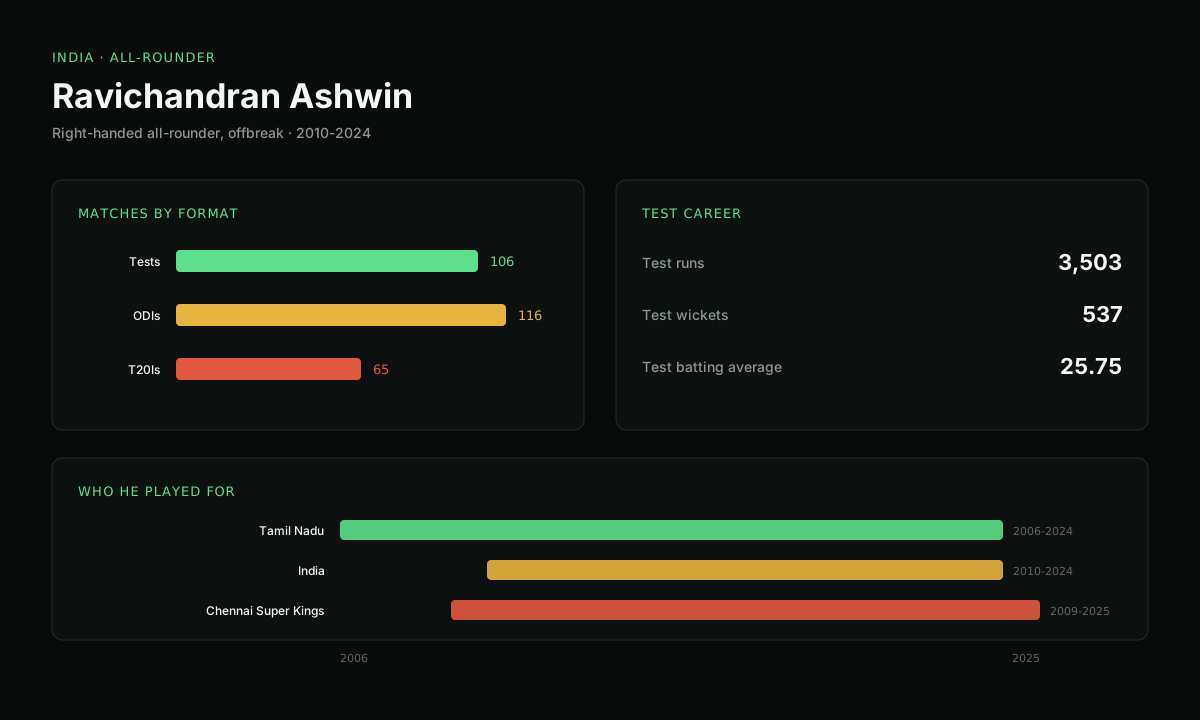
The full record is on his player page.
The rate
537 wickets from 106 Tests is five a match, which is the same rate as Hadlee and better than Warne, McGrath or Anderson.
The average of 24.00 is the second-best of anybody with 500 Test wickets, behind Muralitharan's 22.72 and ahead of Warne, Kumble, Anderson and Broad.
The immediate objection is conditions, and it is a fair one: he bowled a large share of his overs in India on surfaces that turn, and his home average is substantially better than his overseas one. The counter is that every spinner's record splits that way, and that his overseas figures improved considerably in the second half of his career.
The continuous reinvention
The thing that separates him from other successful off-spinners is that he did not settle.
Most bowlers find a method that works and repeat it. Ashwin added the carrom ball, then a leg-break, then several variations of pace and release point, then a period of bowling from wider on the crease, then a phase of bowling much slower through the air. Each of them lasted a couple of years.
The stated reasoning was that a bowler who does the same thing will be worked out within eighteen months at that level, and that the answer is to have changed before they do.
It is a rare approach and it is why his wickets kept coming through his mid-thirties when most finger-spinners are declining.
The batting
3,503 runs at 25.75, with six centuries.
Six Test hundreds from a bowler is a substantial record — very few players in history have 300 or more wickets and six centuries — and they came at seven or eight in matches where India needed a lower-order partnership.
The batting declined as the career went on and the bowling did not, which is the usual pattern for an all-rounder whose primary discipline is bowling: the batting is the thing that gets less practice when the bowling workload rises.
The overseas question
The critique that followed him for a decade was that he was a home-track bowler, and the record has two halves.
In the first half of his career he was frequently left out of overseas Tests in favour of a fourth seamer, which produced a self-fulfilling pattern: fewer overseas matches, fewer overseas wickets, and a record that supported the decision.
In the second half he took wickets in Australia, England and South Africa, and the overseas average came down substantially. He also became a significant lower-order batter in exactly those conditions.
The honest reading is that he was outstanding at home from the start and became good away, and that the selection policy for the first five years made the second part harder to demonstrate.
The Manchester omission
He was left out of the World Test Championship final in 2021 and again at the Oval in 2023, in conditions where India played four seamers.
Those decisions were argued about at length, and the argument is a specific one: whether a side with a bowler averaging 24 should ever leave him out, or whether the conditions genuinely favoured seam to the point where it was correct.
He retired mid-series in Australia in December 2024, which surprised everybody including his own dressing room.
The role narrows it, and the wickets column separates him from every other Indian all-rounder.
Ravichandran Ashwin — Second only to Kumble among Indian Test wicket-takers, and a genuine batting all-rounder. Full record
The home record, in detail
The home figures are extraordinary and it is worth stating them rather than gesturing at them.
He took the great majority of his 537 wickets in India, at an average in the low twenties, and India lost very few home Tests during his career. A side that wins every home series for a decade needs somebody who can take twenty wickets on a fourth-day surface, and he and Ravindra Jadeja did it repeatedly.
That is a genuine achievement and it is also the thing the criticism is about: a bowler who takes 400 wickets at home and 130 away has a record that depends on where he played.
The two claims are both true and they are not in tension. He was the best home spinner of his generation by a distance and a good overseas one once he was given the matches.
Reaching 500
He passed 500 Test wickets in 2024, becoming the second Indian to do it after Kumble, and did it in 98 Tests — faster than anybody except Muralitharan.
The rate is the part that gets least attention and is the strongest argument for him. Anderson needed 129 Tests to reach 500, Broad 140, Warne 108. Ashwin needed 98.
The tactical mind
He is the most publicly analytical cricketer of his generation, running a long-standing video channel in which he discusses matchups, field settings and his own dismissals in technical detail.
That is unusual and it matters here for one reason: a great deal of what would normally be inferred about a bowler's plans is available in his own words. The carrom ball's purpose, the wider crease position, the specific plan against a left-hander — all of it is documented rather than reconstructed.
He was also involved in one of the more contested run-outs at the bowler's end in recent years, which is covered in the run out at the bowler's end.
- A home-track bowler
- Only effective on turning pitches
- A bowler who bats a bit
- Left out overseas on merit
- An average of 24.00, second among 500-wicket bowlers
- Wickets in Australia, England and South Africa later
- Six Test centuries
- Left out overseas, which then justified leaving him out
The partnership with Jadeja
The two of them bowled together in India for a decade and are the most productive spin pairing in the history of Test cricket by wickets taken as a pair.
They were complementary in a way that is easy to miss. Ashwin attacked with flight, drift and variation; Jadeja bowled flat, fast and at the stumps with almost no bad balls. A batter surviving one of them had no relief at the other end, which is exactly the arrangement West Indies used with four fast bowlers and which India reproduced with two spinners.
Between them they took the great majority of the wickets in India's home Tests through that period, which is the mechanism behind a home record that lost one series in twelve years.
Where he sits in our dataset
Difficulty tier 1 on the player list. India, all-rounder, 2010 to 2024 is a unique combination and the wickets column confirms it.
- 537 Test wickets at 24.00, at five a match
- Six Test centuries, which almost no 500-wicket bowler has
- He changed his primary variation roughly every two years, deliberately
- The overseas record improved substantially once he was picked overseas
The short version
He took wickets at a rate and an average that put him among the best spinners in the history of the game, scored six Test hundreds while doing it, and spent fourteen years assuming he was about to be worked out. The last part is why the first two happened.
For the delivery he popularised, see slower balls explained, and for the board he sits high on, most Test wickets of all time.