Anil Kumble by the numbers, and the ten-wicket innings
619 Test wickets from a leg-spinner who barely spun the ball, took his wickets with bounce instead, and is one of two men ever to take all ten in an innings.
Anil Kumble took 619 Test wickets bowling leg spin that did not turn much, at a pace closer to a medium-pacer's than a spinner's, and he did it while the conventional description of him was that he was not a big turner of the ball.
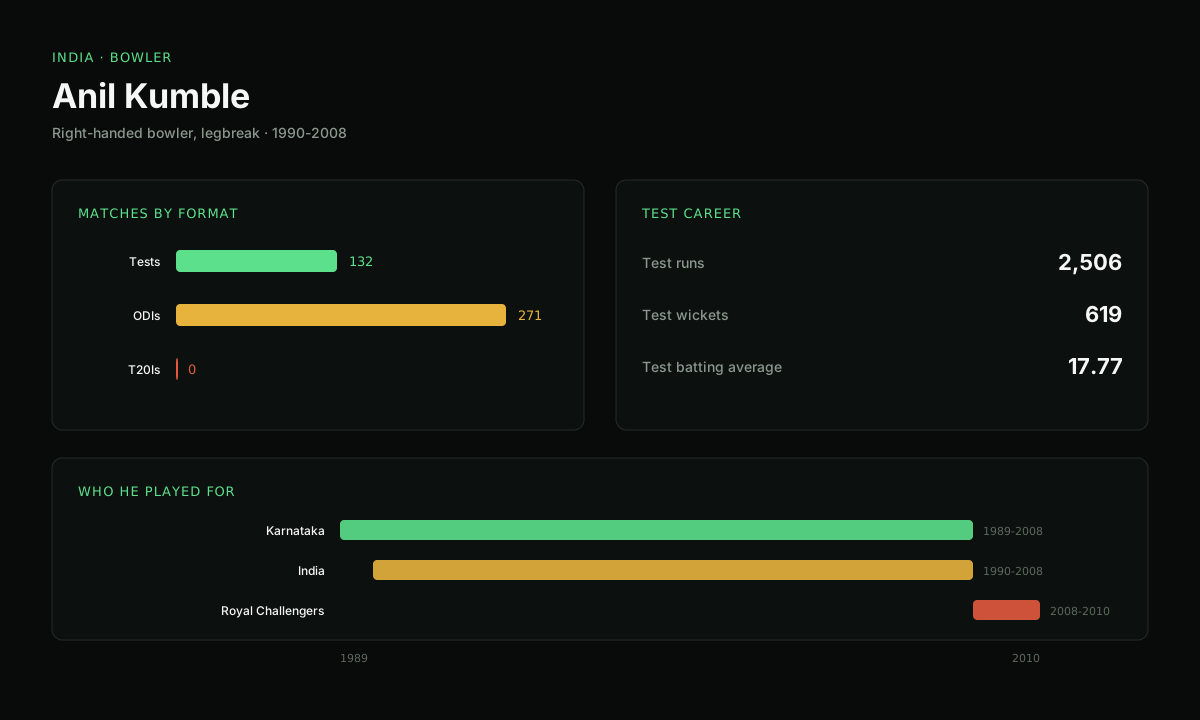
- 619 Test wickets at 29.65, from 132 Tests
- One of only two bowlers to take all ten wickets in a Test innings
- He bowled leg spin fast and flat, with bounce rather than side spin
- He bowled an over with a broken jaw, bandaged, and took a wicket
The record
| Format | Matches | Wickets | Average | Span |
|---|---|---|---|---|
| Tests | 132 | 619 | 29.65 | 1990-2008 |
| ODIs | 271 | 337 | 30.89 | 1990-2007 |
The full record is on his player page.
The method, which was not conventional leg spin
A classical leg-spinner is slow through the air, loops the ball, and turns it sharply. Kumble was none of those things.
He bowled at around 90 kilometres an hour — fast for a spinner, close to slow medium — with a flat trajectory and comparatively little side spin. What he generated instead was bounce: from a tall frame and a high action, the ball climbed at the batter from a length.
The wicket-taking deliveries were therefore different from a conventional leg-spinner's. Not the ball that turns past the outside edge, but the one that goes straight on quicker than expected, hits the pad, or takes the shoulder of the bat and loops to short leg.
The word used against him for a decade was that he did not spin it. The rejoinder is 619 Test wickets.
The ten
Delhi, February 1999, against Pakistan. Kumble took all ten wickets in the second innings for 74 runs.
It has happened twice in the history of Test cricket. Jim Laker took ten for 53 at Old Trafford in 1956; Kumble is the other.
The circumstances are worth stating. Pakistan were chasing 420 and were 101 without loss. He then took ten wickets in 26.3 overs, and India won by 212 runs. His partner at the other end, Javagal Srinath, has said he was deliberately bowling wide of the stumps near the end so as not to take one.
The one-day career
337 wickets from 271 one-day internationals, at an economy rate that was respectable for a spinner in an era before spinners were considered a middle-overs solution.
The white-ball version of his method translated better than most people expected. Flat, fast leg spin at the stumps is difficult to get away in the middle overs because there is no width to work with and not enough turn to premeditate against, and he was a containing option and a wicket-taking one at the same time.
He was also part of the 1996 World Cup semi-final at Eden Gardens that was abandoned after a crowd disturbance, and of the 2003 World Cup side that reached the final — two of the more memorable Indian one-day campaigns of the period, both of which ended in a way nobody wanted.
The broken jaw
Antigua, 2002. He was struck on the jaw by a delivery from Mervyn Dillon while batting, and the jaw was fractured in two places.
He returned to the field with his head and jaw bandaged and bowled fourteen consecutive overs, dismissing Brian Lara. He flew home for surgery the following day and did not play again on the tour.
It is the image most people who watched him retain, and it is a reasonable summary of a career built on turning up and bowling for eighteen years in a role that required enormous quantities of overs.
At home and away
The honest reading of the record is that he was a great bowler in India and a good one everywhere else, and that the gap is larger than for most bowlers of comparable standing.
The reason is the method. A bowler relying on bounce and pace off the pitch needs a surface with something in it. Indian pitches, dry and worn from the third day, suited him exactly. Flat overseas surfaces with less bounce gave him less to work with, and his overseas average is meaningfully higher.
That is a real limitation and it is also the shape of almost every spinner's career. Very few spinners in history have been equally effective in Perth, Kingston and Chennai, and the ones who were are the ones the argument about the greatest is between.
Role and country narrow it hard. The wickets column separates him from the only two Indian bowlers close to him.
Anil Kumble — One of only two bowlers to take all ten wickets in a Test innings. Full record
The overs, and what they cost
619 wickets required more than 40,000 deliveries, and Kumble bowled a large share of them in conditions and situations that would have been given to somebody else in a side with more bowling.
India through the 1990s had one world-class bowler and a supporting cast that varied between adequate and absent. The plan in most home Tests was to bowl Kumble for thirty overs a day and hope. He did it for a decade, and the physical cost — a shoulder that required surgery, a permanently damaged finger, the jaw — is part of the record.
There is a comparison worth drawing here with the other great spinners of the period. Warne bowled in an attack containing McGrath and Gillespie; Murali bowled in one containing nobody comparable, as Kumble did. Two of the three carried an entire bowling side, and both of them have the injury history that goes with it.
The batting, briefly
2,506 Test runs at 17.77, with one century.
The hundred came at the Oval in 2007, against England, batting at number eight, after seventeen years of Test cricket. It is one of the more popular centuries of the decade for reasons that have nothing to do with its importance, which was modest.
A number eight averaging under eighteen is not a batter and he made no claim to be one. What he was, reliably, was somebody who occupied an end while a recognised batter scored, which is a specific and undervalued skill in a side whose tail started early.
The captaincy and after
He captained India in 14 Tests late in his career and retired in 2008 during a match, having decided mid-Test that his hand injury meant he could not continue.
He later coached India for a year and left after a public disagreement, and he has chaired the ICC's cricket committee — the body responsible for recommending changes to the playing conditions, which is a role that suits an engineer by training who spent a career solving the same problem from different angles.
What the average says and does not
29.65 is a good Test bowling average and it is higher than Warne's 25.41 or Muralitharan's 22.72, which is the comparison always made.
Two things sit behind the gap. He bowled a great deal on flat Indian surfaces of the 1990s that were prepared for draws rather than results, where wickets were expensive for everybody. And he bowled without a supporting bowler for most of his career, so batters could see him off and score at the other end rather than being squeezed from both.
Neither excuses the number. Both explain why comparing bowling averages across careers without looking at who was bowling at the other end produces conclusions that do not survive contact with the matches.
Where he sits in our dataset
Difficulty tier 2 on the player list. Recognisable to anybody who watched cricket in that period and less immediately identifiable than Tendulkar or Dravid from a country column alone.
The wickets column is what closes it. Only three Indian bowlers are anywhere near 600, and the span column separates them.
- He does not turn it
- Only effective at home
- Too fast to be a leg-spinner
- A workhorse rather than a match-winner
- 619 Test wickets
- Very good at home, good away, like most spinners
- The pace was the method, not a flaw
- Ten in an innings, and 35 five-wicket hauls
- 619 Test wickets at 29.65, third on the all-time list when he retired
- Fast, flat leg spin that took wickets through bounce rather than side spin
- Ten in an innings at Delhi in 1999, one of two in the sport's history
- Fourteen consecutive overs with a jaw broken in two places
The short version
He was described for most of his career by what he did not do, and finished with 619 Test wickets doing it. The method was unorthodox, it depended on bounce, and it worked for eighteen years.
For the discipline he bowled a version of, see the googly explained without jargon, and for the list he sits high on, most Test wickets of all time.