Most Test wickets of all time, and the two who will not be caught
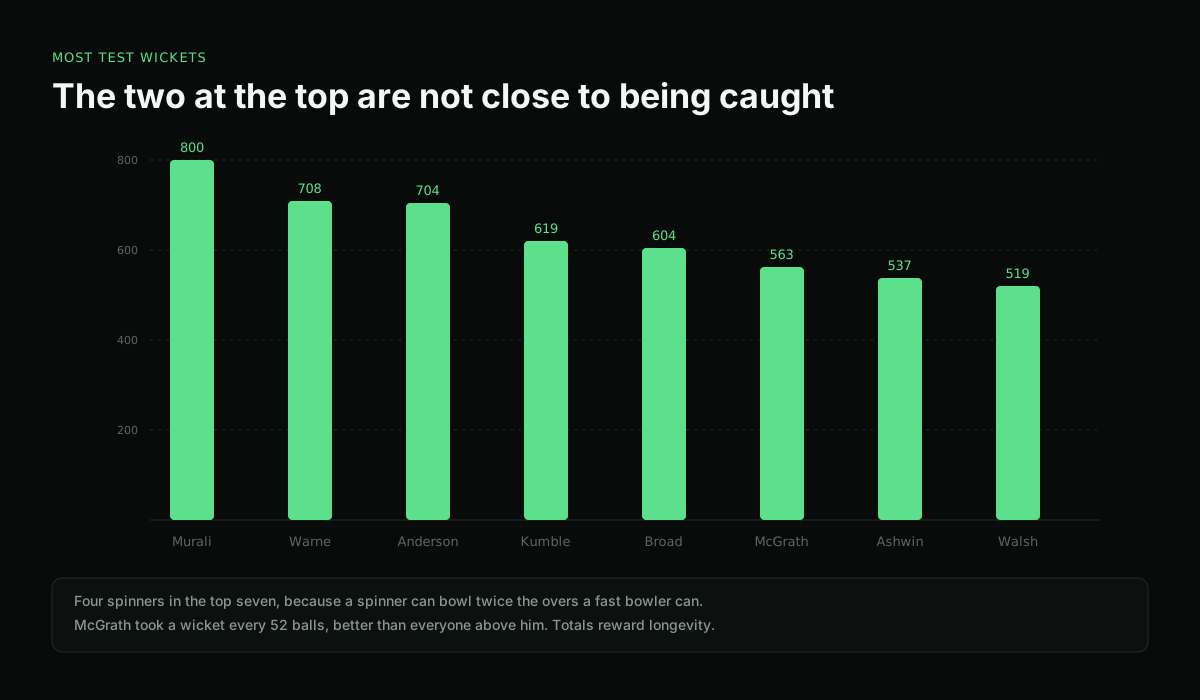
Muralitharan's 800 and Warne's 708 sit above everybody. The list below them explains more about how cricket changed than the two at the top do.
Two spinners occupy the top of the list of Test wicket-takers, and the gap between second and third is larger than most people assume. The names below them tell a story about workload, longevity and what a career looks like in each era.
- Muttiah Muralitharan's 800 is the record and is not seriously threatened
- Shane Warne's 708 is second; the next name is nearly a hundred behind
- James Anderson is the only fast bowler above 700
- Longevity, not strike rate, is what separates this list
The list
| Wickets | Bowler | Country | Type |
|---|---|---|---|
| 800 | Muttiah Muralitharan | Sri Lanka | off spin |
| 708 | Shane Warne | Australia | leg spin |
| 704 | James Anderson | England | fast-medium |
| 619 | Anil Kumble | India | leg spin |
| 604 | Stuart Broad | England | fast-medium |
| 563 | Glenn McGrath | Australia | fast-medium |
| 537 | Ravichandran Ashwin | India | off spin |
| 519 | Courtney Walsh | West Indies | fast |
Four spinners in the top seven, in a sport where fast bowling is usually considered the harder discipline to survive. That is not an accident.
Why spinners dominate the top
Workload. A fast bowler can bowl perhaps twenty overs in a day before the returns collapse; a spinner can bowl forty. Across a twenty-year career that difference compounds into thousands of deliveries.
Spinners also age better. Warne, Murali, Kumble and Herath were all taking wickets past thirty-five, at a point when most fast bowlers have either retired or become medium pacers.
James Anderson at 704 is the outlier that proves it: a fast bowler who kept bowling until he was forty-two, at a pace he had deliberately reduced in order to keep swinging it.
How did Muttiah Muralitharan take his 800th Test wicket?
The final delivery of his final Test, in Galle in 2010. He needed one wicket going into the last over of the innings and got it with the last ball available to him.
The strike rate nobody mentions
Total wickets rewards longevity. It says very little about how dangerous a bowler was.
| Bowler | Wickets | Balls per wicket |
|---|---|---|
| Muralitharan | 800 | 55.0 |
| Warne | 708 | 57.4 |
| Anderson | 704 | 56.7 |
| McGrath | 563 | 51.9 |
| Walsh | 519 | 57.8 |
McGrath took a wicket every 52 balls, better than everyone above him on the totals list, and finished nearly 250 wickets behind Murali because he played fewer than two thirds as many Tests.
A career total is a measurement of opportunity as much as ability, which is why it should always be read next to the strike rate and the matches played.
Who is actually close
The board changes slowly, and the honest answer to "who is next" is usually nobody for several years.
Reaching 500 Test wickets requires roughly a hundred Tests at five a match, which is a decade of being first choice and fit. Reaching 600 requires that plus another three or four years past the point where most fast bowlers have stopped. The bowlers in contention at any given time are always spinners with long careers ahead of them or fast bowlers who have been remarkably durable, and the second group is very small.
The three numbers that decide who gets on this list
A wicket total is the product of three things and the third one is invisible.
Overs bowled. More than anything else. A spinner bowling twenty-five overs a day for fifteen years will out-accumulate a faster, better bowler who manages fifteen overs a day for ten.
Strike rate, meaning balls per wicket. This is the actual measure of how dangerous a bowler was, and it is the one that flatters the fast bowlers on the list at the expense of the spinners above them.
Availability. Fast bowlers miss Tests. Stress fractures, side strains, ankles, backs: the injury list for a genuine quick is long and the recovery periods run to months. Spinners simply play more.
| Bowler type | Overs per Test day | Career length | Typical strike rate |
|---|---|---|---|
| Front-line spinner | 20 to 30 | 15 to 20 years | 60 to 70 balls |
| Genuine fast bowler | 12 to 18 | 10 to 14 years | 45 to 60 balls |
| Fast-medium workhorse | 15 to 22 | 12 to 18 years | 55 to 65 balls |
There is one more reason, and it is the least discussed: they bowled for a good side. A bowler in an attack where somebody else takes the wickets at the other end will finish with fewer, because there are only twenty available per match and they are shared. Some of the most economical bowlers in history have modest totals for exactly this reason, and the totals are not the criticism they look like.
The bowlers the list will never contain
Some of the best bowlers who ever played are nowhere near this board, and the reasons are worth stating because they are the same reasons every time.
They played in an era with fewer Tests. A bowler from the 1950s playing five Tests a year cannot accumulate at the rate of one playing twelve, however good they were.
They broke down. The list of fast bowlers whose careers ended at thirty with extraordinary strike rates and modest totals is long, and it is the strongest argument for reading strike rate alongside the total.
They lost years to something other than cricket. Wars, bans, boycotts, the years World Series Cricket removed from a generation of Australians and West Indians, and the isolation of South African cricket for two decades. There is no column in a record book for a career that was interrupted.
The context that is usually missed
Murali played for a side that needed him constantly. Sri Lanka's attacks across his career were built around one bowler, and he bowled more overs per Test than almost anyone in history.
Warne played for a side that did not. Australia through the 1990s had McGrath, Gillespie and others taking wickets at the other end, which cost Warne opportunities and made his total harder to build.
Anderson bowled in England. Conditions that suit swing gave him a home record no other fast bowler on this list could match, and he was picked at home for two decades.
- Longevity and durability
- Matches played, and therefore selection
- The team's dependence on that bowler
- A whole career
- How hard the bowler was to face
- Strike rate
- Conditions and opposition
- A peak
Who is close now
Nobody. The active bowler nearest the top of this list would need another decade at current rates, and the modern calendar makes twenty-year Test careers less likely rather than more, because franchise cricket competes for the same years.
Murali's 800 is likely to stand for a very long time, and it may stand forever.
- Murali 800, Warne 708, Anderson 704, and then a real gap
- Spinners dominate because they can bowl twice the overs and age better
- McGrath's strike rate beats everyone above him on the list
- The modern calendar makes twenty-year Test careers less likely, not more
For the players in our dataset, see the player list. For what a bowling strike rate actually measures, see strike rate.