The pink ball, and what day-night Tests actually changed
A red ball is invisible under lights and a white one falls apart. The pink ball is the compromise, and it swings longer and makes twilight the hardest hour in cricket.
Test cricket needed a ball that could be seen under floodlights and survive eighty overs. Red does not work under lights, white does not last, and the answer took about a decade of trials to arrive at.
- A pink ball has a black seam because pink stitching would be invisible
- It carries more lacquer, so it swings longer than a red ball
- The twilight session is the hardest batting period in the format
- Day-night Tests finish faster than day Tests on average
Why a new ball was needed at all
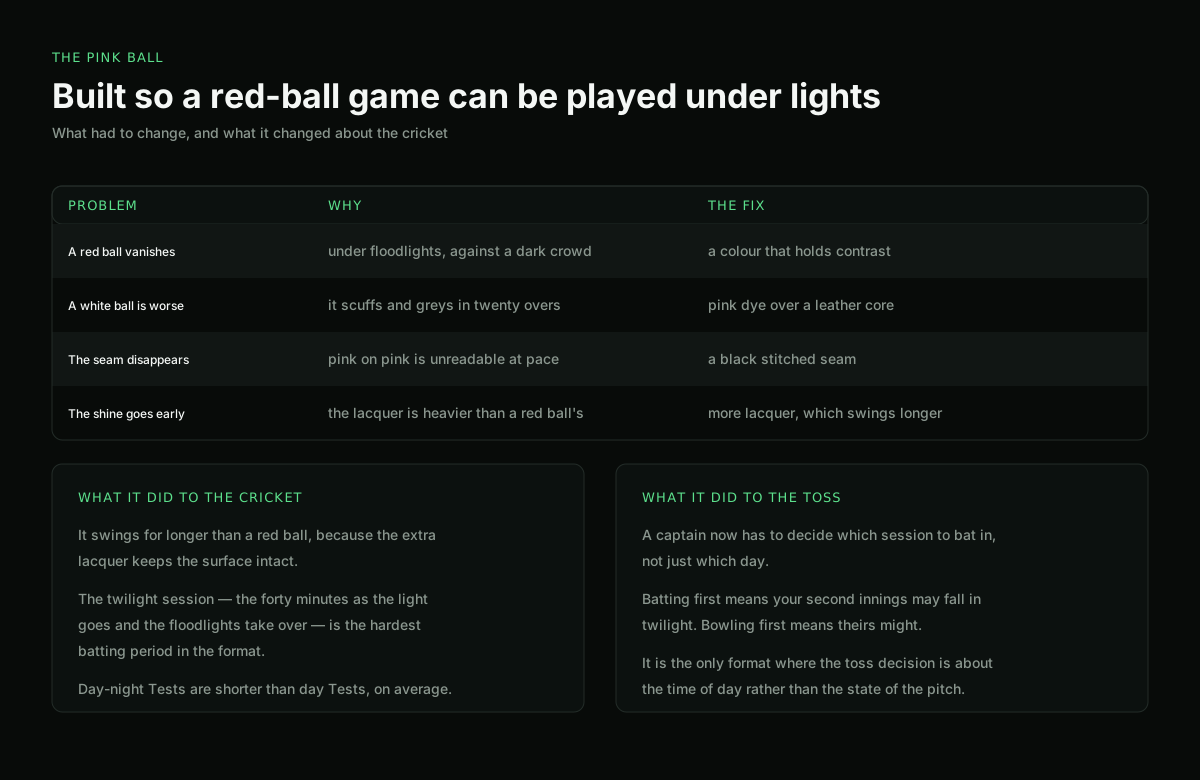
A red ball under floodlights, against a dark background of empty seats or a crowd, becomes very difficult to pick up. This is not a marginal effect: players describe losing it entirely at certain points.
A white ball solves visibility and creates two new problems. It scuffs and greys quickly, which is why one-day cricket uses two of them and replaces nothing; over eighty overs a white ball would be unusable. And white clothing, which Test cricket retains, makes a white ball harder to see against the bowler and the fielders.
Pink is the compromise: enough contrast against both the sky and the players, and a leather ball underneath that can be built to last.
What had to be engineered
Four problems, and the fixes are visible if you look at one.
The seam is black. Pink stitching on a pink ball is unreadable at pace, and a batter who cannot see the seam cannot read the delivery. Black thread solves it and is the most obvious visual difference from a red ball.
More lacquer. The pink dye needs protection or it wears off, so the ball carries a heavier coating. That coating is also what keeps the surface intact, which is why a pink ball swings for longer.
A harder finish. The extra lacquer makes the ball skid on rather than gripping, which changes what a spinner can do with it — pink-ball Tests have historically been seam-dominated.
Visibility at both ends of the day. The ball has to be usable in bright afternoon sun and under lights three hours later, which is a harder specification than either alone.
The twilight session
The forty minutes as natural light fades and the floodlights take over is the defining feature of the format.
Batters describe it as the hardest period they face in any format. The background is changing, the ball behaves differently as the air cools, and the lights are fighting residual daylight rather than replacing it. Sides plan around it: a captain will hold back their best bowler for that window, and a batting side will happily block through it.
The effect on the format is real. Wickets fall disproportionately in that session, and it is the main reason day-night Tests finish faster than day Tests.
| Session | What it is like |
|---|---|
| Afternoon | ordinary Test cricket, in warm conditions |
| Twilight | the hardest hour, and where the match usually turns |
| Night | good batting, under stable light, with a ball that still swings |
What the toss becomes
In a normal Test, the toss is a decision about the pitch. In a day-night Test it is also a decision about the clock.
A captain batting first will bat through the twilight session on day one. A captain bowling first hands it to the opposition. And because the match structure means each side's second innings falls at a roughly predictable time, the choice is partly about which of your two innings you are willing to have interrupted by the worst light.
That makes it the only situation in cricket where the toss decision is genuinely about the time of day rather than the surface, which is a strange thing for the oldest format to have acquired.
What it did to the game
Day-night Tests were introduced to solve an attendance and audience problem: Test cricket played entirely during working hours is difficult to attend and difficult to broadcast into a prime-time slot.
On that measure they worked. Attendances and audiences for day-night Tests have generally been higher than for the equivalent day matches, which is the whole point.
The cricketing consequences were less predictable. Matches are shorter, which means fewer days of gate revenue and a format that is already accused of being bowler-dominated becoming more so. Spinners have been less effective. And the scheduling has been uneven: some boards play several a year and others almost none, which means the conditions are unfamiliar to most touring sides.
Why does a pink ball have a black seam rather than a pink or white one?
A batter reads the seam position to judge what a delivery will do. Pink on pink is unreadable at pace, so the seam is stitched in black for contrast. It is a visibility fix, not a performance one.
What it did to preparation
A side touring for a day-night Test has a problem that does not exist for any other fixture: they need to practise against a ball they may never have faced.
Domestic first-class cricket in most countries is played with a red ball in daylight. A batter arriving for a pink-ball Test may have faced the ball a handful of times in their career, all of them in the preceding warm-up week, and the warm-up match — if there is one — is unlikely to be scheduled to hit twilight at the right hour.
Boards that play several a year have an advantage that has nothing to do with skill, and it compounds the home advantage the format already carries. It is a small effect in a series and a large one in a single Test.
Whether it should be used more
The arguments are genuinely balanced, which is why it has not been settled.
For: it puts Test cricket in front of an audience that can watch it, without changing any of the Laws. That is a rare thing — a format problem solved by a manufacturing change rather than a rule change.
Against: the conditions are materially different, matches are shorter, and the twilight period introduces a variable that has nothing to do with either side's cricket. A series where one Test is day-night and two are not is a series played under two different sets of conditions.
The current position is a compromise nobody designed: a handful of day-night Tests a year, mostly at venues where they draw well, and a continuing argument about whether the ball is the same contest.
- An audience that could not attend
- Prime-time broadcast slots
- Empty grounds on weekday afternoons
- Nothing about the Laws changed
- A session where batting is much harder
- Shorter matches and less gate revenue
- Conditions most touring sides rarely face
- A ball that behaves differently from a red one
- Pink solves visibility; black seam solves readability; lacquer solves durability
- The extra lacquer is why it swings longer than a red ball
- Twilight is where the wickets fall and where matches turn
- The toss becomes a decision about which session you bat in
The short version
The pink ball is a piece of engineering aimed at two hours of the day, and it changed the cricket around it more than anybody intended. The lacquer that keeps it visible also keeps it swinging, and the light it was built for is the hardest light to bat in.
For what the other balls do, see what a Kookaburra ball does that a Dukes does not, and for the stoppage day-night cricket was partly designed to avoid, bad light and how it is measured now.