Reverse swing explained, and the conditions it needs
Why an old ball swings the wrong way, why it took decades to be believed, and why two new balls in one-day cricket nearly removed it from the format.
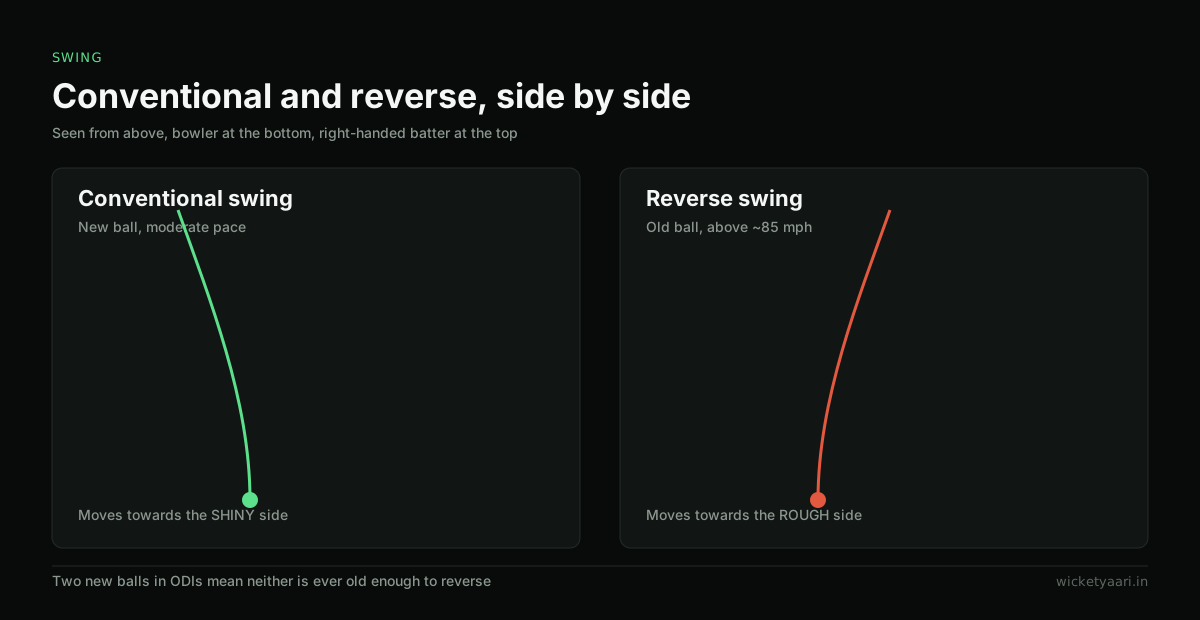
Conventional swing moves towards the shiny side. Reverse swing moves the other way, at higher pace, with an older ball, and for years it was widely assumed to be cheating because nobody could explain it.
- It needs an old ball with one side rough and one side kept smooth
- It happens at higher speeds than conventional swing, not lower
- The ball moves towards the rough side, which is the reverse of normal
- Two new balls in ODIs made it almost impossible in that format
Conventional swing first
A new ball has a raised seam and two smooth halves. Angle the seam, keep one side shinier, and the air travels differently over each face. The ball drifts towards the shiny side.
It works best at moderate pace, with a ball under about thirty overs old, and it is what most people mean when they say a bowler swings it.
What changes with an old ball
After forty or fifty overs one side is scuffed and rough and the other has been polished continuously. At that point, above roughly 85 miles an hour, the airflow behaves differently: it separates earlier on the smooth side than the rough one.
The ball now moves towards the rough side, which is the opposite of conventional swing, and it does so late, which is what makes it dangerous.
| Conventional | Reverse | |
|---|---|---|
| Ball age | new to ~30 overs | ~40 overs and older |
| Moves towards | shiny side | rough side |
| Pace needed | moderate | high |
| When it moves | early and gradually | late |
Which way does a reverse-swinging ball move?
Towards the rough side, which is the reverse of conventional swing and the reason for the name. At high pace the airflow separates earlier on the smooth side.
Why it was disbelieved
Reverse swing was developed in Pakistan in the 1970s and 1980s, and became famous through Wasim Akram and Waqar Younis in the early nineties.
Two things made it suspicious. It happened with an old ball, when everyone believed swing should have stopped. And it happened to bowlers from one country, which invited a simpler explanation than physics.
Accusations of ball tampering followed for a decade. The science was eventually understood and reverse swing is now coached everywhere, but the reputational residue lasted a long time.
What the conditions have to be
A dry ground. Abrasive outfields rough one side up quickly. Lush, damp outfields do not, which is why reverse swing appears in the subcontinent and Australia more than in England.
Discipline about the shine. One side must be polished continuously and the other left alone. A team that polishes both sides, or lets both scuff, gets nothing.
Pace. Below the threshold the effect does not appear at all.
A ball old enough. Which is exactly what modern one-day cricket removed.
Why ODIs barely have it
Since two new balls were introduced, one from each end, neither ball is more than about twenty-five overs old when the innings finishes. That is nowhere near old enough.
The rule was introduced to help batters see the ball in the evening, and it quietly deleted an entire bowling discipline from the format. Death bowling in ODIs became a contest of yorkers and slower balls rather than movement, and economy rates rose accordingly. See Test, ODI and T20 for the other effects of the same change.
- Test cricket, from around over forty
- Dry, abrasive grounds
- Attacks with genuine pace
- Sides that manage the shine deliberately
- One-day internationals, because of two new balls
- Damp outfields that do not scuff the ball
- Medium-pace attacks below the threshold
- Sides that treat both faces the same
The physics, without the equations
Conventional swing works because the two sides of the ball are different: one polished, one rough. Air moves smoothly over the shiny side and turbulently over the rough side, the pressure differs, and the ball moves towards the rough side. It needs a reasonably new ball and it works best at moderate pace.
Reverse swing happens because above a certain speed the airflow becomes turbulent on both sides. Once that happens, the polished side is no longer the smooth one in any useful sense, the pressure difference flips, and the ball swings towards the shiny side instead — the opposite direction from what the seam position advertises.
The three requirements are pace, an old ball, and a genuine difference between the two sides. Which is why it is a fast bowler's skill, why it arrives after about forty overs, and why the fielding side spends the whole innings shining one side and leaving the other alone.
What the ball-tampering arguments were actually about
Maintaining the ball is legal and universal. Polishing one side with sweat or saliva — before saliva was prohibited — and drying the other on your shirt is what every fielding side in history has done. The Laws permit it in as many words.
What is illegal is changing the condition of the ball by any other means: scratching it, picking at the seam, applying anything artificial, or using the ground. The line is not about intent, it is about method, and the method is the only thing an umpire can adjudicate.
The controversies that ran for two decades happened because reverse swing was poorly understood outside the sides that had learned it, and a ball that suddenly started moving the wrong way looked like evidence of something. It was not. It was a skill that Pakistani bowlers developed first, on dry abrasive grounds with a soft ball, and that everybody else eventually learned.
The saliva ban, introduced during the pandemic and later made permanent, was expected to kill it. It has not, quite. Sweat still works, and sides have adapted, but the ball takes longer to get into the condition that produces it.
Nothing about reverse swing is visible from the batter's end until it is too late, which is the whole reason it is feared. Conventional swing announces itself in the air over twenty metres. Reverse happens late, at pace, to a ball that looks old and harmless, and the batter's only warning is the fielding side suddenly getting interested in the forty-fifth over.
Why one-day cricket almost lost it
Two new balls, one from each end, means no ball in an ODI innings is ever more than twenty-five overs old.
Reverse swing needs a ball at forty overs and beyond. So the format engineered it out of existence, entirely by accident, while trying to solve a different problem — a single white ball became discoloured and hard to see by the end of a fifty over innings.
The consequence was a decade of enormous totals and a death-overs phase with no weapon in it except the slower ball and the yorker. It is one of the clearest examples in the sport of a regulation change with a large unintended effect, and it took years for anybody to connect the two.
Reading it live
Two signs. The fielders start throwing the ball in on the bounce to help it scuff, and one player is polishing constantly on the same trouser leg. And the keeper and slips move squarer, because the movement is late and the edge goes finer.
If you see a captain suddenly bring back his fastest bowler around the fortieth over of a Test innings, that is what he is doing.
- Old ball, one side rough and one polished, above about 85 miles an hour
- Moves towards the rough side, late, which is why it takes wickets
- Needs a dry abrasive ground and deliberate shine management
- Two new balls removed it from one-day cricket almost entirely
For the bowling number it most affects, see economy rate.