Michael Holding by the numbers, and fourteen wickets at the Oval
249 Test wickets from 60 matches, taken by the fastest and quietest bowler of the great West Indian attack, whose run-up umpires could not hear.
Michael Holding took 249 Test wickets from 60 matches and is remembered as much for how he bowled as for the figures: a run-up so smooth that umpires reported not hearing him approach, at a pace almost nobody has matched.
- 249 Test wickets at 23.68, from 60 Tests
- 14 for 149 at the Oval in 1976, the best match figures by a West Indian
- The nickname "Whispering Death" came from umpires, not from journalists
- He played only 60 Tests because West Indies had four other bowlers of the same standard
The record
| Format | Matches | Wickets | Average | Strike rate |
|---|---|---|---|---|
| Tests | 60 | 249 | 23.68 | 50.9 |
| ODIs | 102 | 142 | 21.36 | 34.6 |
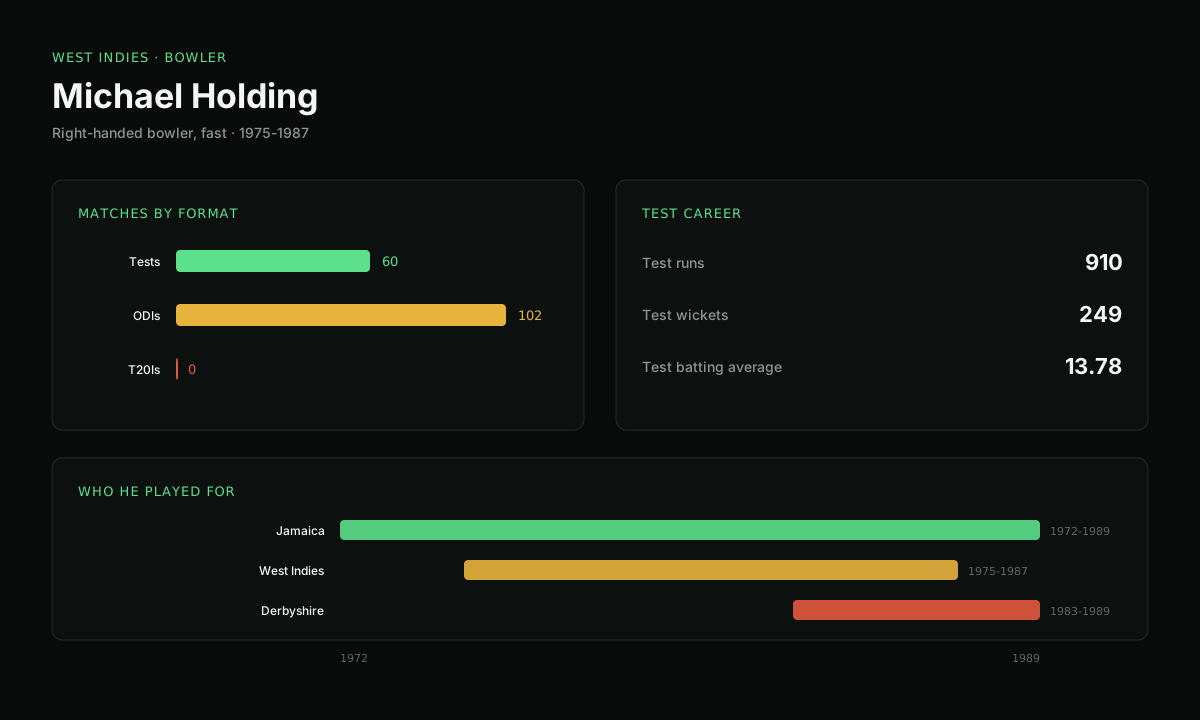
The full record is on his player page.
The Oval, 1976
England were 1-2 down in a series West Indies would win 3-0. The Oval pitch was flat, dry and gave the bowlers nothing at all.
Holding took 8 for 92 in the first innings and 6 for 57 in the second: 14 for 149 in the match, which remains the best analysis by a West Indian bowler.
The context is what makes it. On a surface where the other bowlers on both sides took their wickets at forty runs each, he bowled fast, full and straight, and took most of his wickets bowled or lbw because there was nothing else available. Batters were beaten by pace rather than by movement.
The run-up
The nickname came from umpires who could not hear him coming.
He ran in from about thirty metres with a long, silent, entirely upright stride, and the delivery came out of an action with no visible effort in it. Batters have described the specific problem it created: without the usual audible and visual cues of a fast bowler's approach, the ball arrived earlier than the run-up suggested.
He was also, by most accounts, the fastest of the West Indian bowlers of that period, which in an attack containing Roberts, Garner, Croft and later Marshall is a strong claim.
The Australian tour of 1975-76
The series that produced the attack is the one West Indies lost.
Australia beat them 5-1 with Lillee and Thomson bowling fast at a side whose own attack included a spinner and whose batters were repeatedly hit. Clive Lloyd concluded from it that the answer was four fast bowlers and no spinner, and Holding — who had taken his first Test wickets in that series — became one of the four.
He took 6 for 62 at Adelaide in that series, which was the only Test West Indies won, and it is the match usually identified as where he arrived.
The action, technically
The run-up was around thirty metres and completely straight, with an acceleration that was gradual rather than sudden, and a gather at the crease that lost nothing.
What made it silent was that nothing was fighting anything else. Most fast bowlers land heavily somewhere in the approach; his stride was even the whole way, and the force went forward rather than into the ground.
It is the action most often shown to young fast bowlers as a model, alongside Dennis Lillee's, and for the same reason: there is nothing in it that has to be corrected.
Sixty Tests
The total is small for a bowler of his standing and the reason is competition.
West Indies through his career had Roberts, Garner, Croft, Marshall, Daniel, Clarke and Holding, and could pick four. Players were rotated, rested and left out, and every one of them would have played 100 Tests for any other country.
He also lost time to World Series Cricket, in which he took 44 Supertest wickets that do not appear in any record.
A reasonable estimate is that on a modern schedule with a settled place he would have played 110 Tests and taken 450 wickets.
Old Trafford, 1976
The over he bowled to Brian Close in the same series is the one that comes up in discussions about how far the short ball should go.
Close was 45, recalled to open the batting, and faced an over from Holding in poor light in which he was hit repeatedly on the body without protection of any kind. The footage is still uncomfortable to watch.
It is one of the specific incidents behind the eventual limits on bouncers per over and behind the acceleration of helmet adoption, which is covered in how cricket helmets went from optional to compulsory.
Holding has said since that the bowling in that period went further than it should have, which is a rare admission from anybody involved.
The one-day record
142 wickets from 102 matches at 21.36, with a strike rate of 34.6, which is outstanding for the era.
He bowled in the 1975, 1979 and 1983 World Cup campaigns, winning the first two. The 1983 final, in which West Indies were bowled out for 140 by India and lost, is the match that ended their dominance of the format and he took two wickets in it.
The batting, briefly
910 runs at 13.78, with one fifty, and a highest score of 73.
He was a tail-ender who could hit the ball a long way and occasionally did. The relevant point for the record is that West Indies in that era batted to seven or eight and the last three were genuinely last three, which is a luxury only a side with four fast bowlers of that standard can afford.
The commentary career
He became one of the most recognisable commentators in the sport and, in 2020, used a broadcast to deliver an extended piece to camera about racism, education and the history behind it.
That broadcast is the single most-discussed thing any cricket commentator has said, and it changed what the sport's coverage was willing to address. He wrote a book on the subject shortly afterwards and stepped back from commentary in 2021.
Country and role narrow it to a group of five. The Tests column separates him: 60 is unusually few.
Michael Holding — Fourteen wickets at The Oval in 1976, on a pitch on which nobody else could take any. Full record
What the strike rate says
50.9 balls per wicket is excellent and is not the best in his own attack, which tells you something about the attack rather than about him.
Marshall took a wicket every 46.8 balls and Garner every 50.8. Those three, plus Roberts and Croft, were competing for four places in every Test, and the one who was rested was frequently the one who had bowled best in the previous match.
No other country has ever had that problem.
Where he sits in our dataset
Difficulty tier 1 on the player list. West Indies, bowler, 1975 to 1987 puts him with his own attack, and the Tests column at 60 is what separates him.
- 249 wickets from 60 Tests
- An average of 23.68
- Fewer wickets than his contemporaries
- A run-up nobody could hear
- 44 more in World Series Cricket
- A schedule with a fraction of the modern number of Tests
- Rotation among five bowlers of the same standard
- Which is why batters said he arrived early
- 249 wickets at 23.68, from only 60 Tests
- 14 for 149 at the Oval in 1976, on a pitch that gave nothing to anybody
- Left out and rotated because West Indies had five bowlers of that standard
- The 2020 broadcast on racism is the most-discussed thing a cricket commentator has said
The short version
He was the fastest bowler in the best attack ever assembled and played sixty Tests because there were four others just as good. The Oval fourteen-for is the innings, and the run-up is what everybody who faced him describes first.
For the attack he was part of, see the rise of the West Indies, and for the bowler most often named ahead of him in it, Malcolm Marshall by the numbers.