Dennis Lillee by the numbers, and the back that should have ended it
355 Test wickets at 23.92 from 70 matches, taken by a bowler who broke his back at 24, was told he would not bowl again, and then took 300 more.
Dennis Lillee suffered stress fractures in four vertebrae at 24, was told his career was over, spent six weeks in a plaster cast and eighteen months rehabilitating, and came back to take more than 300 further Test wickets.
- 355 Test wickets at 23.92, from 70 Tests
- He broke his back in 1973 and was told he would not bowl fast again
- 167 further wickets came in World Series Cricket, which do not count
- He and Jeff Thomson formed the most feared new-ball pair of the 1970s
The record
| Format | Matches | Wickets | Average | Strike rate |
|---|---|---|---|---|
| Tests | 70 | 355 | 23.92 | 52.0 |
| ODIs | 63 | 103 | 20.82 | 34.9 |
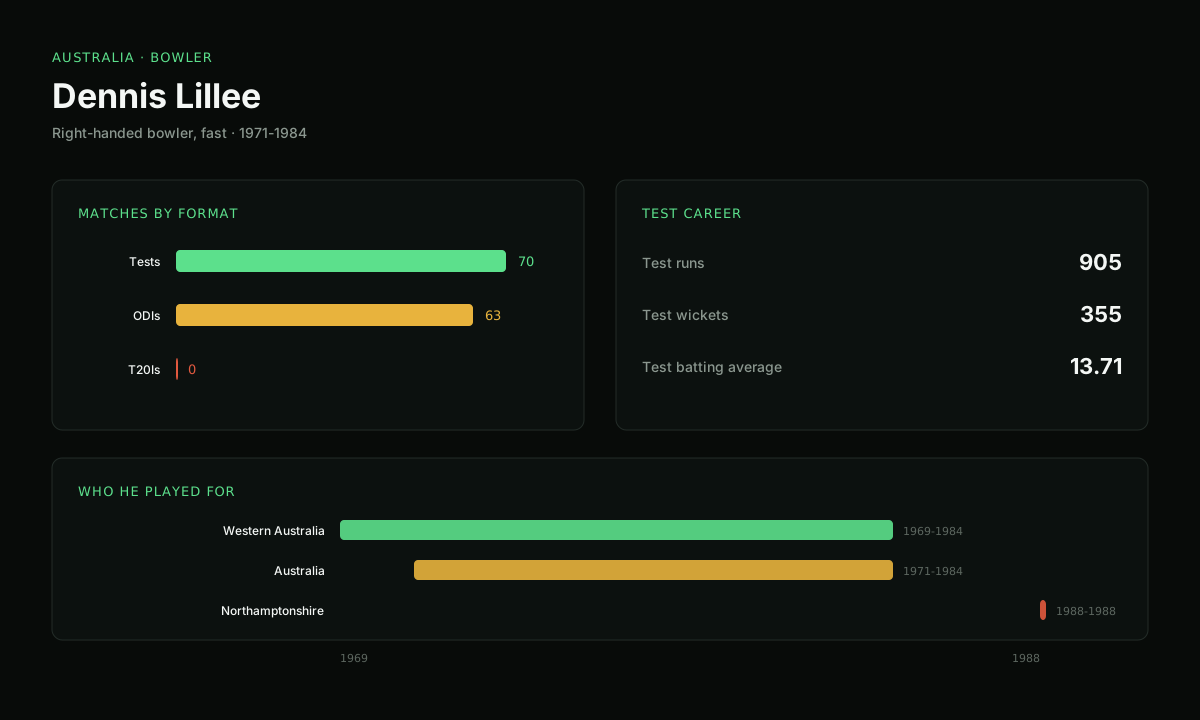
The full record is on his player page.
The back
In 1973, on tour in the West Indies, he was diagnosed with stress fractures in four vertebrae. He was 24 and had taken 31 Test wickets.
The medical advice was that he would not bowl fast again. He spent six weeks in a plaster cast from his hips to his chest and eighteen months rebuilding, on a rehabilitation programme that was essentially invented for him because nothing comparable existed.
He came back in 1974 and took 25 wickets in the Ashes that summer, and another 300 in the decade that followed.
The rehabilitation programme he went through is one of the origins of modern sports medicine in Australian cricket. Fast bowlers with stress fractures now follow a recognised path; before him there was not one.
The missing wickets
70 Tests is a small number for a bowler with 355 wickets, and there are two reasons beyond the injury.
He played two seasons of World Series Cricket, in which he took 79 wickets in Supertests against the best batters in the world. Those matches are not recognised as Tests, so the wickets do not appear in his record.
And Australia played fewer Tests in the 1970s than any modern side does. He was available for far fewer matches than a bowler of his standing would be now.
A reasonable estimate is that on a modern schedule, without the injury and without World Series Cricket, he would have played 120 Tests and taken 600 wickets.
The effect on batters was not only physical. England's batting order in that series was rearranged repeatedly, players withdrew from tours afterwards, and the phrase that attached itself to the pairing — "Ashes to ashes, dust to dust, if Thommo don't get you, Lillee must" — circulated widely enough to become the standard description of what facing them was like.
Two of England's batters in that series were hit on the head. Neither was wearing anything.
Lillee and Thomson
The pairing with Jeff Thomson through the mid-1970s is the most feared new-ball combination before the West Indian quartet.
Thomson was the faster of the two — probably the fastest bowler who has ever played — with a slinging action that gave batters almost no sight of the ball. Lillee was the more skilful, with an outswinger, a bouncer he used tactically, and a clear plan for every batter.
The 1974-75 Ashes, in which they took 58 wickets between them and England were beaten 4-1, is the series that established both. It was also bowled at bare heads: helmets did not exist in Test cricket yet.
There is a second reason the action matters. It became the template Australian coaching used for two decades, and a generation of Australian fast bowlers were built to look like him, which is a genuine legacy and produced its own problems when bowlers whose bodies did not suit it were made to try.
The action
His action is the one most often held up as a model, and it is worth stating why.
Everything moved in the same direction. A long, rhythmic run-up, a high leap, a side-on delivery with the front arm driving down, and a complete follow-through. There were no lateral forces in it and nothing that had to be corrected.
The paradox is that the model action produced the broken back. The reason appears to be volume rather than technique: he bowled enormous quantities in his early twenties in an era before workload management, and the fractures were the result.
The second career
After the injury, having lost some pace, he became a more complete bowler.
The outswinger became the primary weapon, he added a leg-cutter, and the bouncer was used sparingly rather than as a stock ball. The wickets came at a better average after 1974 than before it.
That trajectory — fast bowler loses pace, becomes better — recurs throughout this series and it is the single most consistent pattern in fast bowling careers.
The span from 1971 to 1984 narrows it enormously. Very few Australians in the dataset span that period.
Dennis Lillee — Came back from stress fractures in his back to become the most feared fast bowler of his era. Full record
The aluminium bat
At Perth in 1979, batting against England, he came out with an aluminium bat.
He had a commercial interest in it. Play was held up for ten minutes while the England captain objected, the Australian captain instructed him to change it, and he eventually threw the bat some distance across the field.
The Laws were amended shortly afterwards to specify that a bat must be made of wood. It is one of the very few occasions when a Law has been written in direct response to a single player's conduct.
- 355 wickets from 70 Tests
- An average of 23.92
- Five wickets a Test
- The model fast bowling action
- 79 more in World Series Cricket, which do not count
- Two years lost to a broken back at his peak
- A schedule with far fewer Tests than a modern bowler gets
- Which is also what broke
The one-day record
103 wickets at 20.82 from 63 matches, with a strike rate of 34.9 balls per wicket.
Those are the best one-day figures of anybody from the format's first decade and they are almost never quoted, because the format was not taken seriously enough at the time for anybody to keep proper track.
He also bowled in the first World Cup final in 1975 and in the 1979 final, and took 5 for 34 against Pakistan in the 1975 tournament.
The coaching afterwards
He ran the MRF Pace Foundation in Chennai for more than two decades, which is the institution most directly responsible for India learning to produce fast bowlers.
The list of bowlers who passed through it includes several who went on to play Test cricket for India, and the broader effect is that a country which had produced one genuine fast bowler in its history acquired a place where young quicks were identified and coached properly.
That is a substantial second career and it is the reason his name comes up in Indian cricket far more often than a foreign fast bowler's normally would.
Where he sits in our dataset
Difficulty tier 1 on the player list. Australia, bowler, 1971 to 1984 is a unique span, and the wickets column confirms it.
- 355 Test wickets at 23.92 from only 70 matches
- Four fractured vertebrae at 24, and 300 more wickets afterwards
- 79 Supertest wickets in World Series Cricket that do not appear anywhere
- The Law specifying a wooden bat exists because of him
The short version
He broke his back at 24, was told to stop, and finished with five wickets a Test. The recognised record understates him by two years of injury, two years of World Series Cricket, and a schedule that gave him half the matches a modern bowler gets.
For the competition that removed two years of it, see World Series Cricket, and for the equipment question he accidentally settled, why bats have a sweet spot and where it is.