Cricket fielding positions, named and explained
Forty-odd names that sound arbitrary and are not. The whole system is three words combined, and once you know the grammar you can name any position on the field.
Cricket fielding positions sound like a private language: gully, fine leg, silly mid-on, deep backward square. They are not arbitrary. The system is a small grammar, and once you have it you can name any position on the field without memorising a list.
- The field splits into off side and leg side, decided by which way the batter stands
- Three modifiers do all the work: how deep, how square, and which side
- "Silly" means very close, "deep" means near the boundary, "fine" means near straight
- Slips and gully are the only positions with names that break the pattern
Step one: off side and leg side
Stand where the batter stands. The side the bat is on is the off side; the side the legs are on is the leg side, also called the on side.
For a right-handed batter facing, the off side is to the bowler's left. For a left-hander it flips, which is why the field is rearranged when a left-hander comes in and why left-right batting pairs are tactically awkward.
Every position name is prefixed or implied by one of these two.
Step two: the three modifiers
| Modifier | Means |
|---|---|
| silly | very close to the bat, inside the ring |
| short | close, but not suicidal |
| (none) | the standard distance, inside the circle |
| deep / long | near the boundary |
| fine | angled towards straight behind the wicket |
| square | at right angles to the pitch |
| backward | behind square |
| forward | in front of square |
Combine them and the names build themselves. Deep backward square leg is near the boundary, behind square, on the leg side. Silly mid-off is very close, in front of the batter, on the off side.
Where is "deep backward square leg"?
Deep means near the boundary, backward means behind square, square means at right angles to the pitch, leg means the leg side. The name is a set of instructions.
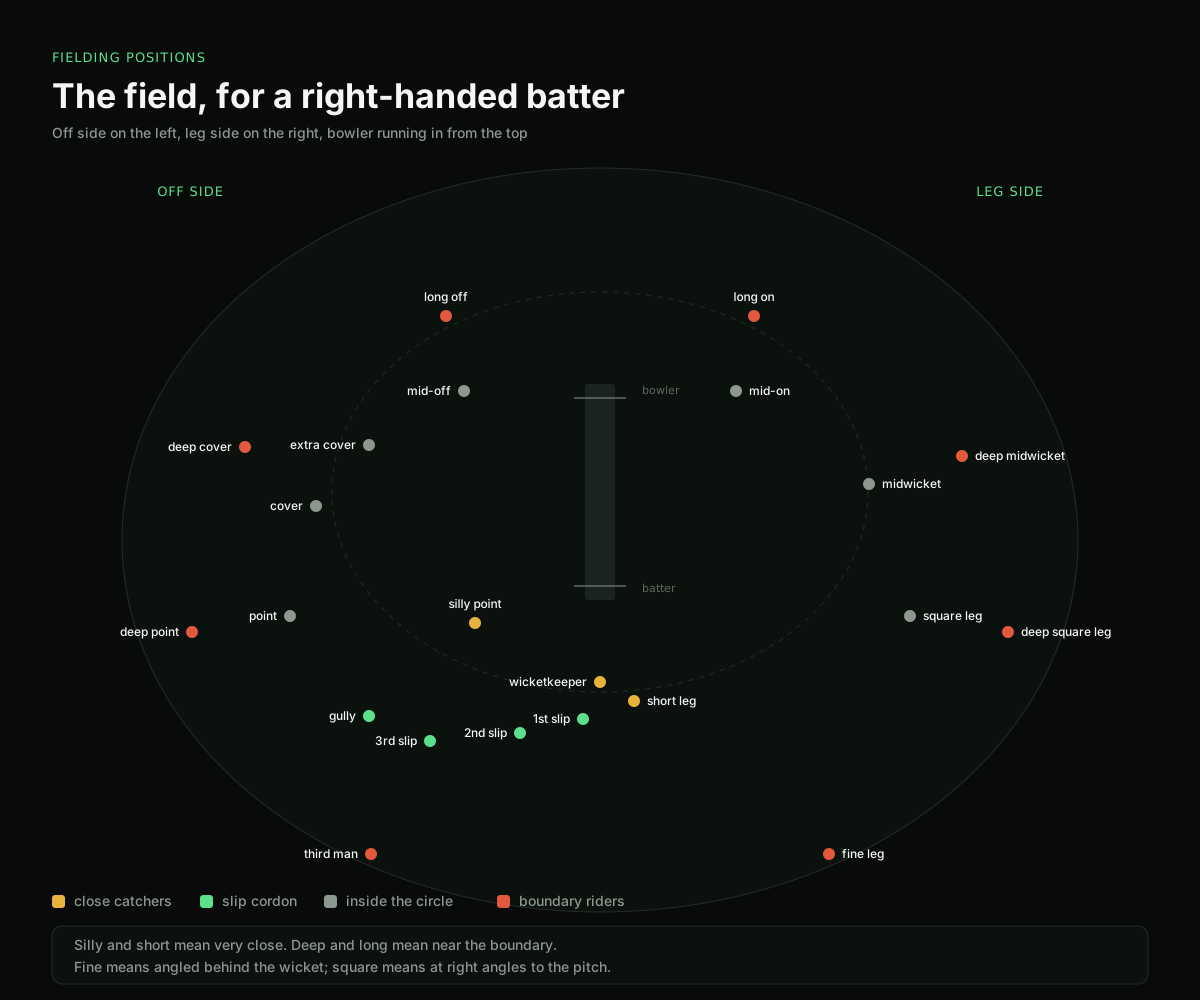
The named positions that break the pattern
A handful have proper names rather than descriptions:
Slip. Behind the batter on the off side, next to the keeper, waiting for an edge. Numbered outward: first slip is nearest the keeper.
Gully. Just beyond the slips, squarer. The name comes from the gap it fills.
Point. Square on the off side, roughly level with the batter.
Cover. Between point and mid-off, the region a cover drive goes through.
Mid-on and mid-off. Straight-ish, in front of the batter, either side of the bowler.
Third man. Deep, behind square on the off side, catching thick edges that beat the slips.
Fine leg. Deep, behind square on the leg side, catching glances and top edges off the hook.
Why the slip cordon is arranged the way it is
Edges do not travel randomly. A ball nicked off the face of the bat goes finer or squarer depending on how late the batter played it and how much the ball was moving.
Faster bowling carries edges further, so the cordon stands deeper and wider. Spin produces slower, closer edges, so the slip moves in and the leg slip appears. A captain who moves second slip a metre squarer between deliveries is making a specific prediction about the next edge.
How a captain actually builds one
Nobody places nine fielders by working through the names. They are placed in three passes, in this order, and the order is why fields look the way they do.
Pass one: the boundaries. Grounds are not symmetrical. The captain finds the short side, decides which shot they are willing to be hit for six by, and puts the riders out accordingly. Everything else is built around that decision.
Pass two: the shot the bowler is trying to make happen. A bowler bowling across a right-hander wants the edge, so cover and point are set for the drive that finds it. A bowler bowling into the pads wants the flick, so midwicket moves squarer. If you can see what the field is protecting, you can see what the bowler is trying to bowl.
Pass three: what is left. Usually two fielders, and they go where the batter in front of them scores. Against a player who works everything square, the last two go square.
The whole process takes about ten seconds between overs and it is the most visible tactical thinking in the sport.
The mirror image for a left-hander
Every name in the diagram is defined relative to the striker, not to the ground. When a left-hander comes in, the entire field flips: what was cover is now midwicket, the slips move to the other side of the keeper, and the man at deep point is now at deep square leg without moving a step.
This is why the fielding side takes so long over a left-right batting pair. Every single they take reverses the field, and a captain who sets a good field for one batter has set a mirror-image field for the other. Sides deliberately keep a left-right pair together at the crease for exactly this reason, and bowlers hate it more than they admit.
It is also the source of the most common confusion for new watchers. The commentator says the ball went to midwicket, you look up the diagram, and it is on the wrong side — because the diagram was drawn for a right-hander and the batter is not one.
What formats do to a field
The same eleven players, three completely different shapes.
| Format | Typical shape | What it says |
|---|---|---|
| Test, new ball | three slips, gully, no rider | we expect an edge, and soon |
| Test, old ball | one slip, seven saving one | we are waiting for a mistake |
| ODI middle overs | two out, ring saving singles | dry it up, force a shot |
| T20 death | five out, two in | we accept four, we refuse six |
A Test field is built to take a wicket and a T20 field is built to prevent runs, and you can tell which game is on with the sound off by counting the slips.
What a field tells you
A field is a captain's plan made visible, and you can read it.
Three slips and a gully: attacking, expecting an edge, probably a new ball.
Two men out on the leg-side boundary: he expects the batter to pull, and is inviting it.
A sweeper on the off side and nobody in catching positions: containment. The captain has given up on a wicket this over and is protecting runs.
Silly point and a short leg: spin, a turning pitch, and a plan to catch bat-pad.
- Slips, gully, short leg
- Fielders inside the circle
- Catching positions in front of the bat
- Expecting a wicket this over
- Sweepers on both boundaries
- Fielders protecting the rope
- Nobody within twenty yards of the bat
- Expecting to concede four an over and no more
The rules that constrain it
Only two fielders may stand behind square on the leg side, ever. During powerplays the number outside the circle is capped. Breaking either is a no-ball.
Everything else is free, which is why a captain's field is one of the few places in cricket where you can see somebody thinking.
- Off side and leg side are defined by which way the batter stands
- Silly, short, deep, fine, square, backward and forward build every name
- Slip, gully, point, cover, mid-on, mid-off, third man and fine leg are the proper nouns
- A field is a plan you can read without commentary
For the Law behind the leg-side limit, see Bodyline.