What the follow-on is, and why captains stopped enforcing it
A 200-run lead lets you make the other side bat again. Three teams in history have lost after enforcing it, and that is enough to have changed the tactic.
The follow-on is a Test cricket rule that lets a side with a large first-innings lead make the opposition bat again immediately, rather than batting themselves. It sounds like an obvious advantage. Captains increasingly decline it.
- The lead required is 200 in a five-day Test, less in shorter matches
- It is optional, always, and the fielding captain decides
- Three sides in history have won after being made to follow on
- Bowler workload, not the risk of losing, is why it is declined now
The thresholds
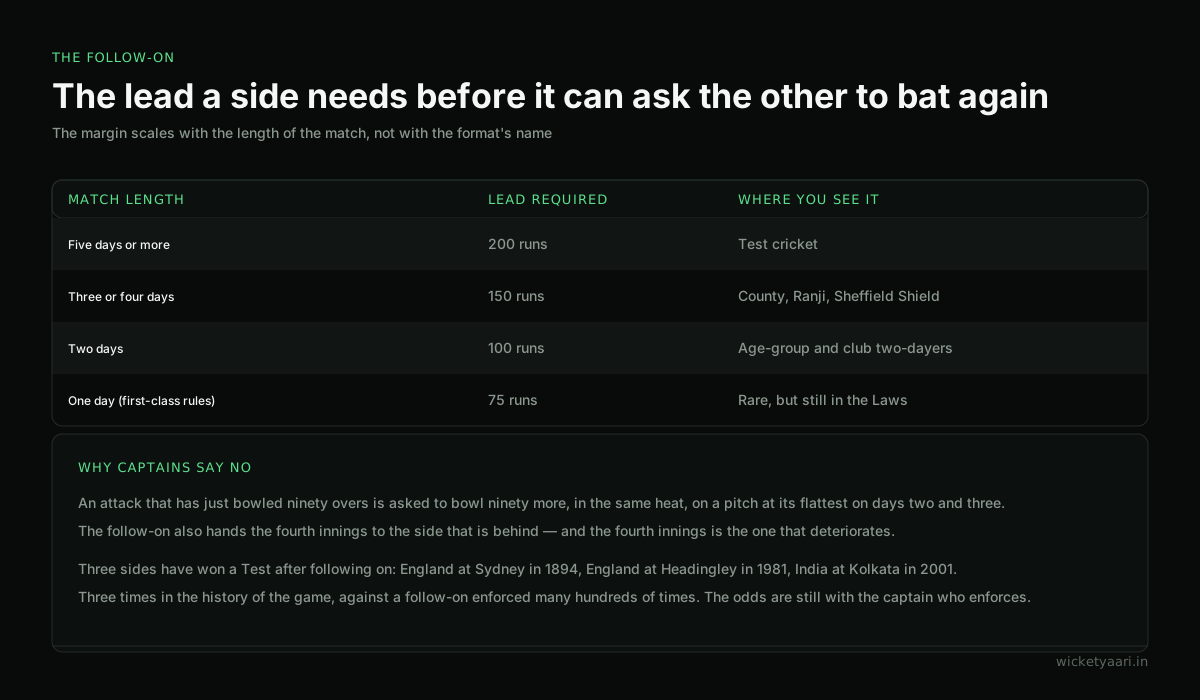
| Match length | Lead required |
|---|---|
| Five days | 200 |
| Three or four days | 150 |
| Two days | 100 |
| One day | 75 |
If rain has cost the first day of a five-day Test, the match is treated as a four-day one for this purpose, so the threshold drops to 150.
The arithmetic in favour
Enforcing it means the opposition must bat again with the deficit still on the board, on a pitch that is a day or two older and usually deteriorating.
If they fail again, the match ends in three or four days and the fielding side never bats twice. If they survive, the fielding side chases a small target in the fourth innings, which is the only bad outcome on paper.
For most of Test history that arithmetic was considered so obviously right that declining it required an explanation.
How many teams have won a Test after being made to follow on?
Three, in the entire history of Test cricket. India at Eden Gardens in 2001 is the most recent, and the reason the tactic acquired a reputation for danger it barely deserves.
What changed the tactic
The famous answer is 2001. India, 274 behind, followed on at Eden Gardens, batted for two days and won by 171. Australia had won sixteen Tests in a row before it.
That match is genuinely responsible for a chunk of the caution that followed. But three occurrences in nearly a century and a half is not a risk profile that justifies abandoning a tactic, and the real reason is duller.
Bowler workload. Modern fast bowlers are managed. Asking an attack that has just bowled a side out to go straight back out, in heat, for another eighty overs, is a load nobody wants to take. Batting for a session instead gives them a rest and puts the game further out of reach.
Fourth-innings pitches. Captains would rather bat third on a pitch that is still good and set a target than bat fourth on one that has broken up.
The declaration alternative
The modern default is to bat again, score quickly for a session or two, and declare with a lead of 400 or more and two days to bowl the other side out.
It costs time, which is the one thing that can turn a winning position into a draw. Captains who bat too long and then fail to take ten wickets are criticised for exactly this, and it happens more often than a follow-on backfiring does.
- The opposition bats on a deteriorating pitch immediately
- Your bowlers go straight back out
- You may have to chase a small fourth-innings target
- Finishes the match faster
- The opposition bats last on a worse one
- Your bowlers rest for a session
- You set the target
- Costs time, and time is what saves a draw
Where it interacts with the weather
The follow-on is at its strongest when the forecast is bad. A side that enforces and bowls the opposition out cheaply can finish the match before the rain arrives; a side that bats again may find the fifth day washed out with the opposition seven down.
That is the situation in which even the most cautious modern captain will enforce it, and it is why the tactic has not disappeared.
The arithmetic of the alternative
A captain who declines the follow-on is buying three things and paying for them with time.
A rest for the bowlers. Usually a session and a half, which for a fast bowler between spells is the difference between bowling at full pace on day five and not.
The good batting conditions. Days three and four are the flattest the pitch will be. Batting again means taking those for yourself and handing days four and five to the opposition.
A target rather than a chase. Setting 350 with two days left is a stronger position than defending a lead of 250 with the opposition batting on a good surface, even though the arithmetic looks similar.
The cost is real: roughly a session and a half of playing time, and the risk that rain takes the rest. Captains who decline the follow-on and then draw a match they should have won get criticised heavily, which is why the decision is more contested than the arithmetic suggests it should be.
| Enforce | Decline |
|---|---|
| Saves a day and a half | Costs a day and a half |
| Bowlers back on immediately | Bowlers rest a session or more |
| Opposition bats on the better surface | You bat on the better surface |
| You chase in the fourth innings, if at all | They chase in the fourth innings |
The detail that catches sides out
The follow-on threshold is based on the scheduled length of the match, not the time remaining in it.
A five-day Test that loses its first two days to rain is still a five-day match: the lead required is 200, not some reduced figure. Sides have miscalculated this in shortened first-class fixtures, worked out a threshold from the days actually available, and found the option was not open to them.
There is a second detail. If the match starts late — the first day lost entirely — the Laws allow a two-innings match to be treated as one day shorter for this purpose in some competitions. Whether that applies depends on the playing conditions, not the Laws, and it is one of the very few places where the two routinely disagree.
When it is still obviously right
Three situations, and captains still enforce in all of them.
When the weather is coming. If two days are forecast lost, the extra day and a half is worth more than everything else on the list.
When the lead is enormous. A lead of 400 with three days left means the match cannot realistically be lost, and the only question is whether there is time to win it.
When the opposition is broken. A side bowled out for 90 in 32 overs, in the first innings, on a pitch that is doing something, is a side that will not suddenly bat for 150 overs. The follow-on is a way of asking them to prove it while the conditions are still helping.
The rule nobody remembers
The side that follows on bats its second innings immediately, but the match innings order does not change. If the follow-on side then sets a target, the side that enforced bats fourth — which is the whole reason the tactic carries any risk at all.
There is also no obligation to enforce it at the earliest opportunity. A captain who declines can still not bat: they simply bat, and the option lapses. It cannot be saved for later in the match.
- 200-run lead in a five-day Test, and it is always optional
- Only three sides have ever won after following on
- Workload and fourth-innings pitches, not the risk of losing, drive the decision
- Bad weather is when even cautious captains still enforce it
The match that changed the reputation is here. For the format the rule only exists in, see Test, ODI and T20.