Bodyline, and the only Law ever changed by a diplomatic cable
England's 1932 plan to contain Don Bradman was legal, effective and so contentious that two governments got involved and the Laws were rewritten.
Bodyline is the only time in cricket history that a tactic worked so well and was resented so deeply that the Laws were rewritten to make it impossible.
It is also the only cricketing dispute that reached the level of governments exchanging messages about it.
- The plan was legal under the Laws as they stood in 1932
- It was designed to contain one batter, and it worked
- The Australian board's cable accusing England of unsportsmanlike conduct escalated it
- The Law limiting leg-side fielders exists because of this series and nothing else
The problem England were trying to solve
Don Bradman had averaged 139 in the 1930 Ashes in England. Not 39. A hundred and thirty-nine.
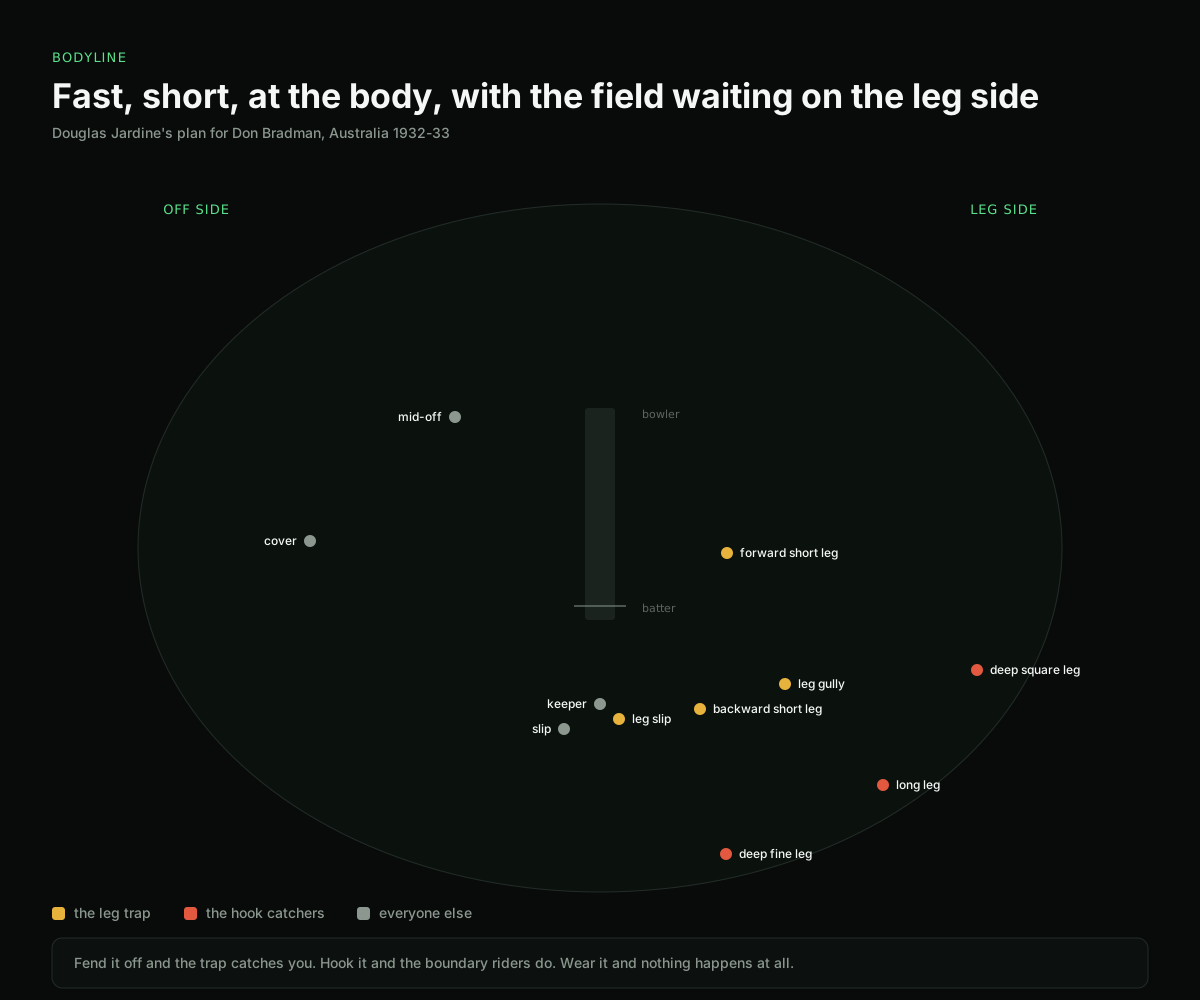
No orthodox plan had contained him, and England's captain Douglas Jardine concluded that no orthodox plan would. The tactic he arrived at was to bowl fast and short at the batter's body, with a packed ring of close catchers on the leg side, so that any defensive fending shot went to hand.
It had a technical name — leg theory — and a name the Australian press gave it, which is the one that stuck.
Why it was legal
Nothing in the 1932 Laws limited how many fielders could stand behind square on the leg side, and nothing prohibited bowling short at the body.
Fast bowling at the body was not new. What was new was doing it relentlessly, with an eight-two field, from bowlers of genuine pace, to a plan, for whole sessions. The individual components were all ordinary. The combination was not.
What made Bodyline legal in 1932?
The Laws simply had no provision covering it. Every element was legal; it was the combination, sustained, that had never been tried.
The cable
After Bert Oldfield was struck on the head at Adelaide, in front of a crowd that came close to a riot, the Australian Board of Control cabled the MCC:
Bodyline bowling has assumed such proportions as to menace the best interests
of the game, making protection of the body by the batsman the main
consideration. This is causing intense bitterness between the players as well
as injury. In our opinion it is unsportsmanlike.
The word "unsportsmanlike" was the problem. In 1933, to an English cricketing establishment, it was close to the worst accusation available, and the MCC replied by threatening to cancel the remainder of the tour.
Both governments became involved, because trade relations between Britain and Australia were being discussed at the same time and nobody wanted a cricket series to complicate them. The Australian board eventually withdrew the word.
- 1930The problemBradman averages 139.14 in an Ashes series in England
- 1932The planJardine's side sails for Australia with a leg-theory attack
- 1933AdelaideOldfield is struck; the crowd nearly riots; the cable is sent
- 1933The replyThe MCC threatens to abandon the tour unless the word is withdrawn
- 1935The LawFielders behind square on the leg side are limited, permanently
What changed afterwards
England won the series 4-1. Jardine was never again a popular figure in Australia and did not captain England for long afterwards.
Within two years the Laws limited the number of fielders permitted behind square on the leg side. That limit exists today and its entire reason for existing is this one series. Later additions restricting short-pitched bowling per over came from the same lineage.
- A legal tactic under the 1932 Laws
- Designed to contain one batter
- 4-1 to England
- Fast, short, to a packed leg-side field
- A permanent Law limiting leg-side fielders
- Rules on short-pitched deliveries per over
- A captain who was never forgiven
- The template for every debate about intimidatory bowling since
Adelaide, which is where it stopped being cricket
The third Test in January 1933 is the match that turned a tactic into a diplomatic incident.
Bill Woodfull, Australia's captain, was struck over the heart by a ball from Harold Larwood — bowled to a conventional field, not a leg trap. Jardine was heard to say "well bowled, Harold". Then, with Woodfull still recovering, England moved the field to the leg side for the next over, in front of a crowd of around fifty thousand that had watched the whole thing.
Later in the same innings Bert Oldfield was hit on the head by another Larwood delivery and suffered a fractured skull. The ball was also to a conventional field, and Oldfield said publicly that the fault was his own. The crowd did not agree, mounted police were positioned at the ground, and the match continued.
Woodfull's remark to the England manager in the dressing room afterwards was the line that got out: "There are two teams out there. One is playing cricket, the other is not."
The cost to the man who bowled it
Harold Larwood was the fastest bowler in the world and he never played for England again after that tour.
He was asked to apologise, in writing, for the way he had bowled. He refused, on the grounds that he had bowled where his captain told him to. That was the end of his international career at twenty-eight. Jardine, an amateur and a captain, lost the captaincy but not his place in the game.
Larwood emigrated to Australia in 1950 and lived there for the rest of his life. The country he had been vilified in received him warmly, which is either a comment on how quickly a sporting grievance fades or on who Australians thought was actually responsible.
What the law changes actually did
Two changes, several years apart, and neither of them mentions bodyline by name.
In 1935 the MCC outlawed direct attack bowling: persistent short-pitched deliveries aimed at the batter's body were made unfair, and the umpire was given the power to intervene. It is a judgement-based law, and judgement-based laws are hard to enforce, which is why it did not settle the question.
In 1957 came the change that actually worked: no more than two fielders behind square on the leg side. That is a countable rule with no discretion in it, and it makes the leg trap physically impossible to set. Every leg-side fielding restriction in the modern game descends from that clause, and it is the reason a no-ball can be called for a field placing.
The bouncer limits per over came much later and for different reasons, but the principle they rest on was established here: if you cannot legislate against intent, legislate against the arrangement that intent requires.
The argument that never resolved
Two readings survive, and both have a case.
The first: Jardine found the only tactic that worked against the greatest batter in history, was within the Laws, and was punished for winning.
The second: a tactic whose primary mechanism is the physical risk to the batter is not cricket, whatever the Laws happen to say at the time, and the Laws caught up.
Nearly a century on, every argument about short-pitched bowling, helmet safety and concussion protocols is a descendant of that one, and it has never been settled.
- Legal in 1932, and effective enough to halve Bradman's average
- The word "unsportsmanlike" turned a cricket row into a diplomatic one
- The leg-side fielding limit exists only because of this series
- The underlying argument about intimidatory bowling has never been resolved
For where this sits in the wider story, see the history of cricket in ten moments. For how the modern game handles the same risk, see every way a batter can be out.