The maiden over, and why it means three different things
Six balls without a run is routine in a Test, notable in an ODI and close to extinct in T20 — and it is worth about eight runs when it happens.
A maiden over is six legal deliveries from which no runs are scored off the bat or as extras charged to the bowler. It is one line in the bowling figures and it means something completely different in each format.
- A maiden is six legal balls with no runs charged to the bowler
- Byes and leg byes do not break it; wides and no-balls do
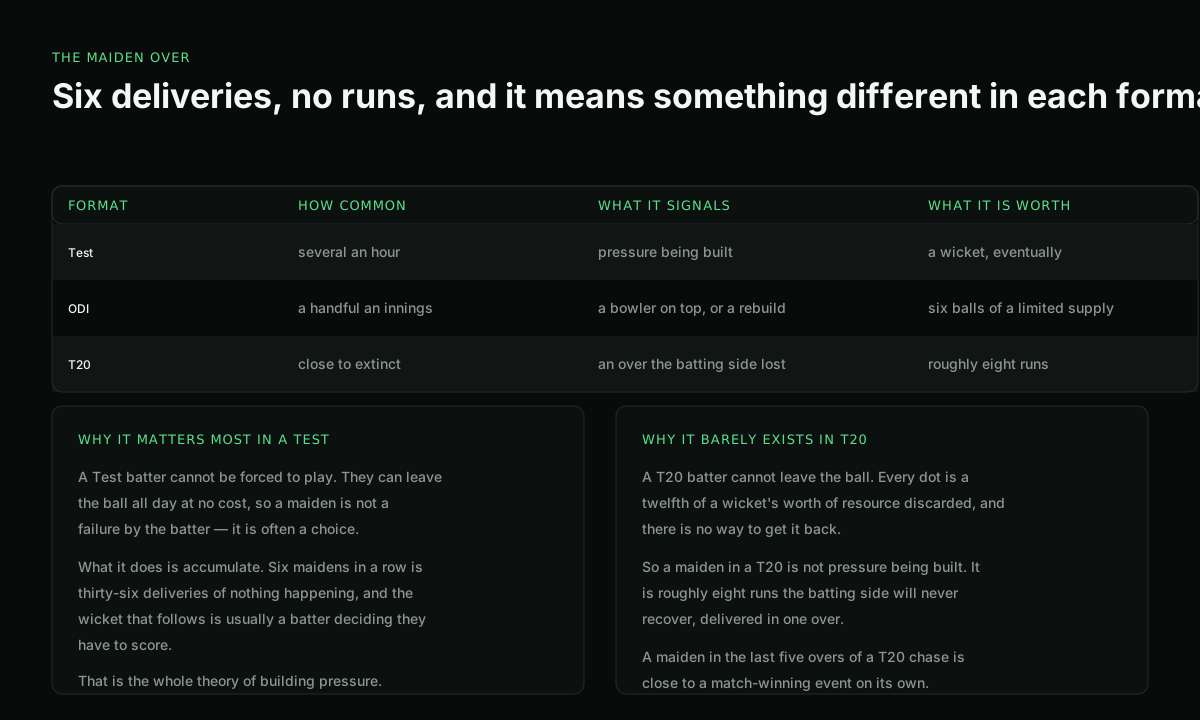
- In a Test it accumulates pressure; in a T20 it is worth roughly eight runs
- A wicket maiden is the best over a bowler can bowl
The definition, precisely
The over must consist of six legal deliveries, so a wide or a no-ball ends any chance of a maiden immediately — those runs are charged to the bowler.
Byes and leg byes do not. The batting side can score four byes off a delivery and the over can still be a maiden, because those runs are not the bowler's fault and are not charged to them.
A wicket maiden is a maiden in which the bowler also takes a wicket. It is the best over available in cricket: six balls, no runs, and a batter removed.
Why it matters most in Test cricket
A Test batter is under no obligation to score. They can leave every ball outside off stump for an hour at no direct cost, because there is no delivery limit.
So a maiden in a Test is frequently a batter's choice rather than a bowler's triumph. What makes it valuable is accumulation. Six maidens in succession is thirty-six deliveries in which nothing has happened, and the batter has been standing still, watching, thinking, and gradually deciding that they need to do something.
The wicket that follows a long sequence of maidens is almost always a shot the batter would not have played half an hour earlier. That is the entire theory of building pressure, and it is the reason a Test bowler's economy rate matters even though nobody wins a Test by conceding few runs.
Why it barely exists in T20
A T20 batter cannot leave the ball. Each of the 120 deliveries in the innings is a resource, and one that produces nothing is gone.
Which means a maiden in a T20 is not pressure being built. It is a direct subtraction: roughly eight runs the batting side expected from that over and will never get back. There is no later phase in which to make it up, because the innings has a hard stop.
A maiden in the last five overs of a T20 chase is close to a match-winning event on its own, and the bowler who delivers one has usually done more for their side in that over than a wicket-taker did earlier.
| Format | Frequency | What it means | Rough value |
|---|---|---|---|
| Test | several an hour | pressure accumulating | a wicket, later |
| ODI | a few an innings | a bowler on top | five to six runs |
| T20 | very rare | an over lost outright | eight runs or more |
The maiden that is not a good over
There is a version worth being sceptical about.
A bowler who bowls six balls a foot outside off stump to a batter who has no intention of chasing them has bowled a maiden and achieved nothing. The batter is not under pressure; they are being left alone. In Test cricket this is called bowling dry and it is a legitimate holding tactic, but a run of such maidens is a stalemate rather than a bowler on top.
The maiden that means something is the one where the batter played at four of the six and missed or edged two of them. That over is identical in the scorebook and completely different in the match.
This is the honest limitation of the statistic: it counts runs not conceded, and says nothing about whether a wicket was ever likely.
Where the record books sit
Maiden counts in Test cricket are dominated by bowlers from earlier eras, and the reason is scoring rates rather than accuracy.
An era in which sides scored at 2.4 an over produced far more maidens than one scoring at 3.4, from bowlers who were not necessarily any more accurate. Comparing maiden totals across generations tells you about the batting of the period at least as much as the bowling.
The same distortion applies within a career: a bowler who spent years bowling to tail-enders and defensive sides will have a higher maiden count than a contemporary bowling at attacking top orders, with no difference in quality.
A bowler delivers six legal balls. The batters run four byes off the third and take no other runs. Is it a maiden?
Byes are not charged to the bowler, so they do not break a maiden. A wide or a no-ball would, because those runs go on the bowler's card and the delivery is not legal.
- No runs charged to the bowler
- Six legal deliveries
- Nothing off the bat or in extras
- A number in the figures
- Whether the batter was ever in trouble
- Whether the bowler was attacking or containing
- Byes conceded, which can be four runs
- The scoring rate of the era it was bowled in
The bowler who bowls them
Maidens cluster around a particular kind of bowler, and it is not always the best one in the attack.
The classic maiden bowler works a fifth-stump line at a full length with a slip and a gully, offers nothing to drive and nothing to leave comfortably, and does it for eight overs at a time. In a Test attack that bowler is the one who holds an end while somebody else attacks from the other, and their figures often understate what they did.
The attacking bowler at the other end takes the wickets and gets the five-for. The holding bowler produces the maidens that made the batter decide to take a risk, and the scorecard splits the credit in exactly the wrong proportion.
Which is one more reason a bowling card should be read as a pair of ends rather than as a list of individuals.
The white-ball maiden as a tactic
There is a specific and underused idea in limited-overs cricket: bowling for the maiden rather than for the wicket.
In a chase where the required rate is climbing, a bowler who concedes nothing has transferred the whole over's requirement onto the remaining overs. Against a side needing nine an over with five to go, a maiden makes it eleven with four — which is frequently the moment a chase breaks.
Captains use it less than the arithmetic suggests, because it requires accepting a higher risk of a boundary in pursuit of a dot-ball sequence, and a boundary in that situation is visible while a dot ball is not.
- Byes do not break a maiden; wides and no-balls do
- In a Test it accumulates; in a T20 it subtracts
- Six balls a batter ignored is a different over from six they played at
- Historical maiden totals reflect the scoring rates of the era
The short version
A maiden is six balls with nothing charged to the bowler, and what it is worth depends entirely on whether the batting side had a way of getting those runs back. In a Test they do. In a T20 they do not.
For the numbers a bowler is measured on, see bowling economy rate explained, and for why the formats value the same over so differently, the value of a wicket in each format.