How the Ashes got its name, and why the urn is tiny
A satirical obituary in a London newspaper in 1882 invented the most durable rivalry in sport, and the trophy everyone pictures has never been the trophy.
The Ashes is the only major sporting trophy named after a joke in a newspaper, and the urn that everybody pictures is not the trophy, has never been the trophy, and is about eleven centimetres tall.
- It began as a mock obituary printed after England lost at The Oval in 1882
- The urn is a private gift, not a trophy, and lives permanently at Lord's
- Sides do not play for the urn; they play for a replica and the title
- The rivalry is older than the ICC, the World Cup and one-day cricket
What actually happened in 1882
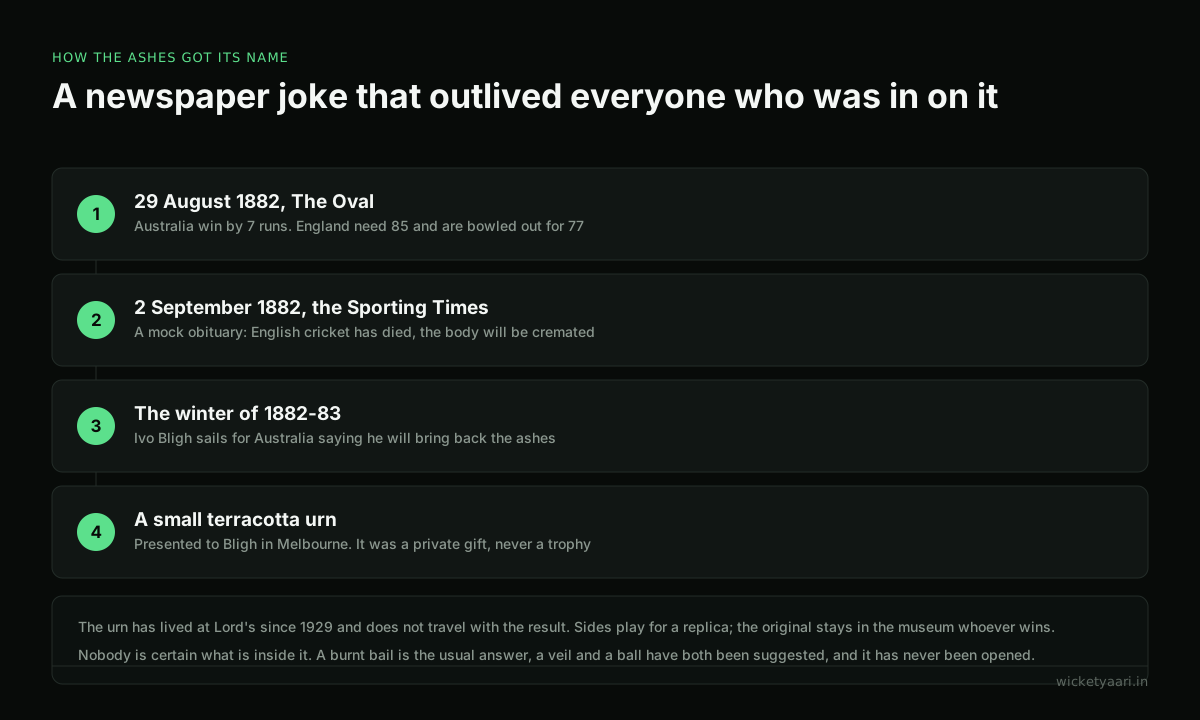
Australia beat England at The Oval by seven runs. It was England's first home defeat to Australia, and it was a shock in the way only a first can be.
Two days later the Sporting Times printed a mock obituary:
In Affectionate Remembrance of ENGLISH CRICKET, which died at the Oval on 29th
August, 1882. Deeply lamented by a large circle of sorrowing friends and
acquaintances. R.I.P. N.B. — The body will be cremated and the ashes taken to
Australia.
That is the entire origin. A satirical death notice, written for a laugh, in a sports paper.
The urn is a private gift
England toured Australia that winter, and the press framed it as a quest to recover the ashes. During that tour a small terracotta urn was presented to the England captain, Ivo Bligh, by a group in Melbourne. What was inside it has been variously described as a burnt bail, a burnt ball, and a burnt veil.
Crucially it was a personal gift, not a trophy. Bligh kept it. It passed to his widow, and only after his death in 1927 did it go to the MCC.
It has stayed at Lord's ever since, and it does not travel with the series result. Winning the Ashes does not mean receiving that urn.
What do the two teams actually receive for winning an Ashes series?
The original stays at Lord's permanently. A crystal replica has been presented to the winners since 1998, and before that the winners received nothing physical at all.
Why it stuck when other rivalries did not
Three things, and none of them is cricketing.
It had a name before it had a history. Most rivalries acquire a label after decades. This one had a story, a joke and an object within six months.
The object is small and strange. A tiny urn photographs better than a large cup, and the fact that nobody is certain what is inside it has kept the story alive for a century and a half.
Neither board owns it. Because the urn is MCC property and not a trophy in the normal sense, it has never been redesigned, rebranded or sponsored.
- 1882The OvalAustralia win by seven runs; the obituary is printed two days later
- 1882The tourIvo Bligh's side sails for Australia to "recover the ashes"
- 1883The urnA small terracotta urn is presented to Bligh as a private gift
- 1927To Lord'sAfter Bligh's death the urn passes to the MCC
- 1998The replicaA crystal replica begins to be presented to the winning side
The rule people forget
The holder retains the Ashes if a series is drawn. There is no reset, and there is no play-off. A side that wins a series keeps them until somebody wins a series outright.
This has produced some of the most defensive final Tests in cricket history, and it is why a fifth-Test draw can be celebrated by one side as a victory. It also means the urn's notional location has occasionally not changed hands for the better part of a decade.
- The urn is the trophy
- The winners receive it
- It contains a burnt bail
- The name was official
- It is a private gift held permanently at Lord's
- The winners receive a crystal replica
- Nobody is certain; a bail, a ball and a veil have all been claimed
- It came from a joke in the Sporting Times
What actually happened at the Oval
The 1882 match lasted two days and produced 363 runs in four innings, which tells you what the pitch was like.
England needed 85 to win and were 51 for 2. Fred Spofforth, the Australian fast bowler who had promised his team "this thing can be done", took 7 for 44 in the second innings and 14 in the match. England were bowled out for 77 and lost by 7 runs.
The reporting afterwards described a crowd in silence, one spectator who chewed through the handle of his umbrella, and another who was said to have died of a heart attack in the stands. That last detail is repeated everywhere and verified nowhere, which is roughly the right level of confidence for most stories about this match.
The joke, in full
The Sporting Times ran the mock obituary on 2 September 1882. It read, in part: "In Affectionate Remembrance of English Cricket, which died at the Oval on 29th August, 1882 ... N.B. The body will be cremated and the ashes taken to Australia."
Reginald Shirley Brooks wrote it. He was twenty-eight, it was a filler item, and he had no reason to think anybody would remember it in six months, let alone a century and a half.
What turned it into a trophy was the timing. Ivo Bligh's side sailed for Australia that winter, and Bligh described the tour as a quest to recover the ashes. The English press repeated the phrase. By the time the urn was presented to him in Melbourne, the joke had become the name of the series, and neither Brooks nor Bligh had done anything to make that happen.
What is actually in it
The honest answer is that nobody knows and nobody has opened it to find out.
The most common account says a bail was burnt and the ashes placed inside. Others have suggested the remains of a ball, or a lady's veil. Bligh's widow, Florence Morphy, said one thing in later life and the family papers imply another.
The urn is about eleven centimetres tall, is terracotta, is fragile, and has been repaired. It has travelled to Australia twice as a museum exhibit and neither time as a trophy. Sides that win the series are presented with a Waterford crystal replica, and the original does not move.
That is the part people find hardest to accept, and it is the most fitting detail in the whole story. The most contested prize in cricket is a joke about a newspaper obituary, attached to an object that was never a prize, held permanently by a museum that gives it to nobody.
Why it matters to how the sport is organised
The Ashes is older than the ICC, older than the World Cup, and older than one-day cricket by eighty years. It is the reason the England-Australia calendar has priority over almost everything else, and the reason five-Test series still exist at all when most bilateral cricket has shrunk to two.
Whatever the format wars do next, that fixture is the last thing that will be shortened. If you want the wider picture of how the formats came to compete at all, Test, ODI and T20 covers what actually separates them.
- A newspaper joke in 1882 named the rivalry before it had one
- The urn is a personal gift, eleven centimetres tall, and never leaves Lord's
- The holder keeps the Ashes on a drawn series, which shapes fifth Tests
- It is older than the ICC, the World Cup and limited-overs cricket
For how the sport got everything else it has, see the history of cricket in ten moments.