The IPL explained, and how it rearranged world cricket
Ten franchises, an auction, and a two-month window every board now schedules around. What the IPL actually is, and what it changed that was not the salaries.
The Indian Premier League is a Twenty20 franchise competition played over about two months each year. It began in 2008. The thing it changed is not what most people say it changed.
- Ten franchises, a player auction, and a two-month annual window
- The salaries get the headlines; the calendar is the actual change
- Every other franchise league is an answer to it
- It funds a large share of professional cricket, including formats that predate it
The structure
| Format | Twenty20 |
| Teams | 10 franchises |
| Season | roughly March to May |
| Squad building | annual auction, with retentions |
| Overseas players per XI | 4 |
| Playoffs | top four, with a second chance for the top two |
The overseas cap is the rule that shapes the competition. Four foreign players per eleven means seven Indian players must be good enough, which is why the auction values uncapped domestic talent so highly and why the tournament works as a development pipeline rather than only a shop window.
The auction, briefly
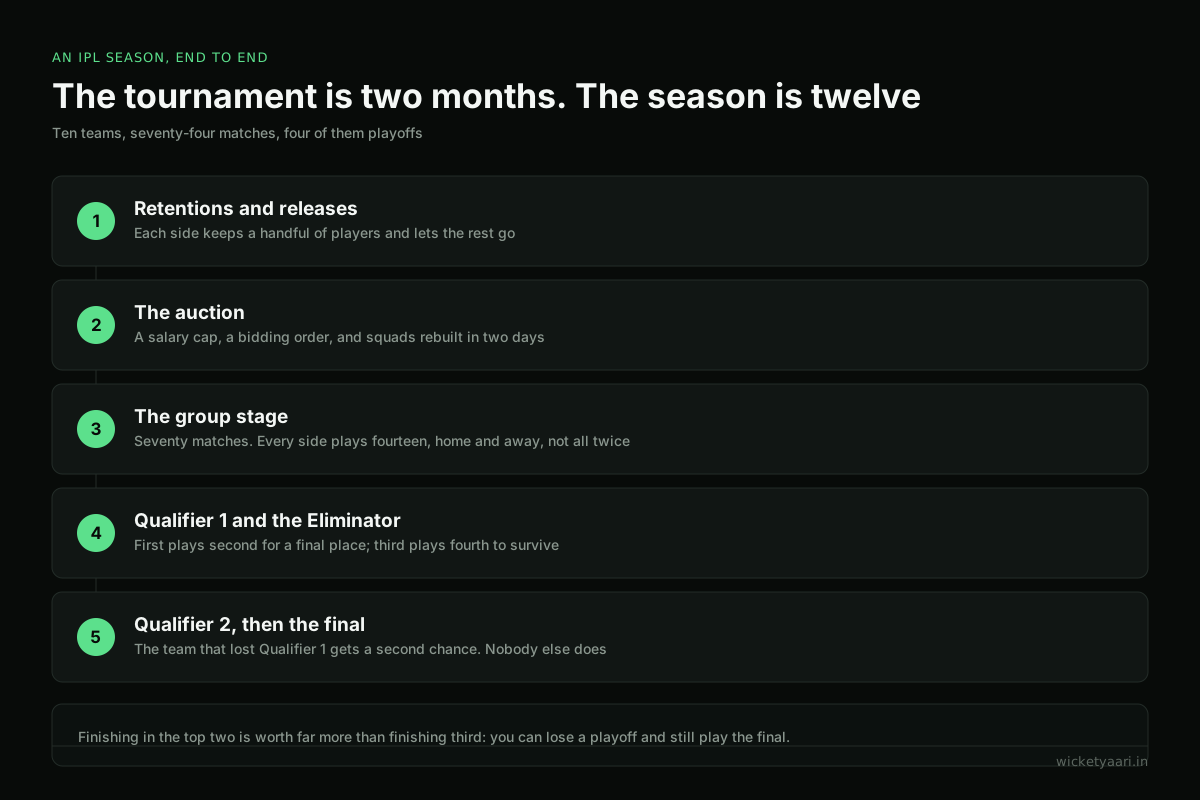
Franchises retain a handful of players and bid for the rest against a salary cap. Every player carries a base price and goes to the highest bidder.
Two consequences that are easy to miss:
Scarcity is manufactured. A limited pool of proven death bowlers or Indian opening batters produces prices that look absurd relative to a player's record, because the buyer is bidding against a shortage rather than valuing a career.
Squads reset. Unlike a football club, a franchise cannot simply accumulate. The auction periodically redistributes talent, which is a large part of why the competition stays close.
How many overseas players may a franchise field in its starting eleven?
Four. Seven of the eleven must be Indian, which is why the auction values domestic players so highly and why the league functions as a development system.
What it actually changed
Not the salaries. Cricketers were already well paid in some countries; the IPL raised the ceiling and, more importantly, raised it for players from boards that could not pay much.
The calendar. This is the real answer. There is now a window each year that most cricketing nations schedule around. Bilateral series are shortened to fit it, Test tours are compressed into two-match series, and players make format choices that did not exist in 2007.
The direction of money. Before 2008, cricket's money came from national boards selling international cricket. A significant share now comes from a domestic league selling franchise cricket, and boards negotiate with that rather than commanding it.
Why the playoff structure is shaped like that
Four teams qualify, and the two ways of getting there are not equal.
Qualifier 1 is first against second, and the winner goes straight to the final. The Eliminator is third against fourth, and the loser goes home immediately. Qualifier 2 is the loser of Qualifier 1 against the winner of the Eliminator, for the last place in the final.
So the top two sides each get two chances to reach the final and the bottom two get one. That is deliberate: a fourteen-match league is a long enough sample to mean something, and a straight knockout would throw all of it away on one bad evening. The structure protects the league table without abolishing the drama.
The practical consequence is that second place is worth far more than third, and sides will chase net run rate hard in the last week of the group stage for exactly that reason.
The auction, and what it actually decides
An auction is not a transfer market. Every franchise operates under the same salary cap, so a side that overspends on one player has structurally weakened itself elsewhere, and the winner of the auction is very rarely the winner of the tournament.
The cap changes each season, as do the retention rules — how many players a franchise may keep, what those retentions cost against the cap, and whether a right-to-match card exists that year. Anyone quoting exact figures from memory is quoting a rule that has probably changed.
What has not changed is the shape of the problem. Twenty-odd squad slots, a fixed budget, four overseas players permitted in the eleven, and a need for at least two death bowlers and one spinner who can bowl in the powerplay. The auction is that constraint satisfaction problem conducted in public, at speed, with the other nine buyers watching.
| Constraint | Effect on bidding |
|---|---|
| Salary cap | one large purchase forces cheap squad depth |
| Four overseas in the XI | overseas bowlers are bid up far past their equivalents |
| Uncapped Indian talent | the cheapest genuine value in the room |
| Right-to-match, when it exists | changes who can bid at all |
The leagues that followed
- 2008IPLIndia, and the template everybody copied
- 2011BBLAustralia, a summer-holiday competition
- 2016PSLPakistan, initially played in the UAE
- 2013CPLThe Caribbean, in the West Indian off-season
- 2021The HundredEngland, with a different ball count entirely
- 2023MLC and SA20The USA and South Africa, both IPL-funded in part
Several of these are owned wholly or partly by IPL franchise groups, which means the same organisations now hold teams in four or five countries. That is the structural story of the 2020s, and it is only beginning.
- It devalues international cricket
- It shortens attention spans
- It distorts the calendar
- Players choose money over country
- It pays for international cricket in most countries
- It brought a domestic audience to a sport that had none
- The calendar was always distorted, previously by the Ashes
- Players finally have the leverage employees usually have
What a franchise actually owns
The confusing part for anyone used to football is that an IPL franchise does not own its players in any lasting sense. Contracts run to the auction, retentions are capped, and a squad can turn over almost entirely in a single winter.
What a franchise owns is a share of a central broadcast deal, a city, a brand and a coaching setup. The revenue is pooled and distributed rather than earned at the gate, which is why the league has no relegation, no promotion and no incentive for a weak side to be sold off. Every team is profitable more or less regardless of where it finishes, and that stability is the reason the auction can be as brutal as it is: nobody is playing for their existence.
It also explains the coaching churn. If your squad is rebuilt every year and your revenue does not depend on winning, the head coach is the only lever an owner can pull in public.
Where it goes next
The open question is whether franchise ownership groups operating across multiple leagues start behaving like club football: contracting players year-round and lending them to national teams rather than the reverse.
Nothing in the current structure prevents it, and the economics point that way. Whether cricket's boards can hold the line is the story of the next decade.
- Ten franchises, four overseas per XI, an annual auction that redistributes talent
- The salaries are the headline; the calendar is the change
- Every other major franchise league descends from it
- Multi-league ownership groups are the next structural shift
For the format it plays, see Twenty20 explained. For where it sits in the sport's history, see the history of cricket in ten moments.