Why run rates rose in every cricket format at once
Test cricket scores twenty per cent faster than it did in the 1990s and nobody changed a rule. Six causes arrived together and the bats are only one of them.
Scoring rates went up in Test cricket, one-day cricket and T20 cricket over roughly the same thirty years. That is a strange thing to happen to three formats with different rules, and it means the cause is not in the rules.
- Test scoring rose from around 2.8 an over to around 3.4
- Nothing in the Laws changed to permit it
- Bats, boundaries, pitches, fielding restrictions, fitness and T20 all contributed
- The Test rise is the one that needs explaining, and T20 is most of the answer
The scale of it
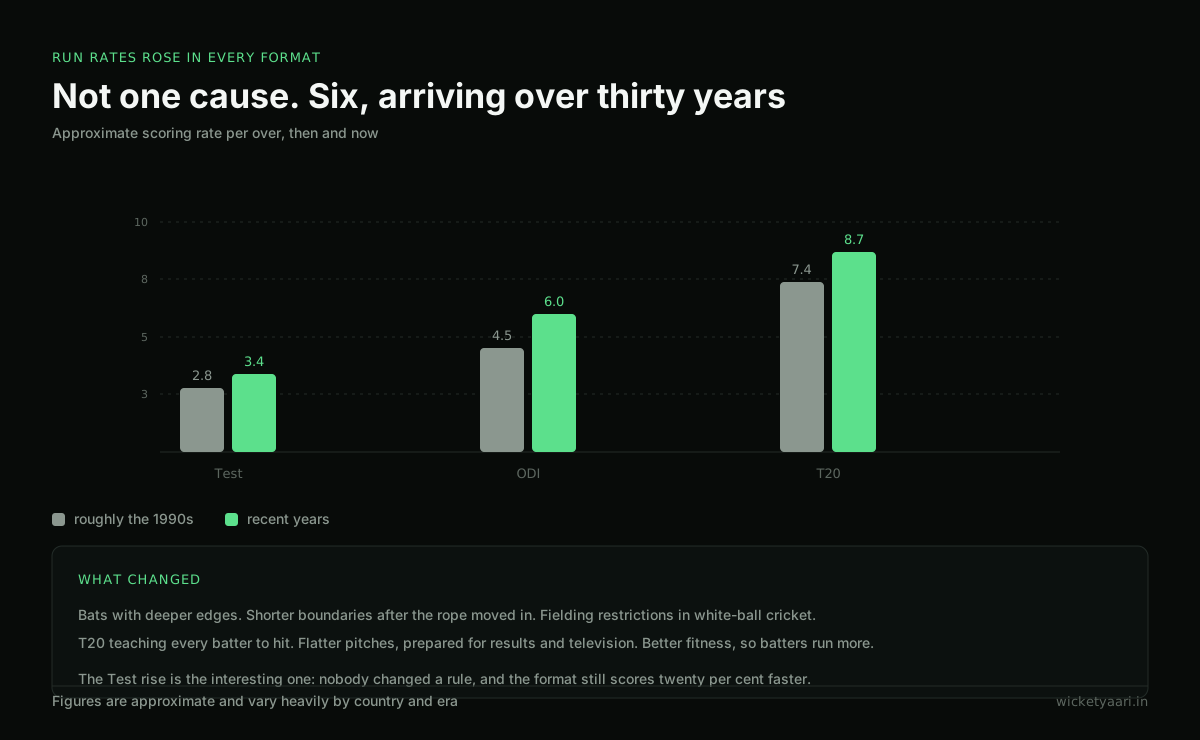
A Test match scoring at 2.8 an over produces around 250 runs in a day. At 3.4 it produces just over 300. Across five days that is the difference between a match that runs out of time and one that produces a result.
One-day cricket moved further in proportion, from totals where 250 was competitive to totals where 300 is par and 350 is not remarkable.
T20 moved least in relative terms, largely because it started high and has less room, but the shape of a T20 innings changed more than the total did.
Bats, and how much credit they deserve
The bat is the first explanation everybody reaches for and it is worth about a third of the answer.
Modern bats are not heavier — most are within the same range they have been for a century. What changed is the distribution of the wood: deeper edges, a pronounced bow, and a larger sweet spot lower down the blade. The effect is that a mistimed shot travels much further than it used to.
That matters more than a well-timed shot travelling further, because well-timed shots were always going to the boundary. The change is at the margin: the top edge that used to be caught at deep square now clears the rope, and the mistimed drive that used to be a single now runs away for four.
The Laws now limit bat dimensions — thickness of edge and depth of the blade — which was introduced specifically to stop this trend going further.
The boundary moved in
Padded ropes replaced fences and painted lines for safety, and the rope is frequently well inside the actual perimeter of the ground.
At a venue that could legally play with an 85-yard square boundary, the rope often sits at 70. Ten to fifteen yards is the difference between a caught-at-deep-midwicket and a six, repeated many times an innings.
Nobody moved the boundary to increase scoring. It happened for a good reason and it raised scoring rates as a side effect, which is a recurring pattern in this list.
Pitches were prepared for results
Groundsmen have been asked, increasingly, to produce surfaces that last five days and produce entertainment. That generally means flat, true and fast-scoring for the first two days.
Uncovered pitches disappeared decades earlier, which removed the worst batting conditions from the game entirely. Modern preparation, drainage and covering mean the surface a batter faces on day one is more reliable than at any point in the sport's history.
| Cause | Roughly how much | Confidence |
|---|---|---|
| Bats and mistimed shots carrying | large | high |
| Boundaries brought in | moderate | high |
| Flatter, better-prepared pitches | moderate | high |
| Fielding restrictions in white-ball cricket | large, but only there | high |
| Fitness, and running between wickets | small | moderate |
| T20 changing what batters attempt | large, and it explains the Test rise | moderate |
The T20 effect on Test cricket
This is the explanation that actually accounts for the Test-match rise, and it is the least direct.
A generation of batters grew up playing a format in which every ball must be scored from. They arrived in Test cricket with shots that did not previously exist in the long form — the ramp, the reverse sweep as a percentage option, the ability to hit a good-length ball over the infield — and with an assumption that a defensive field is an opportunity rather than a wall.
The result is that a Test batting side facing a defensive field in the middle session now scores at three and a half rather than two and a half. Nothing forced them to. They simply have a larger set of scoring options than the previous generation did, and less cultural resistance to using them.
The bowlers changed too. A bowler who has learned his trade in T20 bowls a fuller, straighter, more attacking length, which takes more wickets and concedes more runs.
What did not change
Two things are worth ruling out, because both get blamed.
Bowling did not get worse. Bowling averages across the same period are broadly stable, and the fastest bowlers of the current era are as fast as any that came before. If bowling had declined, averages would have risen alongside scoring rates, and they did not.
Boundaries were not shortened by regulation. The maximum and minimum permitted distances have not moved. What moved was the rope, inside those limits, for safety — which is a different thing and had the same effect.
Fitness, and the runs nobody notices
The least visible cause is the one between the wickets.
Professional cricketers are fitter than they were, and the effect shows up in converted singles. A push into the covers that was a single in 1994 is a single taken more quickly now, which means a two is available where it was not, and the fielder has to hurry, which produces overthrows and misfields.
Across an innings that is worth perhaps ten to fifteen runs. It is small next to the bats and the boundaries, and it is the one component that reflects the players rather than the equipment or the conditions.
Fielding improved at the same time and in the same direction, which is why the effect is smaller than it might have been: better running met better fielding and the two partly cancelled.
What it did to the formats
Test cricket got more results. A side scoring at 3.4 leaves time to bowl the opposition out twice. The proportion of drawn Tests has fallen substantially, and that is the single clearest benefit of the whole trend.
One-day cricket got a problem. Totals of 350 made the middle overs of a chase less interesting, not more, and the format spent a decade adjusting fielding restrictions in response.
T20 got deeper. The change there was not the total so much as who scores it: sides now bat to eight or nine, and the last four overs are worth twice what they were.
Test match scoring rates rose by roughly twenty per cent over thirty years. Which of these changed in the Laws to permit it?
No rule change permitted faster Test scoring. The causes are equipment, pitch preparation, the rope being moved in for safety, and a generation of batters who learned in a different format.
- Modern bats
- Weaker bowling
- Flat pitches
- T20
- Partly — mostly for mistimed shots
- No: bowling averages have not moved much
- Yes, and preparation for results
- Yes, and it is the largest single cause in Test cricket
- Six causes, arriving over the same thirty years
- Bats matter most at the margin, on mistimed shots
- The rope moved in for safety and shortened boundaries as a side effect
- T20 is the best explanation for the Test rise, and it changed bowlers too
The short version
Nothing was changed to make cricket score faster. Equipment improved, grounds got safer, pitches got better, and a generation learned the game in a format that required them to attack. The Laws stayed still and the numbers moved anyway.
For the equipment limits that were introduced in response, see why bats have a sweet spot and where it is, and for the format that caused most of it, Twenty20 cricket explained.