The declaration, and the arithmetic behind when to make one
A captain ending their own innings is not asking whether they have enough runs. They are asking whether there is enough time left to bowl the other side out.
A declaration is a captain voluntarily ending an innings that could have continued. It exists only in cricket with two innings a side, and it is the most public tactical decision any captain makes.
- The question is not "have we enough runs" but "is there enough time"
- Every extra run costs an over, and a final day holds around ninety
- A target too large is as bad as one too small: nobody chases, nothing happens
- Captains declare fractionally late far more often than fractionally early
What is actually being traded
A captain with a lead of 250 and two days left has a fixed budget: the overs remaining in the match. Every over spent batting is an over not spent bowling, and the side needs ten wickets.
So the decision has two failure modes, in opposite directions.
Declare too early and the target is chaseable. The opposition wins, or gets close enough that the fielding side has to bowl defensively and the match dies.
Declare too late and the target is unreachable, the opposition shuts up shop, and the match is drawn with the fielding side unable to take ten wickets in the time left.
The second is more common, and it is more common because it is less embarrassing.
The rough arithmetic
A full day of Test cricket is ninety overs. Bowling a side out usually needs somewhere between sixty and a hundred, depending on the pitch and the opposition.
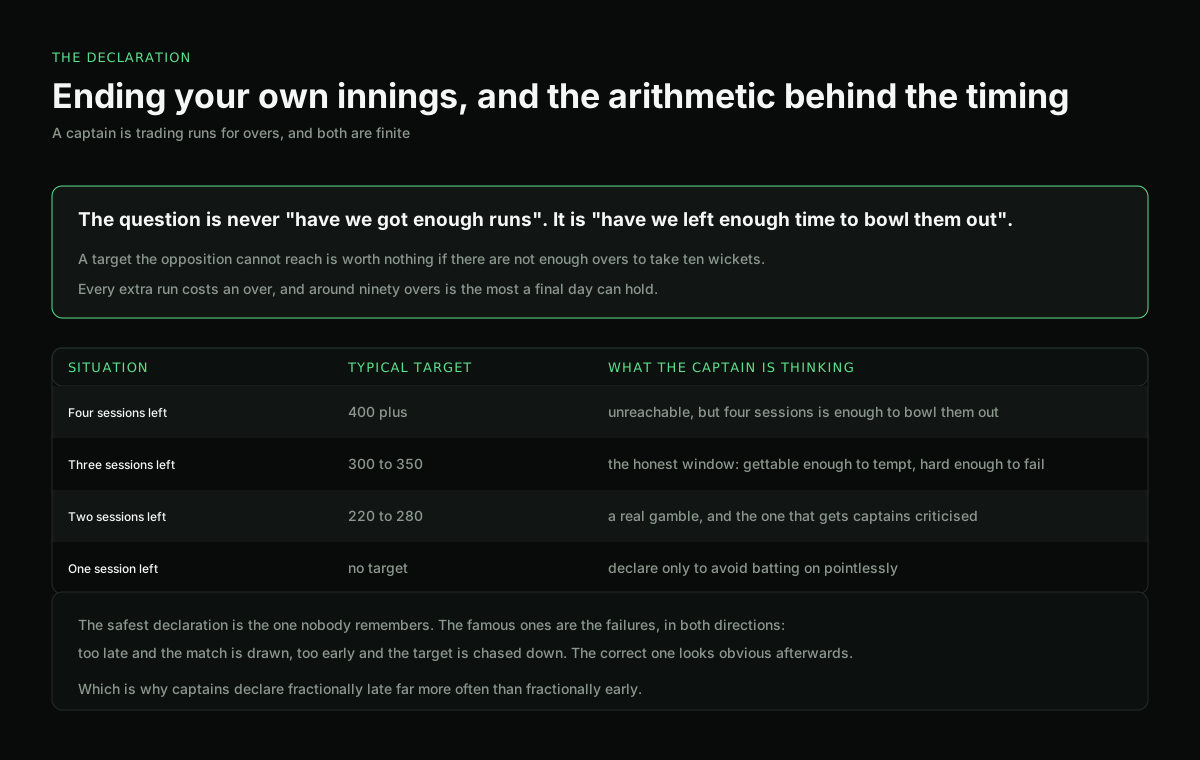
That gives a shape. Three sessions left — about ninety overs — is the classic declaration window, and the target that goes with it is usually somewhere between 280 and 350: enough to be difficult, little enough that the opposition will try.
Four sessions is comfortable and the target can be larger, because there is genuinely time to bowl a side out twice over. Two sessions is a gamble in both directions: sixty overs is not many for ten wickets, and any target small enough to tempt is small enough to be chased.
| Time left | Overs, roughly | Typical target | The risk |
|---|---|---|---|
| Four sessions | 120 | 400 plus | almost none |
| Three sessions | 90 | 300 to 350 | balanced |
| Two sessions | 60 | 220 to 280 | real, in both directions |
| One session | 30 | rarely worth it | a declaration for its own sake |
Why the target has to be tempting
This is the part that is genuinely counter-intuitive: a captain does not want to set an unreachable target.
A side chasing 500 in a day will not chase. They will block, protect wickets, and play for a draw, which removes every attacking option from the batting side and means the fielding captain has to take ten wickets against a team that has stopped trying to score. That is much harder than taking ten wickets against a side going for the runs.
A target the opposition believes in produces shots. Shots produce wickets. Which is why a good declaration leaves a target the opposition will attempt for at least two sessions before deciding it is beyond them — by which time they are four down and committed.
The variables that move the number
Four things change the right target on any given day.
The pitch. A fifth-day surface with uneven bounce and rough outside off makes 280 harder than 350 would be on a flat one, and the captain has been watching it deteriorate for four days.
The weather. Rain forecast for the final session removes the overs and forces an earlier, more generous declaration.
The attack. A side with two spinners and rough to bowl into needs fewer overs than a side relying on reverse swing that may not appear.
The series situation. A captain one up with one to play declares differently from one who must win. The correct target is not a property of the match alone.
Why captains err late
The asymmetry in the criticism is the reason, and everybody involved knows it.
A captain who declares too late and draws a match gets a column saying he was too cautious. A captain who declares too early and loses gets a column saying he lost the match, the series and possibly the captaincy. The two errors are not treated as equivalent by anybody, so the incentive is to be safe.
That produces a systematic bias towards over-large targets and drawn matches, and it is one of the few tactical questions in cricket where the analysis and the practice have been diverging for decades without the practice moving much.
The first-innings declaration
Most declarations happen in the third innings of a match. The rarer and more interesting one is a captain closing a first innings while his side is still scoring freely.
The reason is almost always the weather or the pitch. A captain who believes two days will be lost to rain needs to compress the match, and the only compression available is to stop batting. A captain on a pitch that will be unplayable by day four wants to bowl on days two and three rather than bat into the good conditions he already has enough of.
There is a third reason that is really about the opposition: declaring with the tail in and twenty minutes left in a session, to get an over or two at the openers before the interval. Cheap, effective, and it costs almost nothing.
The forfeited innings
There is a rarer relative of the declaration worth knowing about: a captain may forfeit an innings entirely.
It has been used to manufacture a result in rain-ruined matches, most famously in an arrangement between two captains where both sides forfeited an innings to set up a chase on the final day. The result stands, the Laws permit it, and it produced a long argument about whether a contrived finish is a real one.
The answer cricket settled on is that it is legal and rare, and that a captain who does it is choosing a possible defeat over a certain draw — which is a defensible thing to prefer.
A side leads by 340 with a full day and a session remaining, on a wearing pitch. What is the strongest argument for declaring immediately rather than batting for another hour?
The constraint is overs, not runs. A target of 340 with 120 overs to bowl in is far more likely to produce ten wickets than a target of 400 with 105, because the opposition will attempt the first and block the second.
- Was the target big enough
- Should they have batted longer
- Were the bowlers tired
- Was it brave
- Were there enough overs left
- Would the opposition have chased a larger one
- Was the pitch going to help by the last session
- Was it arithmetically sound
- Runs and overs come from the same budget
- An unreachable target produces a blocked draw, not a win
- Three sessions and a target around 320 is the classic shape
- The criticism is asymmetric, so captains declare late
The short version
A declaration is a captain buying overs with runs. The good ones leave a target the opposition will chase for long enough to lose wickets doing it, and the common error is greed for a margin that nobody was going to attack anyway.
For the other way a captain trades time, see what the follow-on is and when captains enforce it, and for what happens when the clock beats both sides, the difference between a tie and a draw.