Eden Gardens 2001 — what the scorecard actually says
India followed on 274 runs behind and won the Test by 171. The scorecard explains how they did it, and it is stranger than the highlights suggest.
Only three teams in the history of Test cricket have won after being made to follow on. India did it at Eden Gardens in March 2001, against an Australian side that had won sixteen consecutive Tests.
The highlights show VVS Laxman driving through cover. The scorecard shows something less elegant and more interesting.
The situation
Australia made 445. India were bowled out for 171 and asked to follow on, 274 behind. At that point the match was effectively over, and the series with it.
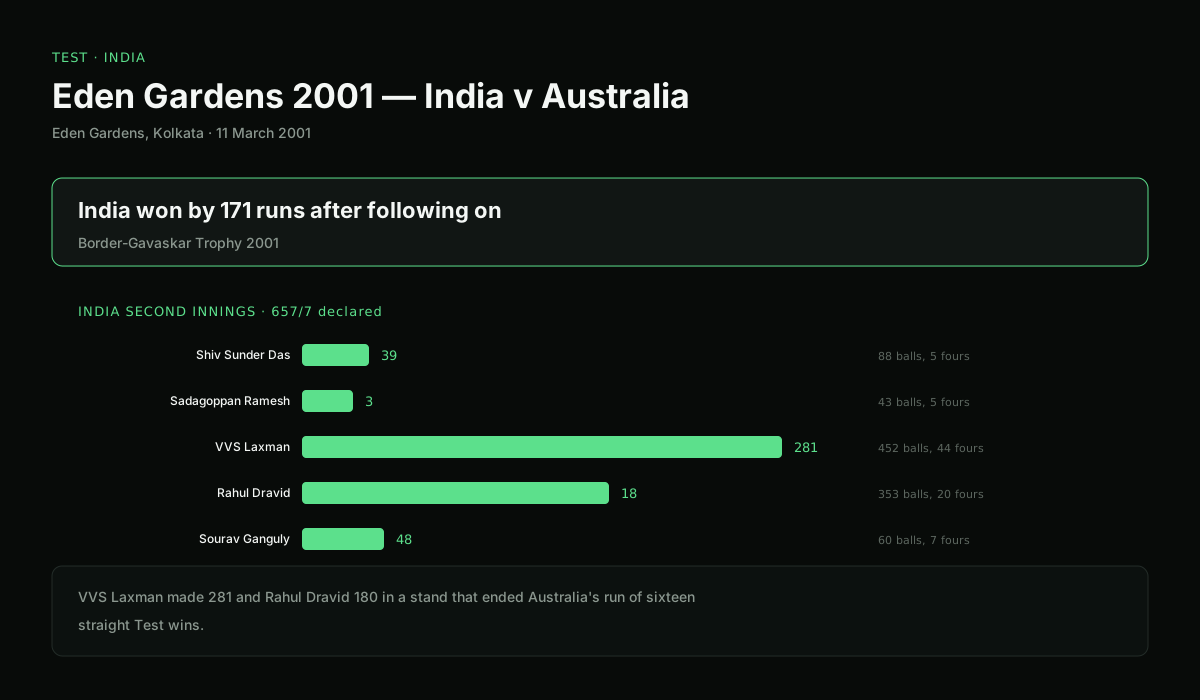
India's second innings finished on 657 for 7 declared.
| India, second innings | |
|---|---|
| Shiv Sunder Das | 39 |
| Sadagoppan Ramesh | 30 |
| VVS Laxman | 281 |
| Rahul Dravid | 180 |
| Sourav Ganguly | 48 |
Full card on the match page.
The number that does the work
Laxman's 281 came from 452 balls. Dravid's 180 came from 353.
Between them, on the fourth day, they faced most of a full day's cricket without being separated. That is the actual mechanism of the win: not the shots, the occupation. Australia's bowlers had already bowled a full innings, and were then made to bowl another 130 overs in Kolkata in March.
The famous cover drives are real. The reason they mattered is that they came after four hours of not getting out.
The decision that looks obvious now
Laxman batted at number three in that innings, having batted at six in the first. It was a promotion made mid-match, on the basis that he had made 59 in the first innings and looked like the only Indian batter comfortable.
Moving your number six to number three when you are 274 behind is the kind of decision that gets a captain sacked if it fails. It is worth remembering that nobody knew it would work.
The sixteen wins that ended here
Australia arrived at Eden Gardens having won sixteen Tests in a row, which is still the record. They had won the first Test of the series in Mumbai inside three days. Nothing in the previous eighteen months suggested this was a side that could be beaten over five days by anyone.
That context is why the follow-on decision was uncontroversial at the time. A 274-run lead against a side you have just dismissed for 171, with your seamers fresh, is not a close call. It became one only in retrospect.
What the follow-on decision actually was
Australia led by 274 after two innings. The threshold in a five-day match is 200, so Steve Waugh had the option, and taking it was the obvious cricketing decision by every standard applied at the time.
His seamers had bowled 59 overs in the Indian first innings, which is not a heavy load. India had been dismissed in under 60 overs and looked incapable of batting for long. The pitch was expected to deteriorate, which favours bowling last only if you can also bat last, and Australia had every reason to think the match would be over inside four days.
What the decision could not price was the possibility that two Indian batters would occupy the crease for most of a day and a half in March heat in Kolkata. The cost of the follow-on is not the runs conceded, it is the overs bowled — and the overs kept coming.
Harbhajan's match, which is usually the footnote
Laxman and Dravid get the match, and the bowler who took fifteen wickets in it is usually a line at the bottom of the report.
Harbhajan Singh took 7 for 123 in Australia's first innings, including the first hat-trick by an Indian bowler in Test cricket — Ponting, Gilchrist and Warne, in three balls. He then took 6 for 73 in the second. Thirteen of the twenty wickets in the match, at 22 years old, in his first series as a front-line spinner.
The reason it gets less attention is that the third-innings stand is the more extraordinary event, and there is only so much room in one story. But a Test is not won by batting alone: somebody had to take those twenty wickets, and one bowler took two-thirds of them.
There is a detail in the scorecard that reads oddly now. Laxman batted 452 balls and hit 44 fours and no sixes; Dravid batted 353 balls and hit 20 fours and no sixes. Two of the longest and most celebrated innings in Indian cricket contain not a single six between them, which tells you exactly what kind of innings they were.
The series, not just the match
Eden Gardens is remembered as a single match and it was the middle Test of three.
Australia won the first in Mumbai inside three days, which took their winning streak to sixteen. India won at Eden Gardens. Then India won the third in Chennai by two wickets, in a finish that went to the last session, to take the series 2-1.
That last detail is what makes the second Test matter as much as it does. A famous win in a lost series is a curiosity. A famous win that turned into a series victory over the best side in the world, at home, is the match that reorganised how Indian cricket thought about itself — and it is the one that Steve Waugh has spent the years since calling the closest he came to the frontier he never crossed.
What the fourth innings shows
Chasing 384, Australia were bowled out for 212. Harbhajan Singh took six, having already taken seven in the first innings, including a hat-trick.
The pattern in that last innings is the giveaway: a side that had bowled 130 overs in Kolkata heat, then batted last on a fifth-day pitch, against a spinner who by then had thirteen wickets in the match. The follow-on decision, correct under any normal reading, cost Australia the one resource they could not get back, which was fresh legs.
Steve Waugh has said since that he would enforce it again. He is probably right, and it still lost him the Test.
Why this match is in our dataset
It is one of the six matches currently behind the Scorecard, Starting XI and Last Over puzzles — a small set that we are actively expanding, because six matches is not enough to keep three games fresh.
It earns its place for a specific reason: the scorecard is recognisable with the names removed. A second innings of 657 for 7 declared with a 281 and a 180 in it, following on, is not a card that could be any other match. Most Test scorecards are anonymous without names. That one is a fingerprint.
What it changed afterwards
The series went to Chennai level at one apiece, and India won that too. It is the only series Australia lost between 1999 and 2005, and it is the point at which India stopped being a side that was only difficult at home.
Sourav Ganguly, who made 48 in that second innings and captained the side, inherited most of the credit for what followed — a period in which India drew in Australia and England and won in Pakistan. Whether one Test can carry that much weight is arguable. What is not arguable is that the belief which made those tours possible did not exist before March 2001 and did exist after it. There is more on that in Ganguly by the numbers.
Laxman never scored another Test double hundred. He did not need to.
How many teams in Test history have won after being made to follow on?
Three, and India at Eden Gardens in 2001 is the most recent of them.
The short version
India followed on 274 behind, batted for two days, and won by 171. Laxman faced 452 balls and Dravid 353, which is the part the highlights cannot show you. Then Harbhajan bowled at a side that had nothing left.
Sixteen straight wins ended there.