The doosra, and why it has been argued about for twenty years
An off-spinner turning the ball the other way requires a wrist position that makes straightening the elbow very hard to avoid, which is where the whole argument comes from.
An off-spinner's stock ball turns into a right-handed batter. The doosra turns away from them, out of the same action. It is one of the most valuable deliveries in cricket and the most contested, and the two facts are connected.
- A doosra is an off-spinner's ball that turns the other way
- It requires a back-of-the-hand wrist position from a finger-spinner's action
- That position makes straightening the elbow very difficult to avoid
- The Laws permit fifteen degrees of straightening, which is a measurement threshold
What it is
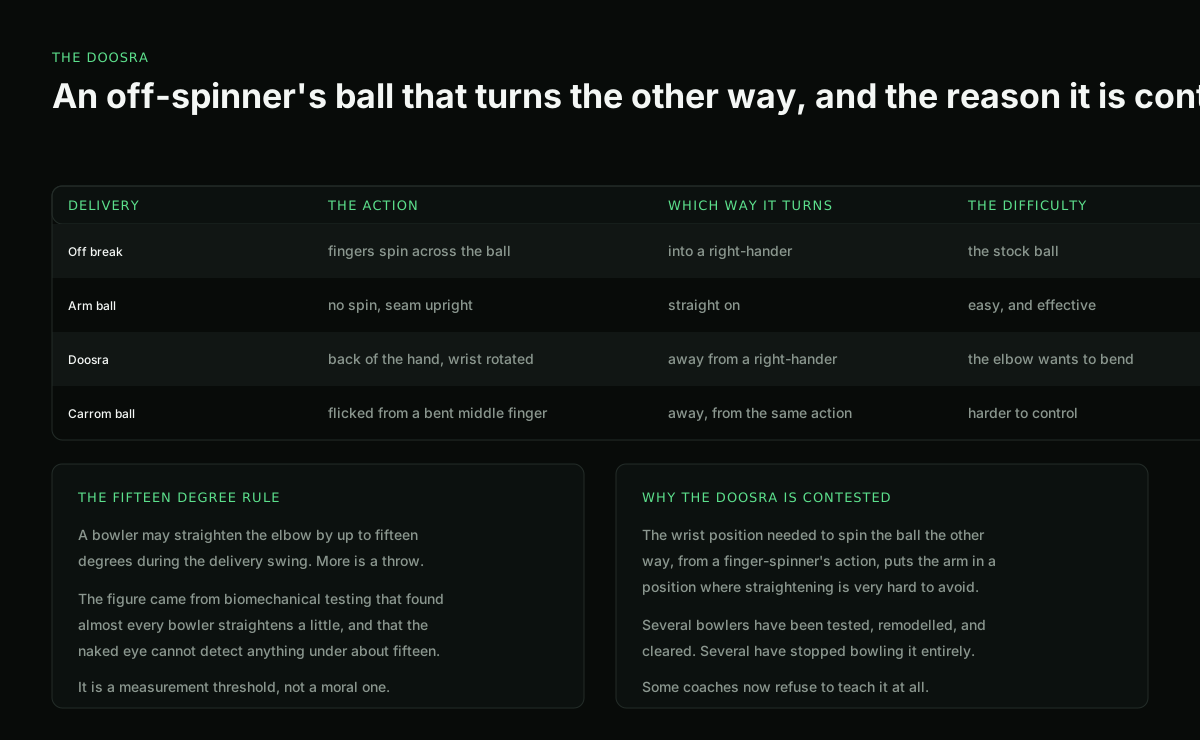
A finger-spinner generates revolutions by spinning the fingers across the ball. For an off-spinner that produces turn from off to leg — into a right-hander.
The doosra reverses it. The wrist is turned so the back of the hand faces the batter at release, in the way a leg-spinner's googly is bowled, and the ball spins the other way. From the batter's point of view the action is identical and the ball does the opposite thing.
The value is obvious. A finger-spinner with only one direction of turn can be played off the pitch by a good batter; one who can turn it both ways from the same action cannot.
Why the elbow is the problem
Here is the mechanical issue, and it is genuinely a mechanical one rather than a matter of character.
A leg-spinner bowls with a wrist-driven action in which the arm is naturally positioned for the back-of-the-hand release. A finger-spinner's action is not: the arm comes over in a way that leaves the wrist in the wrong orientation, and getting it into the doosra position requires the forearm to rotate.
For most bowlers, achieving that rotation without straightening the elbow during the delivery swing is very difficult. Some can. Many cannot, and the ones who cannot are bowling an illegal delivery whether or not they intend to.
The fifteen degree rule
Cricket's definition of a throw is a delivery in which the elbow straightens by more than fifteen degrees during the bowling action.
The number came from biomechanical testing in the early 2000s that found two things. Almost every bowler straightens the elbow to some degree, including fast bowlers nobody had ever questioned. And the naked eye cannot reliably detect straightening below about fifteen degrees.
So the threshold is a measurement decision, not a moral one. It is set at the point where a human observer could plausibly notice, and it applies identically to everybody.
| Delivery type | Typical straightening | Legal |
|---|---|---|
| Fast bowling | usually well under fifteen | yes |
| Orthodox off break | small | yes |
| Doosra, in many bowlers | frequently over fifteen | no, as bowled |
| Doosra, remodelled | under fifteen | yes |
What happens when a bowler is reported
The process is bureaucratic and worth knowing, because "reported for a suspect action" is widely misunderstood.
Umpires report an action they believe may be illegal. The bowler is then tested in a laboratory: markers on the arm, high-speed cameras, and every delivery in their repertoire bowled at match pace. The report gives an angle for each delivery type.
A bowler may be cleared for their stock ball and found illegal for the doosra alone, which happens frequently. In that case they may continue bowling and must stop bowling that one delivery. Others are remodelled, retested and cleared.
The important part is that being reported is not an accusation of cheating. It is a request for a measurement, and the measurement frequently finds an action that was never deliberate.
The arm ball, which does most of the same work
There is a delivery that achieves a large part of what the doosra achieves and carries none of the difficulty.
The arm ball is bowled with the seam upright and no finger spin at all. It does not turn. Bowled to a batter who is playing for turn, a ball that goes straight on beats the inside edge and hits the pad or the stumps, which is exactly the outcome the doosra is trying to produce.
It is legal, it is easy, and it takes a substantial share of every finger-spinner's wickets. The reason it gets less attention is that it does nothing spectacular: the ball simply goes where it was aimed, and the batter played for something that did not happen.
Why some coaches will not teach it
There is a real school of thought that the doosra should not be taught at all, and the argument is not about legality.
The position required is at the edge of what a finger-spinner's arm can do. Bowlers who force it risk elbow and shoulder injury, and young bowlers who learn it before their bodies have finished growing are being asked to do something their joints are not ready for.
The second argument is developmental. A young off-spinner who has a doosra tends to rely on it rather than developing the things that actually take wickets at higher levels: drift, dip, changes of pace, and the ability to bowl the same ball six times.
Several national coaching setups discourage it for those reasons rather than because of the throwing question.
How a batter picks it
The same three cues that apply to a leg-spinner's googly, and the doosra is harder than any of them.
The hand at release. The definitive cue, and with a finger-spinner it is visible for a fraction of the time it is with a wrist-spinner, because the arm is faster through the action.
The seam in flight. A doosra's seam is angled differently, and batters who face a great deal of spin can sometimes read it in the first third of the flight.
The bowler's habits. The most practical answer at every level below the top: a bowler who bowls the doosra with a slightly different pace, a slightly different trajectory, or after a particular sequence has told the batter what is coming.
The batters who play it best usually admit they are not picking it. They are playing the line and using the pad, or playing late with soft hands, and accepting that they will occasionally be beaten. That is a legitimate answer to a delivery you cannot read.
What replaced it
The carrom ball, largely, and it is the more interesting delivery.
Where the doosra requires a wrist rotation, the carrom ball is flicked out from between the thumb and a bent middle finger. It turns away from a right-hander from a finger-spinner's action, which is the same effect, and it does it without the elbow position that causes the problem.
It is harder to control and easier to pick, and it is legal without any argument, which is a trade a lot of bowlers have been willing to make.
A bowler is reported for a suspect action and tested. The report clears their off break at 9 degrees and finds their doosra at 19. What normally happens?
Testing measures each delivery type separately. A bowler cleared for their stock ball and found illegal for one variation may keep bowling and must stop bowling that variation, unless they remodel it and are retested.
- Umpires have asked for a measurement
- Testing measures each delivery separately
- Fifteen degrees is a visibility threshold
- Most bowlers straighten a little
- An accusation of cheating
- The whole action is illegal
- Fifteen degrees is a moral line
- Straightening at all is a throw
- The doosra turns away from a right-hander out of an off-spinner's action
- The wrist position needed makes elbow straightening hard to avoid
- Fifteen degrees is where the naked eye stops being able to see it
- The carrom ball achieves the same effect without the elbow problem
The short version
The doosra is valuable because it does the one thing a finger-spinner cannot otherwise do, and contested because the only way most arms can produce it is outside what the Laws permit. The threshold is a measurement, and the argument around it is mostly not.
For the wrist-spinner's version of the same idea, see the googly explained without jargon, and for the delivery that replaced it, slower balls explained.