Bad light in cricket, and how it is actually measured
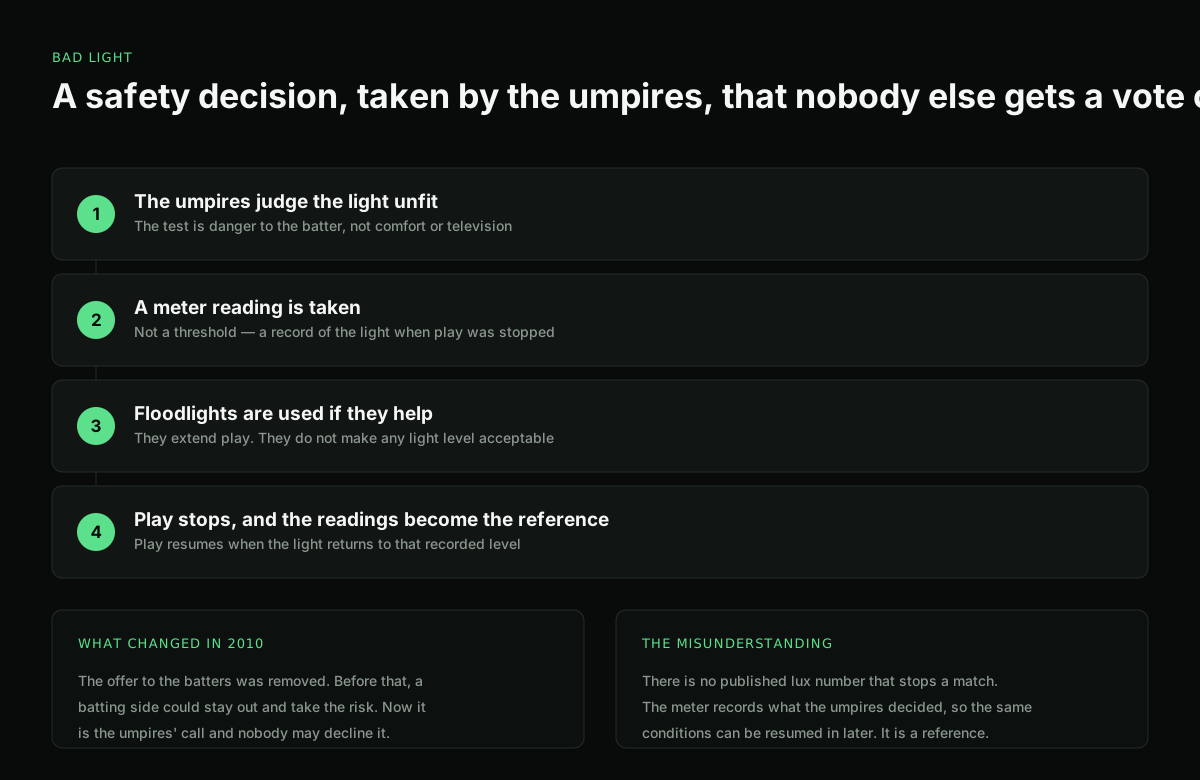
There is no published light level that stops a cricket match. The meter records what the umpires decided, so play can resume at the same reading later.
Bad light stops more Test cricket than rain in some countries and is the least understood stoppage in the game. The main reason is that almost everybody believes there is a number, and there is not.
- The test is danger to the batter, not comfort, not television
- Light meters record a reference reading; they do not set a threshold
- Since 2010 the batters are not offered the light — the umpires decide alone
- Floodlights extend play; they do not make any level of natural light acceptable
What the umpires are deciding
The Law asks whether conditions are dangerous or unreasonable. In practice that means one question: can a batter see a ball travelling at ninety miles an hour in time to avoid being hit by it?
That question has no fixed answer, because it depends on the bowling. Facing spin in gloom is uncomfortable. Facing a fast bowler in the same gloom is genuinely dangerous, and the umpires are entitled to take the difference into account — which is why you see sides bring on spinners to keep play going, and why umpires allow it up to a point.
The meter, and what it is for
Umpires carry light meters and take readings when they stop play. Almost everybody misunderstands what happens next.
The reading is not compared to a published minimum. There is no such minimum. What the reading does is create a reference: the light was at this level when we decided it was unfit. When the light later returns to that level, play resumes; when it falls further, it stays off.
This is why the meter matters for consistency rather than for the decision itself. It stops the same umpires making inconsistent calls at the same ground on the same afternoon, and it lets the two umpires agree on something measurable rather than arguing about a judgement.
It also explains a thing that looks arbitrary from the boundary: play stopping at what appears to be brighter light than it stopped in yesterday. Different umpires set different references, and the reference travels with the officials, not with the ground.
What changed in 2010
For most of the game's history the umpires offered the light to the batting side. The batters could accept and come off, or decline and stay out.
That produced obvious distortions. A side batting to save a match had every reason to come off; a side chasing quick runs had every reason to stay out and take the risk. The decision that was supposed to be about safety was being made by the people with the greatest interest in the result.
The offer was removed. The umpires now decide, both sides come off, and nobody has a vote. It is a better rule and it is unpopular, because it removes the one moment where a batting side could show defiance.
Floodlights, and why they do not solve it
Floodlights are used to extend play in bad light and they help. What they do not do is make any level of natural light acceptable.
The problem is the transition. Under lights, with residual daylight, a ball can be genuinely harder to pick up than under either condition alone — the background brightness and the lit foreground fight each other. Umpires are alert to this and will sometimes take players off with the lights on, which looks perverse and is not.
There is also a competition-by-competition question about whether artificial light is permitted in a red-ball match at all, and for how long. Playing conditions vary, and a Test can be governed by a rule its own broadcast commentators get wrong.
The one thing nobody has solved
Every proposal to remove the judgement runs into the same wall: a fixed threshold would have to be set for the most dangerous case, which is a genuinely fast bowler with a new ball, and applying that threshold to a spinner would take players off in light everybody can see perfectly well in.
A variable threshold that depends on who is bowling is what the umpires already do, informally, using judgement. Writing it down would require defining "fast", which cricket has consistently declined to do anywhere in its Laws.
So the discretion stays, the meter records it, and the complaints continue — which is roughly where every rule involving a safety judgement ends up.
Why it feels arbitrary and mostly is not
Three things make it look inconsistent when it usually is not.
The bowling changes. Play continuing with spin and stopping when a seamer returns is not inconsistency, it is the safety test being applied to different risks.
The reference is per-decision. If the umpires stopped play at a certain reading in the first innings, that is the reference for the rest of the match, and it may be brighter or darker than another match's.
Television lies about light. Broadcast cameras have automatic exposure. The picture at home looks perfectly bright in conditions the players describe as almost unplayable, which is the single largest source of viewer frustration and is purely an artefact of the camera.
Play is stopped for bad light in the first innings at a certain meter reading. In the fourth innings the light falls to a slightly brighter reading. What should happen?
The reading taken when play was stopped becomes the reference for the match. Light brighter than that reference is, by the umpires' own earlier judgement, playable.
The formats it barely touches
Bad light is close to a Test-cricket-only problem, and the reason is scheduling rather than any rule.
A day-night limited-overs match is played under floodlights from the start, in conditions the lights are designed to cover. A T20 finishes inside three hours, usually well before dusk becomes an issue. It is the five-day match, played through late afternoons in autumn and spring, that runs into failing light with overs still to bowl.
That is also why the pink ball exists. Day-night Test cricket was introduced partly to move the last session into properly lit conditions rather than deteriorating natural ones — and it brought its own problem, the twilight period, which is discussed in the toss and how much it is actually worth.
What it costs
Bad light is expensive in a way rain is not, because it takes the end of the day rather than the middle.
The overs lost are the ones a captain was planning to attack in: the second new ball taken at 80 overs, the last hour of a chase, the session where a nightwatchman would otherwise be exposed. A side pushing for a result loses far more than the over count suggests, and a side batting to survive is handed the best possible outcome for nothing.
That asymmetry is why the offer to the batters had to go. It was not that batters made unsafe choices; it was that the choice itself was worth so much to one side that it stopped being about safety at all.
- A lux reading below a set number
- The batters asking to come off
- Rain clouds
- Television going dark
- The umpires judging it unfit
- The umpires deciding, with no offer
- Light level, which can be a clear evening in October
- Television is the least reliable guide there is
- The test is whether a batter can see a fast ball in time, not brightness
- Meters record the decision and set a reference for the rest of the match
- The batters have had no say since 2010, for good reasons
- Floodlights extend play, and the transition period can be worse than either state
The short version
There is no number. There are two umpires, a safety test, and a meter that records what they decided so they can be consistent about it afterwards. Everything that looks arbitrary about bad light follows from that.
For the other weather stoppage, and the one cricket does have a method for, see Duckworth-Lewis explained.