Cricket ground dimensions, and why no two are the same
The pitch is fixed to the inch and the boundary is a range of twenty-five yards, which is why the same shot is six at one ground and caught at another.
Almost every other major sport specifies its playing area exactly. Cricket specifies the middle twenty-two yards and then gives the rest a range, which is why grounds differ more than any comparable sport's.
- The pitch is 22 yards by 10 feet, identical everywhere
- Boundaries are a maximum of 90 yards and a minimum of 65 from the centre
- Nothing specifies the shape, so grounds are ovals, circles and odd polygons
- A ground may have a 90-yard straight boundary and a 65-yard square one
What is fixed and what is not
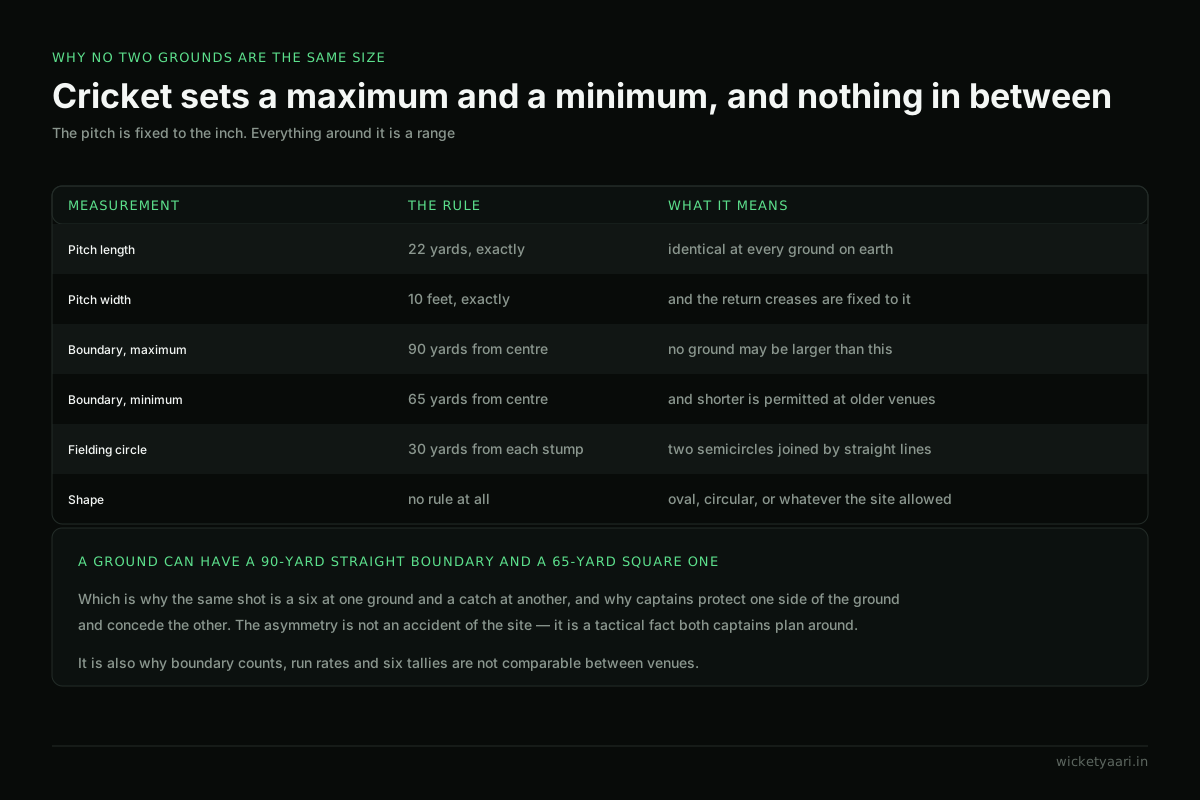
The pitch is 22 yards from stump to stump and 10 feet wide. The creases are fixed relative to it, the stumps are a specified height and width, and the bails sit in grooves that are also specified. Every ground on earth is identical inside that rectangle.
Outside it, the Laws give a maximum and a minimum distance from the centre of the pitch to the boundary, and say nothing at all about the shape. A ground may be a circle, an oval, or an irregular polygon that follows whatever the site allowed when it was built.
The fielding circle is defined precisely — two semicircles of 30 yards centred on each middle stump, joined by straight lines — which means the circle is the same everywhere and the boundary is not.
Why the range exists
Because grounds came first and the Laws came second.
Cricket grounds were laid out on commons, on estates and inside city blocks over two centuries, long before anybody thought to standardise them. Several of the best-known Test venues are physically incapable of meeting a uniform standard: the land is the wrong shape, and buildings that have been there for a hundred years are in the way.
Writing a fixed dimension into the Laws would have made a large number of historic grounds illegal overnight. The compromise was a range wide enough to include almost all of them, plus a provision for older venues that cannot even reach the minimum.
What the asymmetry does to the cricket
This is the interesting part, and it is a tactical fact rather than a curiosity.
A ground with a long straight boundary and short square ones rewards a completely different batter from one shaped the other way. Sides adjust selection to it. Captains protect the short side and concede the long one, which is why a field can look lopsided for no reason visible on television.
| Ground shape | What it rewards | How the field responds |
|---|---|---|
| Long straight, short square | cutters, pullers, sweepers | two out square, straight boundaries left open |
| Short straight, long square | lofted drives down the ground | long on and long off, ring square |
| Genuinely large all round | running between the wickets | ring saving one, few riders |
| Small all round | clean hitting, and bowlers suffer | five out from over seven |
It also makes cross-venue statistics unreliable. A six count, a boundary percentage and a run rate are all measured against a boundary that moved. A batter who plays half their cricket at a small ground and half at a large one has two different records inside one career average.
The rope, and why it moved inwards
Boundaries in modern cricket are marked with a padded rope rather than a painted line or a fence, and the rope is frequently well inside the actual perimeter of the ground.
The stated reason is safety: a fielder chasing at full speed should hit a rope rather than concrete, advertising boards or a fence. That is a genuine improvement.
The consequence, which is discussed less, is that bringing the rope in shortens the boundary — sometimes considerably — at grounds that would otherwise be at the larger end of the permitted range. A ground that could be 85 yards square plays at
- More sixes are hit, which broadcasters do not mind, and the honest description
is that the safety benefit and the entertainment benefit point the same way.
The other measurements
Two more that come up and are less well known.
The bowler's run-up has no specified length. A bowler may start from as far back as the ground allows, which at some venues means starting outside the playing area entirely.
The sightscreen is not specified in the Laws either, but its absence or inadequacy is grounds for a batter to complain and for play to be delayed. This matters more than it sounds: at grounds where a sightscreen cannot be positioned for a left-arm-over bowler, the bowling side loses an angle it would otherwise have.
The Laws set the boundary at a maximum of 90 yards and a minimum of 65 from the centre of the pitch. What do they say about the shape of the boundary?
Nothing in the Laws specifies the shape. A ground may be any shape that fits inside the maximum and outside the minimum, which is why straight and square boundaries at the same venue routinely differ by twenty yards.
- Pitch length and width
- Stump height and width
- Crease markings
- The 30-yard fielding circle
- Boundary distance, straight and square
- The shape of the playing area
- Where the rope sits relative to the fence
- The outfield speed and the slope
The drop-in pitch
One modern development sits between the fixed part and the variable part: pitches grown off-site in trays and lowered into a ground before a match.
They exist because many venues are shared with other sports, and a stadium that hosts football through the winter cannot maintain a square through it. A drop-in is grown in ideal conditions, transported, and installed.
The cricketing consequence is a surface that tends to be truer and more consistent than a native square, and that ages differently: drop-ins are often criticised for being flat on days one to three and then deteriorating sharply, because the tray is a shallower body of soil than the ground beneath a traditional square.
Whether that is good is a matter of opinion. What is not in dispute is that it adds a third category — grounds where the pitch is not really part of the ground at all — to a sport whose Laws assume the two are the same thing.
Slope, which is not a dimension at all
Nothing in the Laws requires a ground to be flat, and several famous venues are noticeably not.
A slope changes which end a bowler wants, how the ball behaves in the air and off the pitch, and how far a shot travels in each direction. It is a permanent local condition that visiting sides have to learn and home sides already know, and it is one more component of home advantage that no rule addresses.
- Twenty-two yards is fixed; everything outside it is a range or unspecified
- Grounds predate the Laws, which is why the range is so wide
- Asymmetric boundaries are a tactical fact, not a quirk
- The rope moved in for safety, and it shortened boundaries as a side effect
The short version
Cricket standardised the contest between bat and ball and left the arena to whatever the site allowed. That is why boundary counts do not travel, why fields look lopsided, and why every ground has a personality that a football pitch cannot.
For what else varies between venues, see how a pitch is prepared and what green means and home advantage measured.