A tie is not a draw, and the difference is not pedantry
A tie means the scores finished level with the match complete. A draw means time ran out. One has happened twice in Test cricket; the other happens constantly.
These two words describe completely different things and are used interchangeably by almost everybody who did not grow up with the sport. The distinction is not pedantry — it changes what a side is playing for.
- A tie means the scores are level with the match complete
- A draw means the match ran out of time and was never completed
- A drawn match can have a hundred-run gap in the scores
- You can bat for a draw. You cannot bat for a tie
The definitions
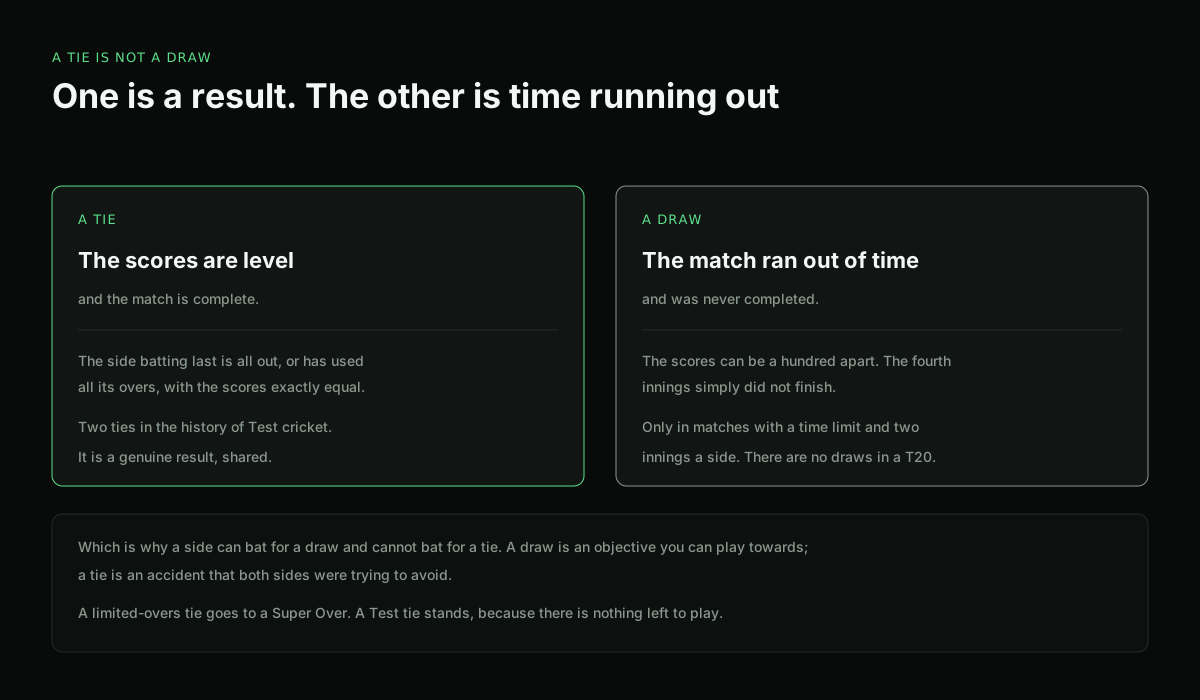
A tie happens when the side batting last is dismissed, or uses all its available overs, with the scores exactly level. The match is finished. Both sides have had everything the format allows and neither is ahead.
A draw happens when the allotted time expires with the match incomplete. The fourth innings has not finished — the side batting has not been bowled out and has not passed the target. The scores are usually nowhere near level.
The single distinguishing question is whether the match was completed. A tie is a completed match with an equal result. A draw is an unfinished one.
Why draws only exist in some formats
A draw requires two things: a time limit and more innings than the time can guarantee.
Test and first-class cricket have both. Each side bats twice, the match lasts a fixed number of days, and there is no requirement that all four innings be finished. If day five ends with the fourth innings in progress, that is a draw.
Limited-overs cricket has neither. Each side bats once, for a fixed number of overs, and the format guarantees that both innings will be completed or a method exists to resolve it. There is no way to run out of time with the match unfinished, so there is no such thing as a drawn one-day match or a drawn T20.
| Format | Draw possible | Tie possible | If tied |
|---|---|---|---|
| Test | yes | yes | it stands as a tie |
| First-class | yes | yes | it stands |
| ODI | no | yes | Super Over in most competitions |
| T20 | no | yes | Super Over, repeated until a result |
Batting for a draw
This is the practical consequence, and it is why the distinction matters.
A side that cannot win a Test can still avoid losing it, by batting out the remaining time. That is a legitimate objective with its own techniques — leaving everything outside off, refusing to score, protecting the tail — and matches saved this way are among the most admired performances in the sport.
Nobody can bat for a tie. It is an outcome nobody is aiming at and nobody can engineer, which is why it is so rare. Both sides are trying to win and both fail by exactly the same amount.
That asymmetry is the whole reason Test cricket has a shape that no other format has. The team behind is not simply losing; they have a second objective available, and the bowling side has to remove them rather than merely outscore them.
Two ties in the history of Test cricket
In more than two thousand Tests, the scores have finished level with the match complete twice.
The first was Australia against West Indies at Brisbane in 1960 — the match generally regarded as the finest Test ever played, decided on the last ball with a run out. The second was Australia against India at Madras in 1986.
That is roughly one in a thousand. The reason it is so rare is that a Test needs twenty wickets to reach a completed fourth innings at all, and most matches that go the distance end with a comfortable gap.
What happens to a limited-overs tie
Nothing, historically. For decades a tied one-day international was simply a tie and both sides shared the points.
Knockout cricket needed an answer, and the answers have been poor. Bowl-outs — five bowlers each aiming at an unguarded set of stumps — were used in the 1990s and are remembered fondly by nobody. Boundary countback decided a World Cup final in 2019 and was abolished within three months.
The Super Over is the current method and it is a genuine improvement: six balls a side, two wickets, repeated until somebody wins. It is cricket rather than a tiebreak procedure, which is the property the previous methods lacked.
Tied group matches in league competitions are frequently still just ties, with the points shared, because there is no need to force a result.
A Test match ends with the side batting fourth on 240 for 6, chasing 350, at the close of the final day. What is the result?
The match ran out of time with the fourth innings incomplete. That is a draw regardless of how far apart the scores were. A tie requires the match to be finished with the scores exactly level.
Why the draw is defended so strongly
Every few years somebody proposes removing it — bonus points for a first-innings lead, a decision on runs scored, anything that produces a winner.
The case against those proposals is that the draw is what makes the fourth innings mean anything. If a side four hundred behind is going to lose regardless, there is no reason for them to bat with any care on the final day, and no reason for the fielding side to keep taking risks to get the last wicket. The last session of a Test would become a formality rather than the most watchable part of the format.
The draw also protects the sport from its own weather. A format that guaranteed a result would have to manufacture one after two days of rain, and every method for doing that is worse than simply saying the match was not finished.
What is genuinely a problem is the bad draw: two flat innings on a lifeless pitch with nothing at stake, which is where the argument for bonus points comes from. That is a pitch-preparation problem wearing a results-system costume.
The other results people confuse
Two more that come up.
No result is a limited-overs outcome where the match cannot be completed and no revised target is possible — usually rain before enough overs have been bowled. Nothing has been decided and the points are shared. It is not a draw and it is not a tie; the match effectively did not happen.
An abandoned match is one that never started or was called off entirely. Same practical effect, different word.
The reason both exist separately from "draw" is that a draw is a genuine cricketing outcome that both sides played towards. No result is an administrative acknowledgment that the weather won.
- The match was played and not finished
- Both sides had a full opportunity
- A side can play for it deliberately
- Only in matches with two innings a side
- The match could not be played
- Neither did
- Nobody can
- Only in limited-overs cricket
- A tie is a completed match with level scores; twice in Test history
- A draw is an unfinished match, and the scores can be far apart
- Draws exist only where time can run out with innings outstanding
- You can play for a draw, which is why Test cricket has a shape nothing else has
The short version
A tie is a result. A draw is the clock. Once you have the difference, a great deal of what looks strange about Test cricket — sides batting without scoring, captains declaring, the fifth afternoon — stops looking strange.
For what a captain is weighing when the clock is the constraint, see what the follow-on is and when captains enforce it, and for how a limited-overs tie gets settled now, what the Super Over is.