VVS Laxman by the numbers, and the innings that outgrew them
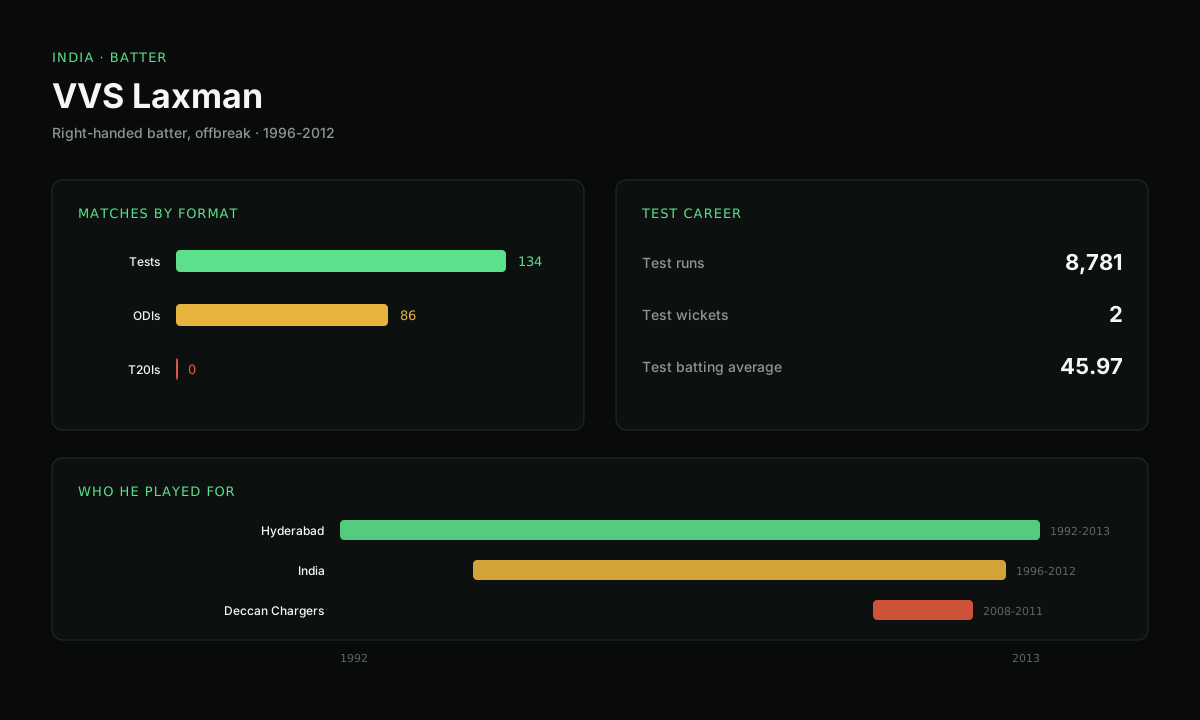
8,781 Test runs at 45.97, a record that undersells him because most of what he was for happened in the situations nobody else could bat in.
VVS Laxman averaged 45.97 in Test cricket, which places him below every other batter in India's middle order of that era. He is also the batter that side turned to when the match was already lost, and the record has no column for that.
- 8,781 Test runs at 45.97, from 134 Tests
- 281 at Eden Gardens in 2001, in the third innings after following on
- An unusually high proportion of his runs came in fourth innings and rearguards
- He played 86 one-day internationals and never appeared in a World Cup
The record
| Format | Matches | Runs | Average | Span |
|---|---|---|---|---|
| Tests | 134 | 8,781 | 45.97 | 1996-2012 |
| ODIs | 86 | 2,338 | 30.76 | 1998-2006 |
The full record is on his player page.
The 281
Eden Gardens, March 2001. India had been bowled out for 171 and asked to follow on, 274 behind, against an Australian side that had won sixteen consecutive Tests.
Laxman was promoted from number six to number three and made 281 from 452 balls. He and Rahul Dravid batted together for the entire fourth day. India declared on 657 for 7 and won by 171 runs.
It is one of three occasions in the history of Test cricket that a side has won after following on, and it ended the longest winning streak the format has produced. The match is covered in Eden Gardens 2001.
Why the average understates him
An average is runs divided by dismissals, and it treats every innings as equivalent.
Laxman's innings were not distributed evenly. A disproportionate number of his big scores came in the fourth innings, or in rearguards, or in matches India were losing — which are the hardest situations to bat in and the ones where the pitch is at its worst and the pressure at its highest.
He also finished not out unusually often while batting with the tail, farming the strike, in chases India won by one or two wickets. Those innings are among the most valuable a batter can play and they contribute less to an average than a flat-pitch double century does.
The result is a career figure of 45.97 that ranks him behind Tendulkar, Dravid and Ganguly, and a reputation among his team-mates that does not match that ranking at all.
The name
The initials stand for Vangipurappu Venkata Sai, and the shortening is not an affectation — it is what everybody including his team-mates called him, and it is how he appears on team sheets.
That matters for one practical reason in a dataset like ours: a puzzle that asks for a player's name has to accept several forms of it, and the alias list for him is longer than for almost anybody. People who watched every ball he faced routinely cannot spell the full version.
Against Australia specifically
His record against the best side of the era is markedly better than his overall record, which is the reverse of the usual pattern.
The 281, a 167 at Sydney in 2000, a 148 at Adelaide in 2003 in a match India won, and a series of innings in Australia that repeatedly put India in positions they had not been in before. Australian players of that period have said, more or less unanimously, that he was the batter they least wanted to see.
That pattern is the strongest evidence for the "average understates him" argument. Batters who score more against the best attacks are doing something that career figures cannot express.
The wrists
The technical description everybody uses is that he was a wristy player, and it is accurate rather than decorative.
He played through the leg side off deliveries pitched outside off stump, using the wrists to change the direction of the shot at the last moment. Fielding sides could not set a field for it, because the shot's destination was decided after the ball had been bowled.
It is a subcontinental technique in origin and it is very difficult to coach. What made it work at Test level was that he played extremely late and close to the body, so the wrists were adjusting a shot that had already been safely started.
The country and the span put four Indian batters in play. The Tests and runs columns separate them.
VVS Laxman — His 281 at Eden Gardens in 2001 turned a follow-on into one of cricket's great turnarounds. Full record
The one-day career
86 matches, and never a World Cup.
He was in the frame for the 2003 squad and was not picked, in what was one of the more debated selections of the period. A batter with his record against Australia, in a tournament where India reached the final and lost to Australia, is an obvious "what if".
The reasoning given was strike rate and fielding, both of which were genuine weaknesses in the format. The counter is that a player who solves the hardest problem in the side's cricket is worth accommodating.
The tail-end partnerships
There is a specific category of innings he played more often than anybody of his generation, and it is the least documented thing in cricket.
Batting with a number ten or eleven, in a chase, with the required total in double figures and one wicket left, requires two skills that have nothing to do with batting technique. You have to score at the right rate without exposing your partner, which means refusing singles for four balls and taking one off the fifth. And you have to keep a bowler's best deliveries for yourself.
India won several Tests in the 2000s from positions that should not have produced wins, and the mechanism in a striking number of them was Laxman and a tail-ender. Mohali in 2010, chasing 216 against Australia with one wicket left, is the one usually named.
None of it appears on a card except as a not-out that lowers the number of dismissals and inflates an average that people then say was inflated.
The Sydney hundreds
He scored 167 at Sydney in 2000 and 178 there in 2004, on a ground where India had historically struggled.
The 167 came in a series India lost 3-0, in a match India lost, which is why it is rarely mentioned. It also came before the 281, and Australian players have said since that it was the innings that made them think about him differently.
That sequence — an innings in a lost match changing how the best side in the world prepared for a player — is worth more than the result it did not affect.
Where he sits in our dataset
Difficulty tier 2 on the player list. Recognisable to anybody who watched Indian cricket in that period and slightly less immediate than the three batters he played alongside, which is a reasonable summary of the whole career.
The 86-ODI column is what identifies him in the puzzle: every other Indian batter of that era played several hundred.
- 45.97, fourth in his own middle order
- Fewer runs than his contemporaries
- 86 ODIs and no World Cup
- A supporting player
- The batter sent when the match was gone
- More of them in fourth innings and rearguards
- A record against Australia better than anybody's
- The third innings at Eden Gardens
- 8,781 Test runs at 45.97, which is the least informative number in this article
- 281 at Eden Gardens, in one of three follow-on wins in Test history
- His record against Australia is better than his overall record
- Wrists that changed a shot's direction after the ball had been bowled
The short version
He is the clearest illustration in modern cricket of a career average failing to describe a career. The runs came in the innings nobody else wanted to play, and the statistic that counts them treats those the same as any other.
For the match that defines him, see Eden Gardens 2001, and for why the average is doing this, batting average is not runs per innings.