Virender Sehwag by the numbers, and the fastest triple centuries
Two Test triple centuries scored at close to a run a ball, from an opener with one plan against every bowler on every pitch: see the ball, hit the ball.
Virender Sehwag opened the batting in Test cricket at a strike rate above eighty for a decade. That is a T20 approach applied to the longest format, and it produced two triple centuries and a career average of 49.34.
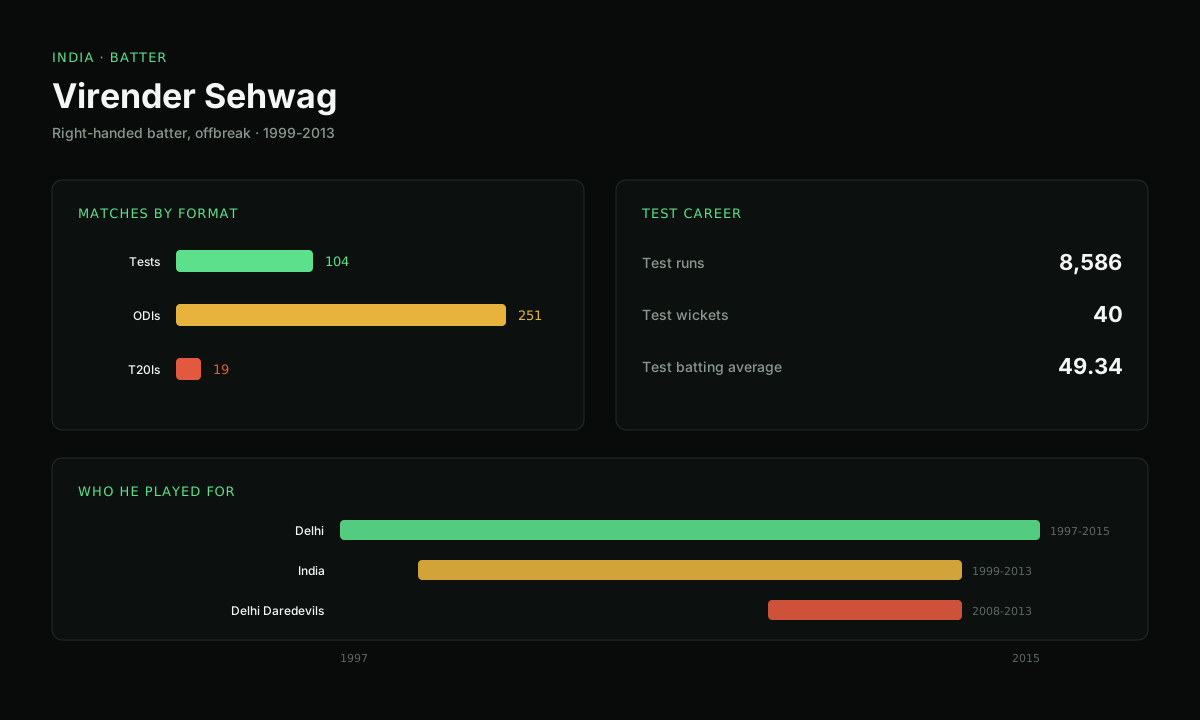
- 8,586 Test runs at 49.34, with a strike rate above 80
- Two Test triple centuries — 309 and 319 — and a 293
- He was a middle-order batter converted to an opener, which nobody expected to work
- The method was one plan: see the ball, hit the ball
The record
| Format | Matches | Runs | Average | Strike rate |
|---|---|---|---|---|
| Tests | 104 | 8,586 | 49.34 | 82.23 |
| ODIs | 251 | 8,273 | 35.05 | 104.33 |
The full record is on his player page.
The strike rate is the record
An average of 49.34 as a Test opener is very good. Scoring at 82 per hundred balls while doing it is unprecedented.
The two things are supposed to trade off. A batter who attacks gets out more; a batter who survives scores slowly. Sehwag did not accept the trade, and the average suggests he was right not to.
The practical effect was that India could declare. A side whose opener scores 150 in a session has bought a day, and India's home Test record in that period rests substantially on innings that finished on the second afternoon rather than the third morning.
The two triples
309 against Pakistan at Multan in 2004, and 319 against South Africa at Chennai in 2008.
He is the only Indian to have scored a Test triple century and one of very few people to have done it twice. The 319 came off 304 balls, which is the fastest triple century in Test history by a distance.
He was also out for 293 against Sri Lanka in 2009, attempting to reach 300 with a boundary, which is entirely characteristic and was described by him afterwards without any evident regret.
The method, which was not a method
He said repeatedly that he did not think about it: see the ball, hit the ball. That is usually a cliché and in his case it appears to have been literal.
There was no footwork to speak of. He stood still, played through the line, and hit the ball extremely hard with a fast bat swing and exceptional hand-eye coordination. Bowlers who moved the ball away found that he simply hit it anyway, and a technique that should have been exposed by lateral movement was not, for a decade.
The one bowler-type that troubled him was genuine pace with steep bounce into the body, because it removed the room to swing. Sides that worked that out took wickets; sides that tried to bowl him out with movement found he was already at 60.
Converted from the middle order
He came into the Indian side as a middle-order batter and was moved to open in 2002 because the position was vacant and Ganguly wanted somebody who would take on the new ball.
It was a strange decision at the time. An attacking middle-order player being asked to face the hardest bowling in the match, with the field up, against a moving ball, had no precedent that anybody could point to as successful.
It worked immediately, and the reason appears to be that his method had no adjustment in it. A batter who does not change what they do does not need the new ball to be easier — they were always going to play the same shots.
Country and role narrow it. The Tests column separates him from the batters around him in that side.
Virender Sehwag — Two Test triple centuries, both scored at better than a run a ball. Full record
Against spin
The part of his game that separated him from other attacking openers was what he did to spin bowling.
He used his feet almost never, which should have been a fatal weakness on a turning pitch. Instead he played spin off the back foot with a horizontal bat, cutting and pulling deliveries that most batters would defend forward to, and hitting straight down the ground against the turn.
It should not work. Playing back to spin gives the ball more distance to deviate, which is precisely why coaching says to get forward. His answer was to hit it before the deviation mattered, and against the best spinners of the era he averaged well.
The one-day record
8,273 runs at a strike rate over 104, including a double century — 219 against West Indies in 2011, which was the highest one-day score at the time.
He opened there too, with the same method, and he is one of the players most responsible for the change in how the first ten overs of a one-day innings are approached. Before openers like him, the powerplay was survived; afterwards it was attacked.
The Multan 309
Pakistan, March 2004, India's first Test tour there in fourteen years.
He reached 300 by hitting Saqlain Mushtaq for six, which is not how anybody reaches a triple century, and finished on 309. It was the first triple century by an Indian and it came in Pakistan, in a series India won.
The shot is the whole story in one delivery. A batter on 294 in a Test match has every reason to take a single. He hit a spinner over long-on and said afterwards that it was the ball to hit.
Where he sat in the order
He opened with Gautam Gambhir for most of the productive period, and the pairing was one of the more effective India have had, precisely because they did different jobs.
Sehwag attacked from ball one and either got out or put the side 80 ahead inside ten overs. Gambhir batted normally. That combination gave India a fast start without requiring both openers to take the risk, and it removed the pressure that usually attaches to a batter scoring at that rate.
What the record does not show
Two things.
He was a genuinely useful off-spinner, with 40 Test wickets, who was used to break partnerships and to get through overs when the over rate needed it.
His career ended abruptly. The last two years were poor, he was dropped, and there was no farewell match. A player who scored at 82 per hundred balls for a decade left the format without the send-off that far less significant careers receive.
- Survive the new ball
- Leave outside off
- Move your feet
- Build an innings
- Attack it from the first ball
- Hit through the line
- Stand still and swing
- Score 99 before lunch
The thing about him nobody can quantify
He changed what Indian sides believed was possible in the first hour of a Test match.
Before him, an Indian innings began cautiously because the new ball was dangerous and the middle order was the strength. After him, sides expected 60 or 70 in the first ten overs, and if it did not come the innings still had four batters averaging over forty to follow.
That is a shift in expectation rather than in technique and it outlasted him. It is also why the accusation levelled at him — that he was reckless — never got any traction inside the dressing room, where the arithmetic was obvious.
Where he sits in our dataset
Difficulty tier 1 on the player list, and one of the more distinctive puzzle answers because the strike-rate-adjacent columns do not appear on the board — so what identifies him is the combination of country, role, 104 Tests and a 1999 to 2013 span.
- 8,586 Test runs at 49.34, scored at above 80 per hundred balls
- Two Test triple centuries, including the fastest ever
- Converted to opener in 2002 with no precedent for it working
- One plan against every bowler, on every surface, for a decade
The short version
He applied a limited-overs method to Test cricket before anybody thought that was possible, opened the batting with it, and averaged nearly fifty for a decade. The strike rate is the record and the triple centuries are the proof it was not a gamble.
For the list his biggest scores sit on, see highest individual scores in Test cricket, and for what a strike rate is actually telling you, strike rate means nothing alone.