Highest individual scores in Test cricket, and what they cost
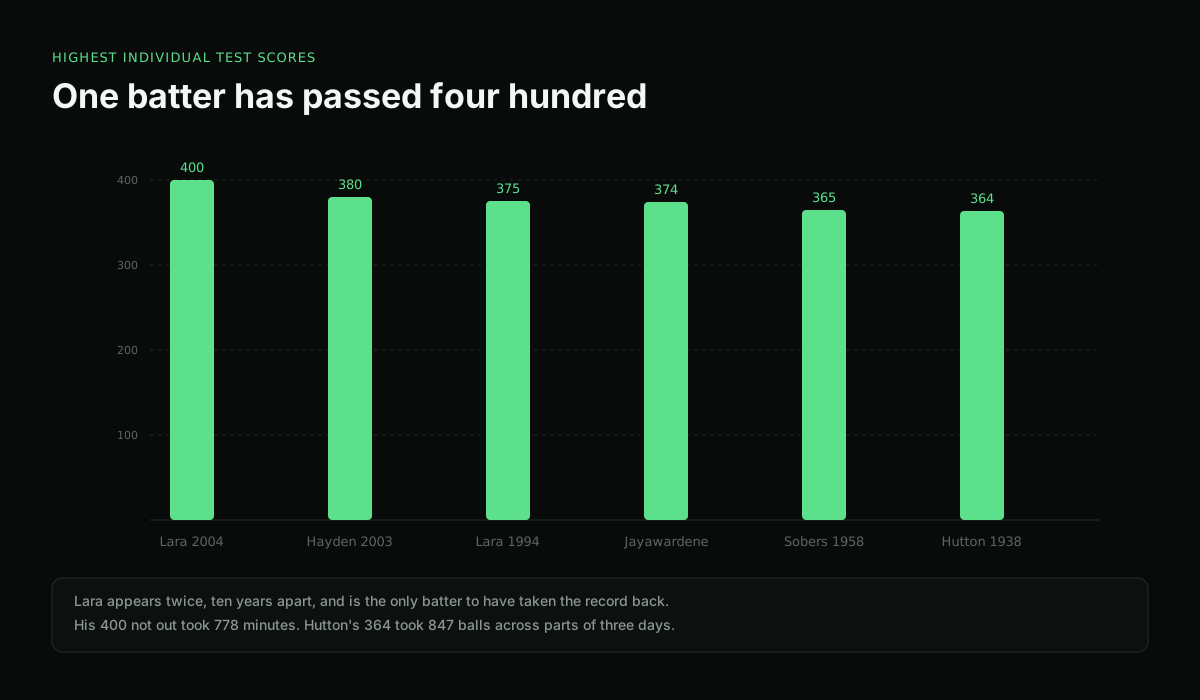
Only one batter has passed 400. The list is shorter than people expect, and the innings on it took between eight and sixteen hours to build.
Nine batters have scored a Test triple century more than once between them, and exactly one has passed four hundred. The list of the highest individual Test scores is short, old, and heavily weighted towards a handful of grounds.
- Brian Lara's 400 not out is the only quadruple century in Test history
- Lara also holds third place, with the 375 he made a decade earlier
- Almost every innings on the list took over ten hours
- Three of the top ten were made against attacks missing their best bowlers
The top of the list
| Score | Batter | Against | Year |
|---|---|---|---|
| 400 not out | Brian Lara | England | 2004 |
| 380 | Matthew Hayden | Zimbabwe | 2003 |
| 375 | Brian Lara | England | 1994 |
| 374 | Mahela Jayawardene | South Africa | 2006 |
| 365 not out | Garfield Sobers | Pakistan | 1958 |
| 364 | Len Hutton | Australia | 1938 |
Lara appearing twice, ten years apart, is the detail that makes the list unusual. He lost the record to Hayden in 2003 and took it back six months later, which is not a thing that happens with records built over ten hours.
What these innings actually cost
The number people quote is runs. The number that explains them is time.
| Innings | Balls | Minutes |
|---|---|---|
| Lara 400 not out | 582 | 778 |
| Hayden 380 | 437 | 622 |
| Sobers 365 not out | — | 614 |
| Hutton 364 | 847 | 797 |
Hutton's 364 in 1938 took 847 balls across parts of three days. Lara's 400 was faster per ball and still occupied most of two days. These are not innings in the ordinary sense; they are occupations.
Who is the only batter to have held the record for the highest Test score twice?
Lara made 375 in 1994, lost the record to Hayden's 380 in 2003, and reclaimed it with 400 not out in 2004. Nobody else has taken it back.
The declaration question
Two of the innings on this list ended because the batter ran out of partners or the captain declared, not because they were dismissed. Sobers and Lara were both not out.
That raises a question nobody has answered satisfactorily: how many of these records exist because a captain chose to let an individual milestone stand rather than declaring earlier. Both cases have been argued about since, and both captains have said the match position allowed it.
What it takes
Look at the list and the same conditions recur.
A flat pitch. Antigua, where Lara made both of his, was one of the flattest Test surfaces of its era.
A depleted attack. Several of these came against sides missing a frontline bowler, or in the fourth or fifth session when a three-man attack had nothing left.
Nothing to lose. Almost none of these innings occurred in a tight match. A side does not bat for two days when the game is in the balance.
None of that diminishes them. It does explain why they cluster.
- A pitch that stays true for two days
- An attack that tires before you do
- A captain who does not declare
- Concentration across three sessions
- A weak opposition, necessarily
- A high strike rate
- Ideal batting conditions throughout
- Luck, though every one of them had some
The shape of the list
Read down it and the same conditions recur with a regularity that stops being a coincidence.
Most were made batting first. Most came against attacks missing a front-line bowler through injury, or in the second innings of a bowling side's long day in the field. A striking number came in the second Test of a series, after a first Test that had already told the batter what the bowlers were going to try.
And almost all of them were made by batters who had already made a double century at some point. The skill that produces 300 is not a different skill from the one that produces 200 — it is the same one, sustained past the point where almost everybody's concentration fails.
What a triple century actually requires
Around thirty have been scored in the entire history of Test cricket, and the requirements are more specific than "batting well".
A flat pitch, and usually a first innings on it. Almost every enormous score comes in the first innings of a match, before the surface has done anything.
A captain who does not declare. This is the constraint nobody thinks about. A batter on 280 is entirely at the mercy of a decision being made in the dressing room about the match, and plenty of very large innings have been ended by a declaration that was correct.
Physical endurance in the specific conditions. Ten hours at the crease in subcontinental heat is a different physical event from ten hours in Wellington, and the innings that get talked about most are usually the ones played in the worst conditions.
Concentration that does not lapse for around 700 deliveries. This is the part that cannot be trained around. One bad ball, played badly, at any point in nine hours, and it is a very good 190 instead.
The other thing the list conceals is how few of these innings were played under pressure. Almost all of them came with the batting side already safe, on a flat pitch, against a demoralised attack in the second day of a first innings. That is not a criticism of the batters — the pressure in a nine-hour innings is entirely internal — but it does mean the greatest innings ever played are mostly not on this list, and the ones that are belong on it for endurance rather than for difficulty.
What the list does to a team
A gigantic individual innings is not always good for the side, and the record books do not record that part.
The batter is at the crease for a day and a half, which means the other ten are not batting, which means the innings has consumed enormous time as well as producing enormous runs. In a five-day match, an innings of 380 that takes 600 balls has used a third of the match's playing time, and the side still has to bowl the opposition out twice.
This is why a captain will declare on a batter who is 285 not out, and why the sides that produce the very largest individual scores lose or draw those matches more often than you would expect. The exceptions — where a triple century won a Test outright with time to spare — are rare enough to be listed individually.
The ones outside the top ten
Don Bradman's 334 in 1930 was the record for nearly a decade, and he made another triple, 304, four years later. Two triple centuries by one batter was not matched until Lara.
Virender Sehwag made two, both at a strike rate above 80, which is a completely different kind of innings from every other name on this list. His 319 against South Africa came off 304 balls — a triple century at a run a ball.
- Lara's 400 not out is the only score above 380 in Test history
- Lara is the only batter to have taken the record back after losing it
- Most of these innings lasted ten hours or more
- Flat pitches, tired attacks and dead matches is the recurring pattern
For the players behind several of these, see the player list. For the format that permits an innings this long, see Test cricket explained.