The World Test Championship points system, explained
Sides play very different numbers of Tests in a cycle, so the table ranks by percentage of points available rather than by points won. That one choice explains the rest.
Test cricket spent a hundred and forty years without a competition attached to it. The World Test Championship is the attempt to build one on top of a fixture list nobody designed for the purpose, and almost everything strange about it comes from that.
- Every Test is worth the same number of points, regardless of series length
- Sides play very different numbers of Tests in a cycle
- So the table is ranked by percentage of available points, not by total
- Over-rate penalties come off that percentage and have decided qualification
Why a percentage
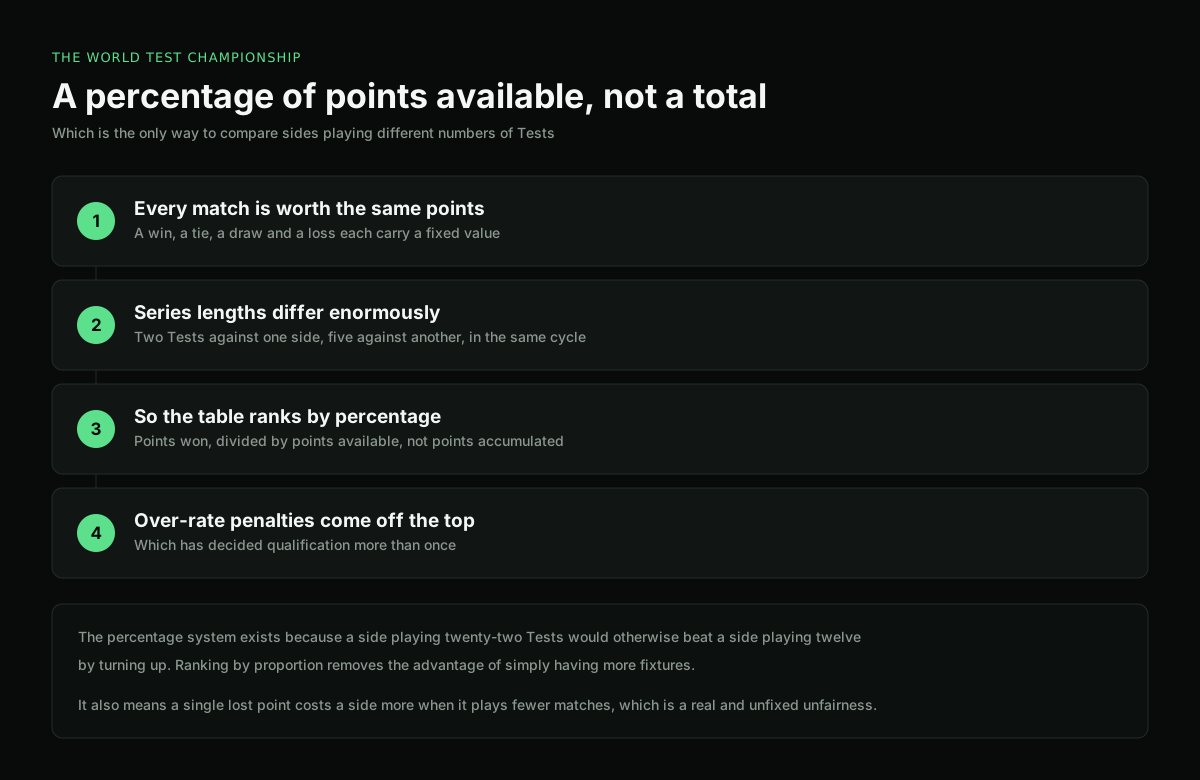
Test cricket has no central schedule. Boards arrange their own series bilaterally, which means one side may play twenty-two Tests in a two-year cycle and another twelve. Those fixtures were arranged for commercial and historical reasons long before any championship existed.
Ranking by total points would reward the side with more fixtures for having more fixtures. A team playing twenty-two Tests could finish above a better side playing twelve without ever beating them.
So the table ranks by the proportion of available points a side has actually won. Play twelve Tests and win eight, and you are compared fairly with a side that played twenty-two and won fourteen.
How the points work
Each match carries a fixed value, and the values are set so that a win is worth substantially more than a draw and a draw more than a loss. A tie sits between a win and a draw.
The key design decision is that series length does not change the value of a match. A Test in a two-match series is worth exactly what a Test in a five-match series is worth. Before that rule, a five-Test series was worth the same in total as a two-Test series, which meant each individual match in the longer series was worth less — and sides playing long series were effectively penalised for it.
| Result | Points, per match |
|---|---|
| Win | the full allocation |
| Tie | half |
| Draw | a third |
| Loss | none |
Those proportions are the shape of the system. The exact numbers have been revised between cycles and are published by the ICC for each one.
The over-rate penalty
Points are deducted for failing to bowl the required number of overs, and this is the part that has actually decided qualification.
The deduction comes straight off the percentage, so a side losing points for slow over rates in a two-Test series is losing a larger share of a smaller total. It has kept teams out of finals.
The intention is sound: over rates in Test cricket have been poor for decades and fines had no effect. Attaching the penalty to something the team cares about worked, in the sense that it changed behaviour. It also means a championship between the two best sides in the world can be decided by how quickly somebody changed their field.
What a draw is worth, and why it matters
Setting the value of a draw is the most consequential number in the system and it gets the least attention.
Make a draw worth too little and sides that cannot win will still play for one, because a third of something beats none of it — but the incentive to chase a declaration collapses. Make it worth too much and a five-day bore draw becomes an acceptable outcome for a strong side protecting a percentage.
The current proportion — a draw worth roughly a third of a win — is deliberately low. It is intended to make holding on for a draw a genuinely poor outcome compared with a win, and the evidence since suggests it has pushed sides towards more aggressive declarations in the last session of dead matches.
What the system is criticised for
Three genuine problems, none of them easily fixable.
Unequal opposition. Percentage corrects for the number of Tests, not for who they were against. A side whose cycle includes two series against the strongest teams and one against the weakest has had a harder cycle than one whose fixtures fell the other way, and nothing adjusts for it.
Home and away imbalance. Boards schedule their own home Tests. A cycle heavy on home fixtures is easier than one heavy on tours, and again nothing adjusts.
The final is one match. Two years of Test cricket, ranked by a careful percentage system, decided by a single Test at a neutral venue in conditions that may suit neither finalist. It is a reasonable compromise — a best-of-three final cannot be scheduled — and it does sit oddly against the care taken with the table.
What a cycle looks like
A cycle runs about two years and involves each participating side playing six series — three at home and three away — against six of the other eight teams.
Nobody plays everybody. That is the structural compromise at the heart of it: a genuine round robin would require every side to play every other home and away, which is roughly double the Test cricket currently played and more than any calendar can hold.
So the fixtures are drawn from what boards were going to arrange anyway, with the championship layered on top. Two sides in the same cycle can have completely different schedules, and the percentage system is the correction for the part of that which can be corrected.
The two sides at the top of the table at the end of the cycle play a final at a neutral venue, and the winner holds the mace until the next one.
What it actually changed
For all the complaints, the championship did something Test cricket needed.
Dead rubbers are less dead. The fifth Test of a series already decided used to be an exhibition; it now carries points that count towards a two-year table, and sides treat it accordingly.
Bilateral series have a context they never had. A two-Test tour that would previously have been a scheduling obligation is now part of something, and the result matters beyond the trophy at stake.
And over rates improved, which no fine had achieved in forty years.
Side A wins 8 of 12 Tests in a cycle. Side B wins 12 of 22. Who is higher in the table, assuming no penalties and no draws?
The table ranks by percentage of available points. Side A has won two thirds of theirs; Side B has won just over half. The whole point of the percentage is that more fixtures is not an advantage.
- A league table of wins
- Longer series worth more
- Points for a good draw
- The best side over two years wins
- A percentage of points available
- Every Test worth the same
- A draw is worth a third of a win
- The best side over two years plays a final
- Percentage, because the fixture list is unequal and always will be
- Every Test is worth the same, regardless of series length
- Over-rate deductions come off the percentage and have decided finals
- It corrects for how many you played, not who you played
The short version
The World Test Championship is a ranking system bolted onto a fixture list that was never designed to be a competition. The percentage is the honest solution to the biggest problem it faces, and the problems it has left are the ones that would require boards to give up control of their own schedules.
For the other ICC ranking system and how it differs, see how the ICC rankings are calculated, and for the penalty that keeps deciding it, the over rate and what it costs.