The Big Bash League explained, and why it uses a draft
Eight city franchises, a draft rather than an auction, and a competition that runs while Australia's best players are busy playing Tests.
Australia's T20 competition is the one major franchise league that does not run an auction, and it is the only one scheduled directly against its own country's Test summer. Both of those are deliberate and both shape what it is.
- Eight city franchises, not the six states
- Overseas players arrive through a draft, not a bidding war
- Five of the eight make the finals, and the top two get a second chance
- It runs during the Australian Test summer, so the best locals are unavailable
The shape of a season
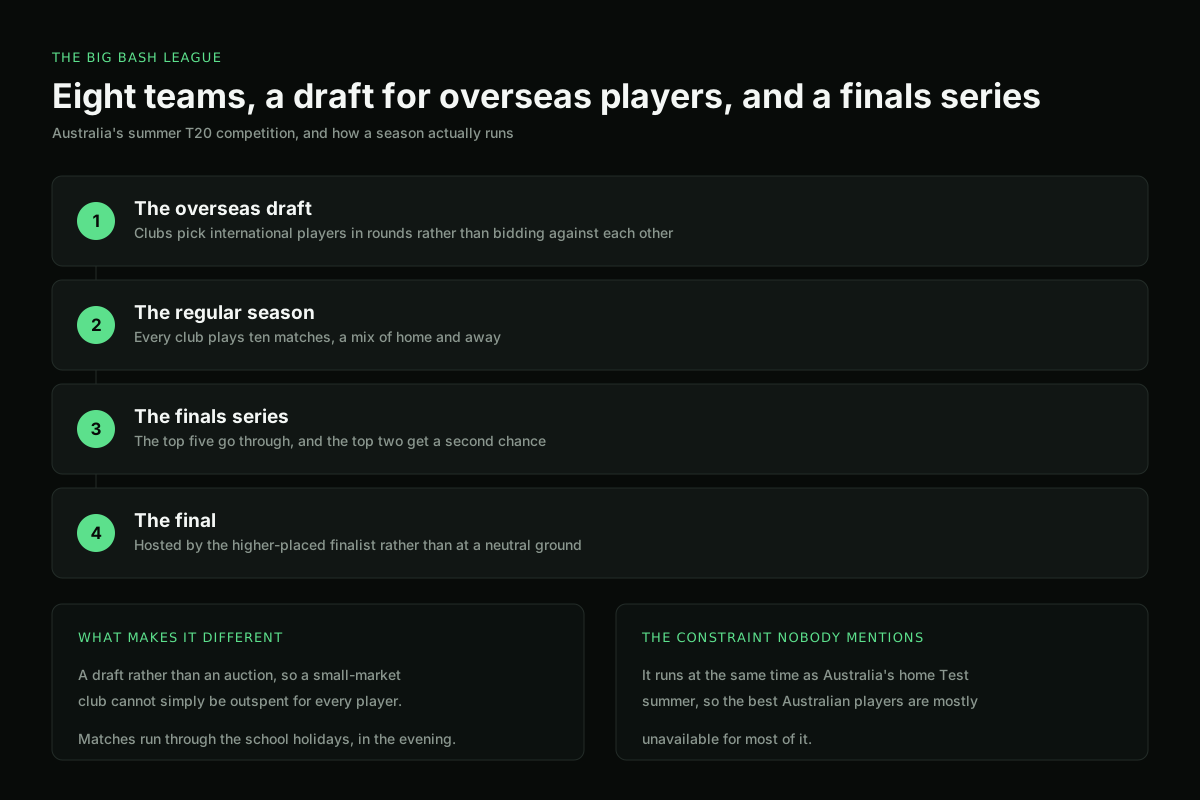
Eight teams, drawn from cities rather than states, which matters because Sydney and Melbourne each get two. That is the entire reason the competition exists in the form it does: a state-based T20 league gives you six teams and two derbies, and a city-based one gives you eight teams and four.
Each club plays ten matches in the regular season. Five qualify for the finals, and the finals series gives the top two sides a second chance in the same way the IPL playoffs do — lose once and you are still alive, if you finished high enough.
The draft, and why it is not an auction
Overseas players are allocated through a draft: clubs pick in rounds, in an order set by where they finished, rather than bidding against each other with money.
The effect is the point. In an auction, the club with the most to spend takes the best available player, and a small-market club is outbid every time. In a draft, the club that finished last picks first, and money cannot fix that.
It is the same logic American sports leagues use and the opposite of the IPL's. It produces a more level competition and it means Australia cannot outbid the IPL for the same players — which is the trade the league has accepted.
| Big Bash | IPL | |
|---|---|---|
| Overseas players | drafted, in rounds | bought, at auction |
| Order set by | last season's standings | how much you have left |
| Effect on competitiveness | levelling | concentrating |
| Effect on player fees | lower | far higher |
The scheduling problem nobody can solve
The Big Bash runs from December to January, which is Australia's Test summer.
That means the best Australian players — the ones whose names would sell the competition — are playing Tests for most of it. A league built to be the country's flagship T20 competition spends its peak weeks without the country's flagship cricketers.
Moving it is close to impossible. Before December is the Shield season and the start of the Tests; after January is the international white-ball schedule and then the IPL, which pays several times more. The window it occupies is the window that exists.
The eight clubs
Two in Sydney, two in Melbourne, and one each in Perth, Adelaide, Brisbane and Hobart.
The two-per-city decision is the whole structural difference from the state system. A Sydney derby and a Melbourne derby are the two best-attended fixtures of the season, and neither exists in a six-team state competition. It also means New South Wales and Victoria supply players to two clubs each, which spreads the strongest state squads rather than concentrating them.
Hobart is the outlier: Tasmania is the smallest state and the only one whose franchise draws from a population under six hundred thousand. That the league has kept a Tasmanian side at all is a choice about coverage rather than economics.
What it changed about Australian cricket
Three things, and only the first was intended.
It brought families to the cricket. Matches are in the evening, through the school holidays, at a length that a child will sit through. Crowds for the Big Bash are demographically unlike crowds for any other Australian cricket.
It gave state players a professional living. A domestic cricketer who was never going to play for Australia can now make a career, which was not reliably true before.
It stretched the summer thin. Shield cricket is now played in gaps around the Big Bash rather than the other way round, and the argument about whether that has hurt Australia's Test batting has been running for a decade without resolving.
Why does the Big Bash allocate overseas players through a draft rather than an auction?
A draft orders picks by last season's standings rather than by spending power, so the weakest club chooses first. An auction does the opposite, which is why the IPL concentrates talent and the Big Bash spreads it.
The rule changes it tried
The Big Bash has been the most willing of the major leagues to experiment, and most of the experiments have been dropped.
The Bash Boost gave a bonus point to whichever side was ahead at the halfway mark of the chase, which produced a second thing to care about and confused everybody about the first.
The Power Surge lets the batting side take two of its powerplay overs later in the innings, at a moment of its choosing. That one survived, because it moves a decision into the middle of a match rather than adding a number to a table.
The X-Factor substitute allows a player who has not batted or bowled much to be replaced after ten overs of the first innings. It is the most interesting of the three and the least used.
The willingness to try things is the league's own explanation for why its rules keep moving. The counter-argument is that a competition changing its rules every season is a competition whose records mean less each year.
The women's competition
The WBBL runs alongside it and, unusually, arrived at a point where it could be scheduled on its own terms rather than as a support act.
It has generally been regarded as the strongest domestic women's T20 competition in the world, and for several years it was the only one that paid enough to make a career. That has changed as other leagues have arrived, which is a good problem for the sport and a real competitive one for the WBBL.
- Fill the Christmas holidays
- Make T20 pay for domestic players
- Compete with the IPL
- Sit alongside the Shield
- Filled them, and drew a new audience
- It does, and they stayed in Australia longer
- It cannot, and the draft is an admission of that
- It displaced the Shield in the calendar
- City franchises, so the two biggest cities get two teams each
- A draft rather than an auction, which levels rather than concentrates
- Five of eight make the finals; the top two get a second chance
- It runs when the best Australians are playing Tests, and cannot be moved
Where it sits against the other leagues
The honest ranking, by what a player earns and who turns up, puts the IPL first and everything else a long way behind it.
The Big Bash competes with the Pakistan Super League, the Caribbean Premier League, South Africa's SA20 and the ILT20 in the UAE for the same pool of travelling professionals, and the newer leagues are backed by IPL franchise owners with deeper pockets. The Big Bash's advantages are the calendar slot, the grounds and the crowds; its disadvantage is that it cannot match the money.
That is the context the draft sits in. A league that cannot outbid anybody is better off with a system where bidding is not how players are allocated.
The short version
A T20 league built for families in the school holidays, allocating overseas players in a way that stops the richest club buying the competition, scheduled in the only window Australian cricket had left. The draft is the interesting part and the scheduling is the permanent compromise.
For the competition it is measured against, see the IPL explained, and for the format itself, Twenty20 cricket explained.